
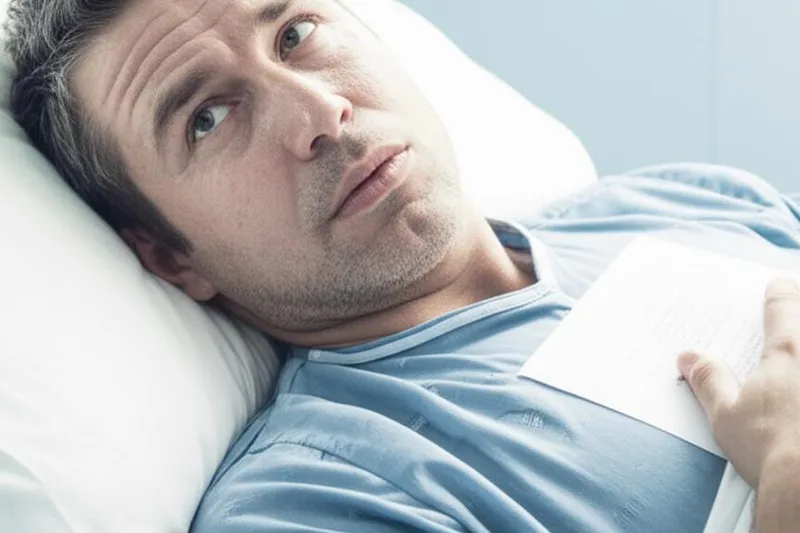
You might be a little scared when you hear the word "heart biopsy ." But it's actually a very valuable test that can help pinpoint certain heart problems. So, let's talk about it in more detail. What is it, who needs it, how is it done, and whether there are any concerns.
What exactly is a heart biopsy?
Simply put, a heart biopsy is a procedure that involves taking a very small piece of tissue from your heart muscle and examining it. This is a diagnostic procedure that is used to find out exactly what the disease is. Think of it like taking a small piece of cloth and checking to see if there is anything wrong with it.
The tissue sample is sent to a lab. There is a specialist there, we call him a ``pathologist``. He is the one who looks at this piece of heart tissue under a microscope and looks for any changes, damage, or abnormalities in the cells. This helps us to identify exactly if there is a problem with the heart.
Are there other names for this?
Yes, doctors sometimes use other names for it. You may have heard these names too:
- `(Cardiac biopsy)` (Cardiac biopsy ) – "Cardiac" also means related to the heart.
- `(Endomyocardial biopsy)` (Endomyocardial biopsy) – "Endo" means inside, and "myocardial" means heart muscle. This means that it is taken from the inner layer of the heart muscle.
- Myocardial biopsy – A biopsy taken directly from the heart muscle.
No matter how you say it, the meaning is the same test.
Who needs a heart biopsy?
Not everyone will need to do this, but there are some special cases where this is very important.
For those who have had a heart transplant (Heart Transplant)
Imagine that someone has a new heart transplant. When that happens, this biopsy has to be done regularly to see if the body is rejecting the new heart ( organ rejection ). The best thing is that this biopsy can detect rejection before it even shows any signs. And if it does, it can also find out what caused it.
- In the early stages after a heart transplant, this may need to be done maybe once a week.
- After that, for about a year, you can do it once every six weeks or once every three months.
Identify other heart conditions
In addition to heart transplants, this biopsy helps diagnose several other heart diseases . Here are a few examples:
- `(ATTR (transthyretin) amyloidosis)`: What happens in this is that a type of protein produced in our body gets deposited in the heart and damages it.
- `(Cardiomyopathy)` (Cardiomyopathy):This refers to diseases that occur in the heart muscle. An example is ``hypertrophic cardiomyopathy '', in which the walls of the heart become excessively thick.
- Cardiotoxicity: Some chemotherapy drugs can damage the heart. This is also done to check for such damage.
- Heart cancer : It is very rare, but cancer can also occur in the heart.
- Heart failure: When the heart becomes weak and cannot pump blood properly to the body.
- Heart infections: For example, a condition called ``myocarditis.'' In this, the heart muscle becomes inflamed, meaning it swells.
- Sarcoidosis : This is a disease in which small swellings (like lumps) form in various parts of the body, including the heart.
Are there people who don't want to do this?
Although this is generally a safe test, it can be a bit risky for some people. For example, people with certain heart valve diseases are at a slightly higher risk of complications. Therefore, it is best to talk to your doctor to decide whether this test is right for you.
Who performs this heart biopsy?
This is done by a cardiologist . He or she has special training to perform these tests. The procedure used for this is called cardiac catheterization. Simply put, this test is done by passing a very thin, flexible tube (catheter) through a blood vessel into the heart.
How should we prepare before a biopsy?
If you decide to have a biopsy, your doctor will tell you about the following:
- You should tell your doctor about all the medications, vitamins, and supplements you are currently taking.
- Some medications, especially blood thinners, may need to be stopped a few days before the test.
- You will also be asked not to eat or drink anything (fast) for a few hours before the test.
The most important thing is to follow your doctor's instructions exactly. If you don't understand something, ask again.
What happens before the biopsy?
This is usually an outpatient procedure, meaning you can go home the same day without having to stay in the hospital. The entire procedure takes about an hour.
- You will be given a sedative to help you relax and get a little sleepy.
- An anesthetic is also given to numb the area where the biopsy is being performed.
- You're awake, but there's nothing to worry about, you won't feel any pain. You might feel a little push.
- You can go home the same day after the test is over. However, you will need someone to drive you home and stay with you for a while while you recover.
What happens during a biopsy?
When your doctor does this, he or she looks at pictures of your heart and blood vessels. This is done using either fluoroscopy X-rays (an X-ray that is continuously visible) or a transthoracic echocardiogram (TTE) (a scan of the heart ).
Here's what happens step by step:
1. The doctor inserts a small tube (catheter) into your heart through a large blood vessel in your arm or leg.
2. Then, through that tube, another fine instrument (a `bioptome`), like a small forceps, is passed into the heart.
3. Using the ``bioptome'', several very small pieces (perhaps as small as the head of a pin) are cut from the heart muscle.
4. Then the bioptome and the tissue pieces are taken out and the tissue is sent to the lab for examination.
5. Finally, remove the catheter and apply a pressure bandage to stop the bleeding.
You won't feel much discomfort when all this happens.
How long does it take to heal after a biopsy?
After the test is over, the medical staff will watch you closely for a few hours to see if there are any problems. During this time, X-rays of your chest will be taken to check for any complications such as:
- Pneumothorax
- Hemothorax (collection of blood between the lungs and chest wall)
After you go home, you should avoid lifting heavy objects or doing strenuous work for about 24 hours. However, you should be able to go to work and do your daily activities normally from the next day.
Are there any risks in this?
A heart biopsy is a relatively safe test.
- Minor complications occur in less than 6% of cases. For example, a small bruise or a little bleeding at the site of the tube. These usually resolve within a few days.
- Serious complications occur very rarely, less than 1%. However, it is good to be aware of the possible complications. These include:
- Heartbeat irregularities (Arrhythmia).
- Blood clots. These can form in the lungs (pulmonary embolism), in the veins of the legs (deep vein thrombosis - DVT), or in the brain and cause a stroke.
- Damage or perforation of blood vessels.
- Collapsed lung.
- Blood filling the chest (Hemothorax).
- An infection or internal bleeding at the biopsy site.
- Nerve damage.
- Pericardial effusion.
- A small blockage in the heart's electrical signals (right bundle branch block).
- Regurgitation is the backward flow of blood through the tricuspid valve of the heart.
Don't be alarmed when you hear about these risks. Your doctor will talk to you about all of these. The chances of these happening are very small.
How long does it take to receive the report?
The results of a heart biopsy are usually available within 24 to 48 hours, or about a day or two . Your doctor will explain the results to you. Depending on the results, you may need to have further tests.
What time should I call the doctor?
After you go home after the biopsy, if you experience any of these symptoms , you should call your doctor immediately, or go to the nearest hospital:
- Dizziness.
- If the heartbeat is unusually fast, very slow, or irregular (Irregular pulse and heart rate).
- Shortness of breath or breathing problems.
- Chest pain, a feeling of tightness in the chest (these can be symptoms of a heart attack)
- Symptoms of a stroke: For example, weakness on one side of the body, inability to speak, mouth pulled to one side.
- Signs of infection, such as fever and chills.
So, what are the things we need to remember from this?
Okay, so let's recap the most important points from what we've talked about.
- A heart biopsy is the removal of a small piece of tissue from the heart for examination.
- This is an important test , especially for heart transplant recipients, to check for rejection and to detect a number of other heart diseases (such as cardiomyopathy, heart cancer, and infections) .
- This is done by a cardiologist, using a method called ``cardiac catheterization''.
- This is a test that can usually be done without having to stay in the hospital, and you can recover quickly.
- Although there are some minor risks, this is mostly safe.
So, if your doctor tells you to have a heart biopsy, don't be afraid to do it, keep this information in mind, talk to your doctor carefully, and ask any questions you may have. This can be an important step for the health of your heart!
👩🏽⚕️ Additional questions (FAQs)
💬 What kind of test is a heart biopsy?
This test involves removing a small piece of tissue from your heart (a myocardial biopsy) and examining it under a microscope to accurately diagnose heart disease.
💬 Do you cut the chest to get this piece of meat?
No! The chest is not cut. The doctor inserts a very thin tube (bioptome) through a vein in your neck or groin all the way to your heart, and uses a small pair of scissors to cut out the piece of flesh.
💬 In what situations is this done?
This is definitely done to check for a rare disease (cardiomyopathy) that weakens the heart muscle, and to check whether a new heart has successfully adapted to the body after a heart transplant.
` Heart biopsy, cardiac biopsy, heart disease, heart tissue testing, heart transplant, heart disease diagnosis, catheterization




💬 Comments (0)
No comments yet. Be the first to share your thoughts here.
Add Your Comment