
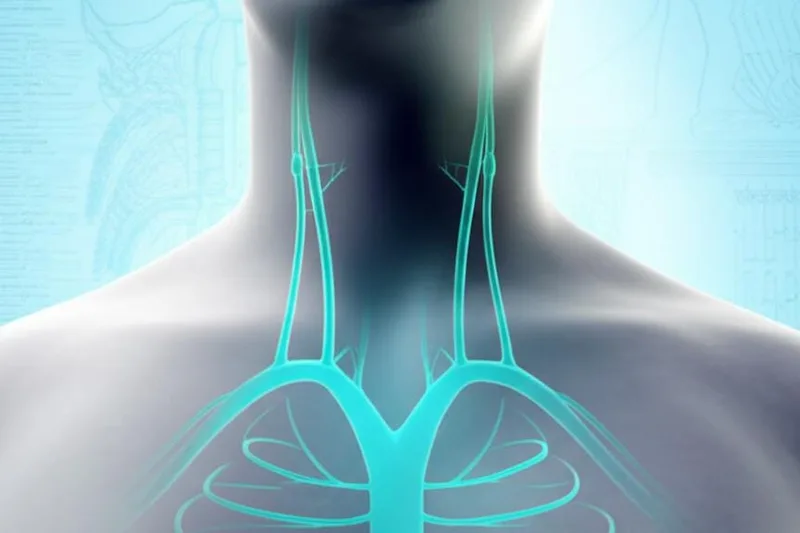
Today we are going to talk about a very important blood vessel inside our body that you may not have heard of. This is the brachiocephalic artery. Although the name is a bit complicated, its function is very simple and essential. It does a great job of carrying blood to the upper right side of our body.
What is this brachiocephalic artery?
Simply put, your brachiocephalic artery is a blood vessel that branches off from the aorta, the large artery in your chest. Have you ever seen the curved part of a stick? That's what the top of our aorta looks like, and we call it the aortic arch. The brachiocephalic artery is the first blood vessel that branches off from the aortic arch. It helps supply blood to the upper right side of your body.
This is also called:
- Brachiocephalic trunk: Because it is like the trunk of two major blood vessel branches.
- Innominate artery: This is also an old name.
Your brachiocephalic artery is part of the circulatory system, the system that carries blood throughout our bodies.
What happens to the brachiocephalic artery?
The brachiocephalic artery does a very important job. It carries oxygen-rich, clean blood to the organs and tissues in the upper part of our body. Specifically, it takes blood from your aorta and delivers it to your right subclavian artery and right common carotid artery. This blood supplies oxygen and nutrients to your upper right arm, the right side of your brain, the right side of your face, and the right side of your neck. Imagine what a big job this little vein can do!
Does this artery carry oxygenated blood or deoxygenated blood?
Good question! Your brachiocephalic artery carries oxygenated blood . Our heart pumps clean, oxygenated blood into the aorta. From there, this blood travels through the other veins that branch off the aorta (including the brachiocephalic artery) to nourish our bodies.
Where is the brachiocephalic artery located?
The brachiocephalic artery (or trunk) is located in the upper right side of your chest, above your heart and slightly below your neck. To be precise, it's in an area of your chest called the ``Mediastinum''. This space called the ``Mediastinum'' is very important because it contains your heart and parts of other major blood vessels.
As I mentioned before, the brachiocephalic artery is the first branch that branches off your `(Aortic arch)`, which is the upper curved part of your aorta. ``First'' means that it is the branch closest to your heart. However, it is not the first branch that branches off your `(Aorta)`. Because, before the `(Aortic arch)`, there is a part of your aorta that comes up from your heart, called the `(Ascending aorta)`. The coronary arteries that supply blood to your heart muscle split off from this `(Ascending aorta)`. So, the first branch that branches off your aorta is actually your coronary arteries.
Importantly, the brachiocephalic artery is not one of the main blood vessels of the heart, nor is it directly connected to a chamber of the heart. It is merely a branch of the aorta.
What are the two main branches of the brachiocephalic artery?
This brachiocephalic artery divides into two branches as it travels away from the heart, that is, upwards. This division is also called `(Bifurcates)`. The two branches are:
- Right subclavian artery: This supplies blood to the upper part of your right arm. It also branches off to supply blood to parts of your head, neck, and chest.
- Right common carotid artery: This supplies blood to your brain and other parts of your head, face, and neck.
These are called terminal branches because the brachiocephalic artery ends here. This division occurs at the right sternoclavicular joint, where the clavicle and sternum meet on your right side.
How big is this brachiocephalic artery?
The brachiocephalic artery (trunk) is usually about 4 to 5 centimeters long . Its diameter, or width, is about 10.5 to 13.7 millimeters . It's small, but it does a lot of work, right?
What is this made of?
Like other arteries in our body, the brachiocephalic artery has a wall made up of three layers:
- Tunica intima `(Tunica intima / interna)`: This is the innermost layer. It has a lining made up of a type of cell called `(Endothelial cells)`. This is what helps the blood to flow smoothly without any obstruction.
- Tunica media: This is the middle layer. The smooth muscle cells in this layer help the artery to widen and narrow as needed, thus controlling the flow of blood.
- Tunica adventitia (Tunica adventitia / externa): This is the outermost layer. It provides strength and support to the artery. This layer is made up of collagen and other connective tissues.
Are there any anatomical variations in the position of the brachiocephalic artery?
Yes, indeed. Since the brachiocephalic artery is divided by the curve of the aorta, various variations in this aortic arch can also affect the position of the brachiocephalic artery. The most common variation in the aortic arch is a pattern in which only two branches are divided.
Normally, three blood vessels branch directly from your aortic arch. They are:
- Brachiocephalic artery (trunk).
- Left subclavian artery.
- Left common carotid artery.
However, in some people, instead of these three, only two branches may branch from the `(Aortic arch)`. Two such patterns are:
1. The brachiocephalic artery and the left common carotid artery originate from the same place: This means that both arteries originate from the same, common trunk, the ``Aortic arch''. The left subclavian artery divides into a separate second branch, the ``Left subclavian artery''.
2. Left common carotid artery originating from the brachiocephalic artery: In this, instead of originating directly from the aortic arch, the left common carotid artery branches off from the brachiocephalic artery. This division usually occurs about one centimeter from the aortic arch. The left subclavian artery divides separately.
These changes are usually not a big problem, but it is important for doctors to be aware of them.
Are there both right and left brachiocephalic arteries?
Most people have only one brachiocephalic artery . It is located on the right side of the chest. However, very rarely, with some variation in the `(Aortic arch)`, there may be brachiocephalic arteries on both the right and left sides, or there may be only one on the left side. These are very rare cases.
What are the common conditions that affect the brachiocephalic artery?
The brachiocephalic artery can also be affected by certain medical conditions. Some of them are:
- Tracheo-innominate fistula (TIF): This is a very dangerous condition. A TIF is an abnormal connection between your windpipe (trachea) and the innominate (brachiocephalic) artery. This is a potentially life-threatening complication of a tracheostomy, a surgical procedure in the neck to keep the airway open. It can cause severe bleeding, so surgery is needed quickly. If you have had a tracheostomy for a long time, your doctor may do CT scans to check for the risk of developing a TIF.
- Atherosclerosis: You may have heard of this. Atherosclerosis is a condition in which fatty deposits (called plaque) build up inside the arteries, which can lead to narrowing of the arteries over time. This restricts blood flow to various parts of the body. When blood flow to the brain is reduced (cerebrovascular disease), most often the cause is fatty deposits in the carotid arteries. However, very rarely, fatty deposits can also form in the brachiocephalic artery and cause it to narrow. In such cases, treatment such as stent placement may be required to improve blood flow.
- Aneurysm: An aneurysm is a bulge in an artery wall due to weakness. Aneurysms in the brachiocephalic artery are very rare. Supra-aortic aneurysms occur in the arteries above the aortic arch, accounting for about 3 in 100 cases.
How can I keep my brachiocephalic artery healthy?
There are many things you can do to keep not only your brachiocephalic artery, but all the other arteries in your body healthy. Here are a few:
- Avoid tobacco use: Smoking, vaping, and using smokeless tobacco all fall under this category.
- Eat a heart-healthy diet low in saturated fat and sodium: Research has found that eating patterns like the Mediterranean diet are good for the heart and blood vessels.
- Exercise regularly: Try to do aerobic exercise (which increases your breathing rate) for at least 30 minutes a day, five days a week.
- Maintain a healthy weight that suits you: Ask your doctor what your ideal weight is and how to reach it.
- Limit alcohol consumption: No more than one `(drink)` per day for women. No more than two `(drinks)` per day for men.
- Manage stress: Learn new ways to relax.
- Use medications exactly as prescribed by your doctor: This includes medications for cholesterol and blood pressure.
- Try to get enough sleep: For adults, seven to nine hours of sleep a day is good for heart health and overall health.
- See your doctor regularly: Get a medical check-up at least once a year. Don't miss your doctor's appointments.
Learning about our arteries, as well as other parts of the circulatory system, can be a bit intimidating at times, but it can also be very interesting. You may be learning about these things because of a medical condition or simply out of curiosity. However, never hesitate to ask your doctor any questions you have. Anatomy is a complex thing, and not everyone's body is the same. So, when you combine what you read with your doctor's knowledge, it's easier to get a complete picture.
Things we should remember from this story (Take-Home Message)
Okay, so, to put it simply, the Brachiocephalic Artery we talked about today,
This is an important blood vessel that branches off from our aorta. This artery supplies oxygen-rich blood, especially to the upper right side of our body, that is, the right arm, the right side of the neck, the right side of the head, and the right side of the brain.
We talked about its location, size, etc. We also discussed several medical conditions that can affect it, and what we can do to keep this artery healthy.
The most important thing is to follow a healthy lifestyle to keep this artery healthy, just like any other part of our body. If you have any questions or doubts about this, definitely talk to a doctor. That's the best thing to do.
` Brachiocephalic Artery, Aorta, Blood Vessels, Blood Circulation, Heart Health


💬 Comments (0)
No comments yet. Be the first to share your thoughts here.
Add Your Comment