
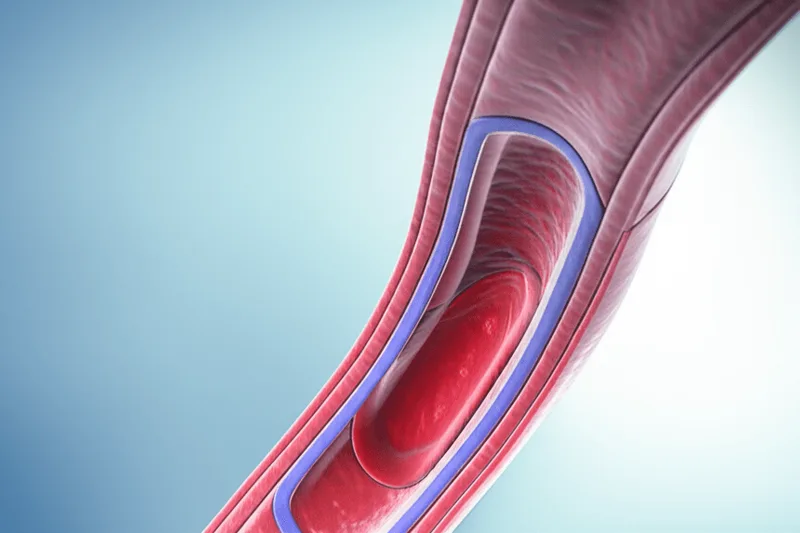
Have you ever thought that the blood vessels (arteries) inside our body are like pipes? These are the ones that carry clean , oxygen- rich blood from our heart to the entire body. So, these blood vessels are not just pipes, they are flexible, like a new rubber tube. But sometimes, these blood vessels start to harden and thicken. That is what we medically call `( Arteriosclerosis )` or “thickening of the artery walls” or “hardening of the arteries”. This is a bit of a serious story, because this happens to us, even without us knowing.
What is `(Arteriosclerosis)`? Let's understand it simply!
Simply put, ``Arteriosclerosis`` is when the walls of your arteries, the main blood vessels that carry blood, gradually thicken, lose their elasticity, and become stiff. Think about it, how easily can a new water pipe bend? But when it gets old and exposed to the sun and rain, it loses its elasticity, and if you try to bend it, it can even break, right? That's what happens to our arteries.
These arteries are a very important system. Every time our heart beats, clean, oxygen-rich blood is carried throughout the body, to every organ and tissue, through these arteries. So, when these arteries become stiff , blood flow can be impeded. Then our entire circulatory system can become disrupted.
This condition called `(Arteriosclerosis)` does not develop in a day or two. It develops gradually over many years. The most dangerous thing is that it can be asymptomatic in the early stages. You may not feel anything for a long time, and then you will only find out when other complications arise due to the hardening of the arteries. This greatly increases your risk of developing cardiovascular diseases, that is, diseases related to the heart and blood vessels.
Many people confuse the words ``Arteriosclerosis'' and ``Atherosclerosis'' and use them as one. However, there is a slight difference between the two.
- Arteriosclerosis is the thickening and hardening of the artery walls due to any cause .
- Atherosclerosis is a condition in which plaque buildup builds up inside the walls of the arteries, causing them to harden . This is a specific type of arteriosclerosis. This is probably the word you've heard the most.
Let's now look in more detail at the other types of arteriosclerosis and how they affect our bodies.
What are the main types of `(Arteriosclerosis)`?
There are three main types of arteriosclerosis:
1. Atherosclerosis `(Atherosclerosis)`
This is the most common type we've talked about before. Atherosclerosis is the gradual buildup of fatty deposits (plaque or atheroma) inside the walls of your medium-sized and large arteries. Think of it like rust building up inside a water pipe. We call this fatty layer ``plaque''.
These are some of the arteries that are mainly affected:
- Aorta – The largest artery in our body.
- Coronary arteries – arteries that supply blood to the heart.
- Carotid arteries – the main arteries that supply blood to the brain.
- Femoral arteries
- Iliac arteries
This `(plaque)` is deposited in the innermost layer of the artery wall `(tunica intima).` In the early stages, this does not cause any problems or symptoms. But as this fatty layer gradually grows, the blood passageway (lumen) inside the artery narrows. Then the space for blood to flow decreases. Also, there is a risk of blood clots forming on this `(plaque)`. These blood clots can completely block the artery. If this happens, emergencies such as heart attack or stroke can occur.
2. Arteriosclerosis `(Arteriolosclerosis)`
While `(Atherosclerosis)` affects medium and large arteries, `(Arteriolosclerosis)` affects small arteries. We call these small arteries `(arterioles).` These are the ones that act as the link between the large arteries and the even smaller capillaries `(capillaries).` These `(arterioles)` play a very important role in controlling our blood pressure `( blood pressure ).`
Arteriolosclerosis is the thickening of the walls of these small arteries (arterioles). This can also affect the small arteries in our kidneys and brain. When these walls thicken, they cannot function properly. Then the organs do not get enough blood, and various complications can occur.
3. Mönckeberg medial calcific sclerosis `(Mönckeberg medial calcific sclerosis)`
Another name for this is `(medial arterial calcification)`. This is when calcium is deposited in the middle layer of the artery wall `(tunica media). When calcium is deposited in this middle layer, the artery wall becomes stiff . This is most often seen in people over the age of 50. However, it can develop earlier in people with certain chronic conditions (for example, chronic kidney disease ).
This condition also causes disruption to blood circulation and increases the risk of cardiovascular complications.
What are the symptoms of `(Arteriosclerosis)`?
Most of the time, there are no symptoms until complications develop due to ``Arteriosclerosis.`` Even if symptoms do occur, they vary greatly depending on the type of problem and where it is affected. Some common symptoms are:
- Feeling of burning or aching in the legs, especially the feet, even when at rest.
- Change in frequency of urination.
- Chest pain or discomfort.
- Dizziness.
- Dry, itchy , or numb skin.
- Feeling very tired (Fatigue).
- Heart palpitations.
- Pain in the legs when walking (legs hurt when walking for a short distance, and it subsides when you stop) – this is called ``intermittent claudication``.
- Nausea or vomiting.
- Shortness of breath.
- Slurred speech or difficulty expressing ideas.
- Foot wounds (take a long time to heal).
- Swelling (edema).
- Loss of sight in one eye.
- Weakness on one side of the body.
Important: If you have symptoms of a heart attack, stroke, transient ischemic attack (TIA) (like a mini-stroke), pulmonary embolism (PE) (blood clot in the lungs), or acute mesenteric ischemia (blockage of the blood vessel that supplies blood to the intestines), you should call 911 or your local emergency number immediately.
What are the causes of `(Arteriosclerosis)`? What are the risk factors?
Arteriosclerosis is caused by changes in the artery wall. These changes first occur at the cellular level, so small that we can't even see them. For example, damage to the inner lining of the artery (endothelium) causes atherosclerosis.
Most of these changes occur as we age. We cannot stop the risks that come with age. That's why it's important to be aware of other risk factors that we can control and manage them. Making lifestyle changes can help a lot with this.
The main risk factors for hardening of the arteries are:
- Chronic kidney disease.
- High blood pressure.
- High cholesterol level in the blood.
- Increasing age.
- Lack of physical exercise.
- Metabolic syndrome.
- Tobacco use (smoking, cigars, chewing gum, etc.).
- Type 2 Diabetes Mellitus.
Talk to your doctor to identify any risk factors you may have. For example, if you have underlying medical conditions like these, managing them with lifestyle changes and medication can go a long way in keeping your arteries healthy.
What are the effects of `(Arteriosclerosis)`? (Complications)
Arteriosclerosis interferes with the normal flow of blood in our body. When the arteries become stiff , the supply of oxygen and nutrients to organs and tissues is impaired. Therefore, stiffening of the arteries can lead to various complications, for example:
- Aneurysms (bulging of arteries).
- Carotid artery disease.
- Coronary artery disease (CAD).
- Critical limb ischemia is a serious condition caused by decreased blood supply to the limbs.
- Heart attack.
- Kidney failure.
- Reduced blood supply to the intestines (Mesenteric ischemia).
- Peripheral artery disease (PAD)
- Pulmonary embolism.
- Renal artery stenosis.
- Stroke.
- Blood clot `(Thrombosis)`.
- Symptoms of transient ischemic attack (TIA).
Sometimes, a person can have more than one type of arteriosclerosis, and their combined effects can cause problems earlier than normal.
For example, some research shows that if someone with `(medial arterial calcification)` (calcium deposits in the middle layer of the artery wall) also has `(atherosclerosis)` (fatty deposits), the process of narrowing the arteries may be accelerated. This is because, normally, when fatty deposits build up in the inner layer of the artery wall `(intima),` the artery wall expands outwards, allowing blood to flow through. However, if the middle layer `(media)` is hardened by calcium deposits, the artery wall cannot expand outwards. Therefore, the fatty deposits in the inner layer directly narrow the `(lumen)` through which blood can flow.
How is `(Arteriosclerosis)` diagnosed?
Doctors diagnose this condition by:
- A physical examination was performed.
- Ask questions about your family medical history, lifestyle, and symptoms .
- Various tests were conducted.
Tests to diagnose `(Arteriosclerosis)`
Your doctor may order various tests to check the health of your blood vessels, blood flow, and heart function. Some of them include:
- Abdominal ultrasound.
- Angiography – An X-ray is taken by injecting a dye into the arteries.
- Ankle-brachial index (ABI) – measures the amount of blood flow to the legs.
- Carotid ultrasound.
- Chest X-ray.
- CT scan `(Computed tomography (CT) scan)`.
- Echocardiogram (Echocardiogram – echo) – an ultrasound examination of the heart.
- E.C.G. Test `(Electrocardiogram – EKG/ECG)` – Measures the electrical activity of the heart.
- Exercise stress test – This tests how the heart works during exercise.
What are the treatments for `(Arteriosclerosis)`?
Treatments for `(Arteriosclerosis)` include:
- Lifestyle changes (e.g., exercising, eating a healthy diet, stopping tobacco use).
- Medications .
- Medical procedures or surgeries .
Your doctor will tailor your treatment plan to your needs. They will create a plan to improve your blood circulation, reduce your risk of complications, and manage your symptoms. Talk to your doctor to find out what is best for you.
Can Arteriosclerosis be prevented?
Hardening of the arteries may not always be preventable. However, you can do these things to reduce your risk:
- Avoid all tobacco use (smoking, vaping, chewing gum, etc.).
- Eat a heart-healthy diet (e.g. Mediterranean Diet).
- Exercise at least five days a week, for at least 30 minutes a day.
- Maintain a healthy weight for you.
- Keep underlying medical conditions (such as diabetes and high blood pressure) well controlled.
What should I expect if I have `(Arteriosclerosis)`?
Arteriosclerosis can cause life-threatening complications. However, if diagnosed and treated early, you can control the condition and live a long, healthy life. Talk to your doctor to learn more about what to expect. They know you and your medical history best.
When should I see my doctor?
See your doctor for an annual physical exam. Also, don't forget to go for any follow-up tests your doctor recommends.
Call your doctor at any time if:
- If you develop new symptoms or if your symptoms change.
- If you have questions about your treatment plan.
- If the treatment causes side effects.
Our arteries don't have a fountain of youth. They age like the rest of our bodies. That means that over time, our arteries gradually become stiffer and less flexible. Certain risk factors can accelerate this process.
The good news is that doctors can identify what you're at risk for. Ask them about the health of your arteries, what to watch out for, and what you can do to prevent complications. They can recommend lifestyle changes or medications that can help keep your arteries healthy for as long as possible.
The most important things to remember (Take-Home Message)
Okay, so let's summarize some of the things we've talked about that you need to keep in mind:
- Arteriosclerosis is the thickening and hardening of the artery walls. This happens all the time.
- Atherosclerosis is one of the main types of this, in which fat deposits build up inside the arteries.
- Often, there are no symptoms in the early stages, so regular medical checkups are important.
- High blood pressure, high cholesterol, diabetes, smoking, and lack of exercise are major risk factors.
- This can cause serious complications such as heart attacks and strokes.
- However, this condition can be controlled and the risk reduced by making lifestyle changes, taking medication if necessary, and following medical advice .
So, take care of the health of your heart and blood vessels. Take a step towards a healthy life today!


💬 Comments (0)
No comments yet. Be the first to share your thoughts here.
Add Your Comment