

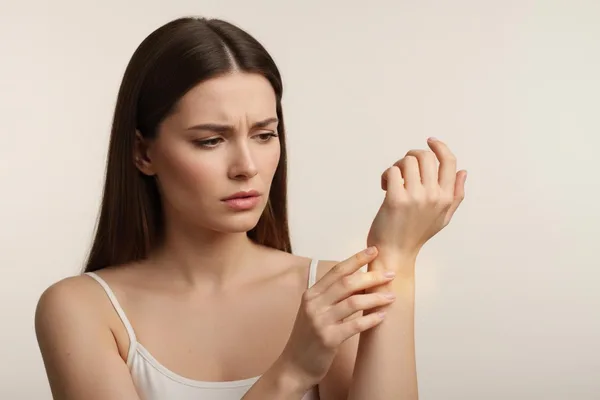
Do you suffer from an itchy, burning sensation on the back of your arm, especially on the forearm, that you can't find a reason for? Do you sometimes feel a tingling sensation, like a tickle, or a jolt? No matter how much you scratch, it won't go away? Then this article will be very important for you. Today we will talk about a condition that many people don't know about, but can be very annoying for some. That is `Brachioradial Pruritus`.
Simply put, what is Brachioradial Pruritus?
This name may sound a bit complicated, but let's keep it simple. `Brachioradial` refers to the muscle that runs from your elbow down and helps you bend your arm (the `brachioradialis muscle`). `Pruritus` is the medical term for "itching."
So `Brachioradial Pruritus` is a term for an itchy, burning, or tingling sensation on the back of your arm (the forearm). The important thing is that this is not a skin rash, nor is it contagious. It is actually a nerve problem. This condition usually affects both arms, but sometimes it can occur in just one arm.
What causes this annoying itching?
Doctors believe this is due to a combination of two main reasons.
1. Cervical Radiculopathy
2. Exposure to sunlight (Ultraviolet - UV Radiation)
Let's look at each of these separately.
1. The connection between the nerves in the neck and this itch
There are eight pairs of nerves, called C1 through C8, that come out of your neck (the part of your cervical spine called your spine). These nerves carry sensation to your neck, shoulders, arms, and fingers. If any of these nerves between C5 and C8 become pinched or damaged, it can cause a variety of unusual sensations (paresthesia) in your hands. These include tingling, numbness, burning, and pain.
Just like when a water pipe gets clogged, the water changes its flow path, when a nerve is pinched, the signals it sends are disrupted and the wrong information is sent to our brain. That's why we feel like we're scratching our hands for no reason.
There are various reasons why a nerve in the neck can be pinched:
- Herniated disk: A jelly-like piece of tissue between the vertebrae of the spine that bulges out and presses on a nerve.
- Osteoarthritis: With age, the bones wear down and the openings through which nerves pass become narrowed.
- Degenerative disk disease
- Narrowing of the nerve passageway (foraminal stenosis)
Many times, people with `Brachioradial Pruritus` do not feel any pain in their neck. Therefore, they do not even know that they have a nerve problem in their neck. However, when people with this condition undergo tests such as `MRI` scans of their necks, many have been found to have some problem in their spine.
2. How does sunlight (UV rays) affect this?
Although the exact cause is still unclear, researchers believe that UV rays, or sunlight, are a major factor in exacerbating these symptoms. There are several reasons for this:
- Many people say that itching increases when exposed to the sun .
- This disease is most common during the summer months.
- Many people have experienced a reduction in symptoms during the winter and when they protect themselves from the sun (wearing long-sleeved clothing, using sunscreen).
Simply put, the nerves in the neck have become a little sensitive due to a nerve problem. When the `UV` rays of the sun hit the skin, those sensitive nerves may be further stimulated, causing this itching.
What are the symptoms of this condition?
The main and most obvious symptom of this disease is the itch on the back of the hand (forehead). However, several other symptoms may also be seen.
| Feature / Effect | Description |
|---|---|
| Main symptom | Severe itching on the back of the forearm. |
| Other places that may be affected | Upper arms, shoulders, and neck. |
| Other sensations | In addition to itching, you may experience pain, stinging, and tingling. |
| Skin changes | This disease does not cause a skin rash, but frequent scratching can cause skin abrasions, sores, and skin discoloration (black or white spots). |
Important: In about 75% of cases, these symptoms occur in both hands. However, it is possible that they may occur in only one hand.
Who is most likely to develop this condition? (Risk Factors)
- Gender: Women are three times more likely to develop this disease than men. This may be because women are more prone to problems with the cervical spine and nerves due to their physical characteristics.
- Age: It is most commonly diagnosed in middle age, between the ages of 50-60, but can occur at any age.
- Skin color: This condition is more common in people with light (white) skin .
- Lifestyle: People who spend a lot of time outdoors, such as cycling, hiking, or spending time at the beach, are at higher risk of developing this disease.
How do you find this, Doctor?
When you visit your doctor, he or she will ask you about your symptoms, your medical history, and your lifestyle. Then, they will examine your hands to see if there is another skin condition (such as a rash) that is causing the itching.
A simple and effective test commonly used to diagnose this disease is the ice pack test.
The doctor will place an ice pack on the itchy area on your arm. If your itching stops completely immediately, and then the itching starts again after you remove the ice pack, it is very likely that it is `Brachioradial Pruritus`.
Very rarely, your doctor may recommend an MRI scan or X-ray to examine your spine and nerves in your neck.
What are the treatments for this?
There are several treatments for `Brachioradial Pruritus`. Usually, one or more of these treatments can be used together to control symptoms.
| Treatment method | Description and examples |
|---|---|
| Avoiding UV rays | This is the most important thing. Limiting your time in the sun, always using a good sunscreen (SPF 30 or higher) , and wearing long-sleeved clothing can greatly reduce symptoms. |
| Oral Medications | Some medications for nerve pain and problems are also very effective. Examples: Medications like `Amitriptyline`, `Gabapentin` . These should be prescribed by your doctor. |
| Topical Medications | Creams and lotions applied to the itchy area can provide temporary relief. Examples include `Capsaicin` creams, `Corticosteroid` creams, and `Antihistamine` creams. |
| Applying ice packs | When itching and inflammation are severe, applying an ice pack can provide immediate relief. |
Very rarely, if the problem with the cervical spine is serious, surgery may be recommended.
What complications can occur due to this condition?
This disease does not pose a major health risk to your life. However, constant scratching of the skin due to unbearable itching can lead to various problems.
- Skin abrasions and wounds.
- Thickening of the skin and a leathery appearance (`Lichenification`).
- Hard skin bumps (`Prurigo nodules`).
- Skin discoloration (dark spots - `Hyperpigmentation` or white spots - `Hypopigmentation`).
- Conditions such as eczema.
Therefore, it is very important to control itching.
When should you see a doctor?
If you have a persistent, unexplained itch on your hand that is interfering with your daily activities, definitely see your doctor. Don't self-treat.
Also, if your symptoms do not improve after starting treatment, let your doctor know. He or she may be able to recommend a different treatment option that is more suitable for you.
Take-Home Message
- `Brachioradial Pruritus` is not a skin rash, it is a neurological problem.
- This is mainly caused by a nerve problem in the neck and exposure to sunlight.
- Sun protection (especially sunscreen and long-sleeved clothing) is the best way to control these symptoms.
- If you have persistent, unexplained itching on your hands, be sure to seek medical advice.
- These bothersome symptoms can be successfully controlled with proper treatment.




💬 Comments (0)
No comments yet. Be the first to share your thoughts here.
Add Your Comment