

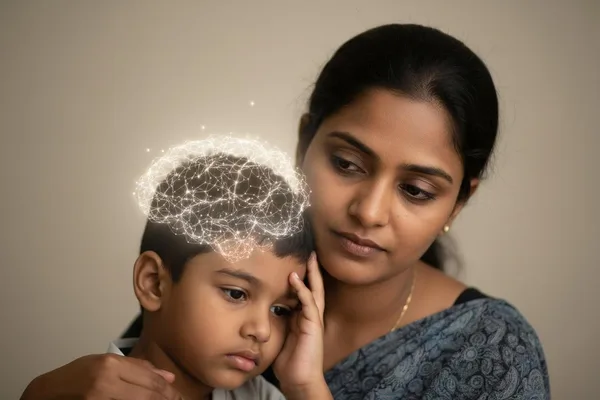
Mom, Dad, does your little one often have a headache? Does he or she sometimes vomit in the morning? Or have you recently noticed a sudden big change in your child's behavior or speech? It's very normal to feel a little scared or worried when you hear or see something like this. However, not every headache or vomiting is a sign of a dangerous illness. However, although rare, sometimes these can be symptoms of a condition like a pediatric brain tumor . So, without further ado, let's talk about this in a little more detail today, in a way that you can understand, and in a very simple way.
What is a brain tumor in these young children?
Simply put, our brain is made up of millions of cells. Sometimes these brain cells start to grow abnormally and uncontrollably. That's when a tumor, or what we call a ``Neoplasm,'' forms inside the brain. The main reason for this is that certain changes occur in the genes of the brain cells. These genetic changes are what cause a healthy cell to behave abnormally and become a tumor.
There are two types of these brain tumors:
- Non-malignant or Benign: These are not cancerous cells. However, if they grow inside the brain, they can push on important parts of the brain and cause problems.
- Malignant or Cancerous: These are what we call tumors. They can grow rapidly and spread to other parts of the brain or sometimes to other parts of the body.
This condition can occur in a child of any age, from very young to very old, and sometimes even into adulthood.
How common are brain tumors among children?
In fact, brain tumors are the most common type of cancer in children . According to statistics, thousands of children are diagnosed with this condition every year. It may sound a little scary, but remember, if detected early and treated properly, the chances of recovery are high.
What types of tumors can be seen in children's brains?
It may sound complicated, but there are many different types of brain tumors in children. They are classified based on the type of brain cells they start in. Here are some of the main categories:
- Gliomas
- Embryonic tumors
- Pineal tumors
- Craniopharyngiomas
- Germ cell tumors
- Choroid plexus tumors
- Schwannomas
- Meningiomas
Now let's take a simple look at each of these.
1. Gliomas
These are the most common types of brain tumors in children. In fact, about half of all brain tumors in children are of this type. They arise from special cells in the brain called glial cells . These glial cells are a type of cell that supports, nourishes, and protects the neurons in the brain. Some gliomas can grow slowly (low-grade), while others can grow rapidly and be aggressive (high-grade).
There are several other subtypes of glioma:
- Astrocytoma: This starts in a type of glial cell called astrocytes. These tumors can develop in the brain or spinal cord. Some grow slowly, while others grow rapidly.
- Oligodendroglioma: These start in glial cells called oligodendrocytes. These are most commonly found in the outer layer of the brain.
- Neuroglial tumors: These contain glial cells as well as neuronal cells. They can develop in the brain and spinal cord and can cause frequent seizures.
- Ependymoma: These tumors begin in the ependymal cells that line the fluid-filled cavities (ventricles) inside the brain.
2. Embryonic tumors
These tumors start in fetal or embryonic cells in the central nervous system. They are cancerous tumors and can occur at any age, but are most common in infants and young children .
Some of the main nuts belonging to this type are:
- Medulloblastoma: This is the most common type of germ cell tumor. It begins in the cerebellum, which is located at the back of the brain.
- Medulloepithelioma: This is a very rare, fast-growing tumor. It is usually seen in infants and young children.
- Atypical teratoid/rhabdoid tumor (ATRT): This is also rare. It often begins in the cerebellum of very young children.
- Embryonal tumor with multilayered rosettes (ETMR): This is a malignant childhood brain tumor that occurs in the central nervous system.
3. Pineal tumors
These tumors develop in the pineal gland. This gland is located in the middle of the brain. The hormone melatonin is secreted by this gland. There are several types of tumors that start in the pineal gland. These can be non-cancerous (benign) or cancerous (malignant).
Types of pineal gland tumors that can occur in children:
- Pineoblastoma: This is the most aggressive type of germ cell tumor. It can spread quickly to the brain and spinal cord.
- Pineal parenchymal tumors: These are moderately aggressive tumors. If detected early, they may be confined to the pineal region.
- Germ cell tumors: These develop from embryonic tissue left over from the pineal gland.
4. Craniopharyngiomas
These are noncancerous tumors that start near the pituitary gland . They develop from the embryonic tissue of the pituitary gland. Craniopharyngiomas can be solid, cystic, or a mixture of both. Some grow slowly, while others grow rapidly.
These tumors can compress the pituitary gland. Did you know that the pituitary gland produces hormones that control things like growth, blood pressure, and reproduction? These tumors can also compress an important part of the brain called the hypothalamus . The hypothalamus controls many things like body temperature, body fluids, and emotions. Optic nerves can also be compressed, which can cause vision problems.
5. Germ cell tumors
These are cancerous tumors that start in embryonic cells called "germ" cells. During the embryonic stage, these germ cells move out of the brain and form the ovaries or testes. However, germ cells that remain inside the brain can sometimes become cancerous and form germ cell tumors. These tumors can also spread to the spinal cord and cerebrospinal fluid (CSF).
6. Choroid plexus tumors
These tumors start in the choroid plexus, a tissue that lines the ventricles of the brain. They can be benign (such as choroid plexus papilloma) or cancerous (such as choroid plexus carcinoma). Atypical choroid plexus papillomas are moderately aggressive tumors. They can become cancerous if left untreated.
7. Schwannomas
These tumors start in Schwann cells, which cover the nerves in the brain. These types of tumors usually grow near the nerves involved in hearing and balance. If they develop near the spinal cord, they can cause weakness and sensory problems. Schwannomas are usually not cancerous (benign), but they can sometimes become cancerous (malignant).
8. Meningiomas
This is also a type of brain tumor, but it is less common in children. Meningiomas start in the membranes that surround the brain, called the meninges . They can invade the brain and spinal cord. Most meningiomas are not cancerous, but they can grow large enough to be life-threatening.
Just think, each of these types is different. That's why the symptoms and treatments are all different.
What causes a brain tumor?
Scientists still don't know exactly why healthy cells grow out of control and form tumors. However, there are several factors that are thought to play a role:
- Genetic changes in a cell's genes.
- Inheritance of cancer-forming genes.
- Having received radiation treatment for another cancer in the past.
There is a link between some childhood brain tumors and a group of seemingly related health problems called cancer syndromes. Experts are still researching this connection.
Some cancer syndromes that may have this connection are:
- Li-Fraumeni syndrome
- Neurofibromatosis type I
- Neurofibromatosis type II
- Tuberous sclerosis
- Von-Hippel Lindau disease
- Nevus basal cell carcinoma syndrome or Gorlin syndrome
- Cowden syndrome
- Familial adenomatous polyposis (FAP)
- Lynch syndrome
What are the symptoms of a brain tumor in a child?
The symptoms of a brain tumor can vary greatly depending on the type of tumor, its severity, how fast it grows, and where it is located in the brain. So not every child will have the same symptoms. However, here are some common symptoms:
- Excessive sleepiness.
- Headaches that occur in the morning and subside after the child vomits.
- Increase in head size (head circumference) in infants.
- Nausea and vomiting, especially if accompanied by headache and not diarrhea.
- Difficulty seeing, hearing, or speaking.
- Balance problems (stumbling when walking, feeling like you're about to fall).
- Lack of coordination of body parts (such as difficulty gripping objects, difficulty controlling limbs).
- Sudden changes in behavior (such as becoming more stubborn than before, becoming easily angered).
- Feeling of weakness in one side of the child's arm, leg, or body.
- Seizures.
If your child has one or more of these symptoms, it is important to seek medical advice immediately. These are not always signs of a brain tumor, but it is wise to get checked out.
How do you diagnose a brain tumor in a young child?
If a doctor suspects a brain tumor in a child, they will order several tests. These may include:
- Physical exam: The doctor will check the child's general health. He or she will ask about the child's symptoms, personal medical history, and family medical history.
- Neurological exam: This test checks how the child's brain is working. It checks things like mental status, balance, coordination, sensation, and reflexes.
- Imaging tests: The doctor may order tests to get detailed pictures of your child's brain and/or spinal cord. For example , an MRI (Magnetic Resonance Imaging) scan, a CT (Computed Tomography) scan, or a PET (Positron Emission Tomography) scan . Sometimes, a special substance may be injected into a blood vessel in your child before this test. This helps the cancer cells show up more clearly on the scan.
- Blood tests: There is a blood test called a serum marker test . This can measure substances related to cancer (tumor markers) in the child's body.
- Biopsy: A biopsy involves taking a small sample of tissue from a tumor and examining the cells under a microscope. This is what helps determine exactly what type of tumor it is and whether it is cancerous or not.
- Spinal tap / Lumbar puncture: In this procedure, a doctor inserts a special needle into your child's lower back and removes a small amount of the fluid (CSF) that surrounds the brain and spinal cord. The fluid is then tested for abnormal cells.
If these tests find abnormal cells, the medical team will determine whether the tumor is benign or cancerous. They may also give the tumor a grade to determine its severity and how fast it is growing:
- Grade 1 Tumors: Tumor cells are very similar to normal cells.
- Grade 2 tumors: They grow slowly and are less likely to spread to other parts of the body. The tumor cells are somewhat abnormal.
- Grade 3 or 4 tumors: These are malignant tumors. They are more aggressive and have a higher chance of spreading to other parts of the brain. The cells are clearly abnormal.
How are brain tumors in children treated?
If a brain tumor is cancerous or is causing your child to have uncomfortable symptoms, your child will need treatment. Treatment depends on factors such as the type of tumor, where it is located, and how quickly it has spread . Treatment options may include:
- Surgery: Surgery may be performed to remove all or part of the tumor, or to remove fluid that is causing pressure on the brain.
- Chemotherapy, targeted therapy, immunotherapy, or other drugs: These treatments are used to kill cancer cells or relieve symptoms.
- Radiation therapy: Destroying cancer cells using high-energy rays.
- Rehabilitation: If the tumor has affected the child's speech, balance, or other abilities, helping to restore those abilities.
What is the recovery outlook for children with brain tumors?
The prognosis for recovery in children with brain tumors varies greatly. There are several factors that affect this:
- The child's age and general health.
- The location of the tumor in the brain.
- The size of the tumor.
- The grade of the fruit.
- Type of tumor.
- The success of treatment in removing all or part of the tumor.
- Whether the tumor has spread to other places.
A large, aggressive tumor can be life-threatening, but thanks to advances in diagnosis and treatment, children are increasingly recovering.
Can a childhood brain tumor come back after treatment?
Yes, a brain tumor that developed during childhood can recur during childhood or adulthood.
Recurrence means that a new, different tumor can form, or some abnormal cells that were left in the brain after treatment can grow back and the old tumor can grow again.
Are there ways to reduce the risk of childhood brain cancer?
Because scientists still don't fully understand what causes brain tumors, there are currently no proven ways to prevent them.
What should I ask the doctor about my child's brain tumor?
It is very important to ask your child's medical team these questions:
- Where is the brain tumor located?
- Does it push on surrounding brain areas?
- Is this benign or malignant?
- Has this spread to other places, or is there a possibility of it spreading?
- What is the grade of the fruit?
- What treatments do you recommend?
- What are the risks and side effects of those treatment options?
- What are the chances of this coming back after treatment?
- Does my child have a cancer syndrome that could cause other health problems?
It's normal to feel scared and shocked when you find out that your child has a brain tumor. You may not know who to turn to for help, what to do, or how to cope. But you're not alone. There are many resources and support groups available to help, talk to, and share experiences. Talking to other families who are going through a similar experience can be a great source of strength during this difficult time. While some tumors can be life-threatening, advances in diagnosis and treatment have allowed many children to recover. Don't give up.
Things you need to know (Take-Home Message)
- Brain tumors in children are abnormal growths of brain cells. They can be cancerous or noncancerous.
- If you have symptoms such as frequent headaches, vomiting, behavioral changes, or difficulty walking, seek medical advice.
- The disease can be diagnosed through tests such as MRI, CT scan, and biopsy.
- There are treatment methods such as surgery, chemotherapy, and radiation therapy.
- Early detection and proper treatment increase the chances of recovery for children. The most important thing is not to panic, but to get the right information and medical help.
` Brain Tumor, Pediatric Brain Tumor, Brain Tumors, Children's Cancer, Glioma, Medulloblastoma, Cancer Symptoms, Brain Cancer Treatment




💬 Comments (0)
No comments yet. Be the first to share your thoughts here.
Add Your Comment