

What exactly is a chest X-ray?
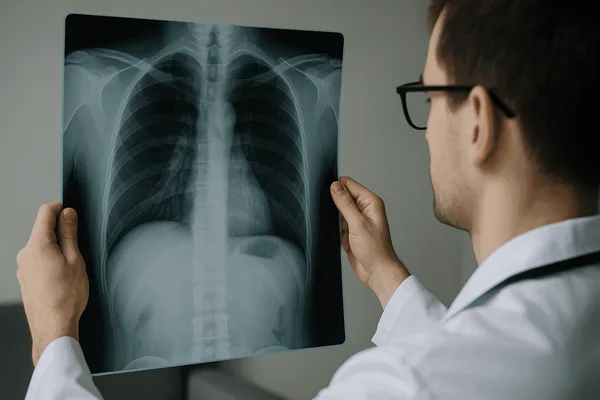
Simply put, a chest X-ray is a test that takes pictures of your heart, lungs, and chest bones . It's like taking a photo, but it's a picture of what's inside your body. It's sometimes called a ``Chest Radiograph'', or ``CXR'' for short. Doctors look at these pictures to see if there's anything wrong with your chest.What diseases and symptoms can be detected with an X-ray?
If you have any chest symptoms, a doctor may order this X-ray. What are these symptoms?- If you have chest pain .
- If you have a chronic cough , that means the cough has not subsided for a long time.
- If you experience difficulty breathing (dyspnea).
- If there is fever with other signs of infection .
- Congestive Heart Failure
- Conditions such as emphysema or chronic obstructive pulmonary disease ( COPD ).
- Lung Cancer
- Pneumonia (This is something we hear all the time)
- Tuberculosis (TB)
- Check for broken ribs in the chest cavity (Ribcage injuries).
How does this X-ray (CXR) work?
This is a bit of a scientific story, but I'll explain it simply. An X-ray machine sends a beam of radiation through your body. Different parts of your body, called tissues, are different in thickness.- For example, your bones are very thick , so not much radiation passes through them. That's why the bones appear white on an X-ray.
- But, because there's air inside your lungs, they're not that thick.So more radiation passes through them. That's why the lungs appear as a grayish-black color on an X-ray image.
How do you prepare before going for an X-ray (CXR)?
This one is pretty easy. There's no need to prepare for a chest X-ray. Once you've been given an appointment, keep these things in mind when you go:- Wear loose, comfortable clothing . Try to minimize the number of metal parts (e.g. zippers, buttons, bra hooks) in your clothing.
- Remove any jewelry (such as necklaces, bracelets, etc.) from your home .
- If you have body piercings , ask the X-ray provider about them and get advice. They may ask you to remove them, as these metal objects may not show up clearly in the image.
What happens when you get an X-ray (CXR)? Don't be afraid!
Taking an X-ray is a very quick process. This is done for you by a specially trained person called a radiographer .- When you get there, you will probably be asked to wear a hospital gown.
- Then, they will ask you to remove any necklaces or other metal objects from your chest.
- Typically, a chest X-ray takes about two images :
- It is very important that you remain still and hold your breath during this X-ray. Even a slight movement or breathing can cause the image to become blurry. Then you will have to take it again.
- This entire process only takes a few minutes , so there's no reason to be afraid.
What happens after the X-ray is taken?
After the X-ray is taken, the radiologist will ask you to wait a few minutes. They will check to see if the images they took are clear. If any of the images are blurry, they may need to be retaken. Then, the radiologist will send your X-ray images to a radiologist . This is a doctor who specializes in looking at X-ray images to find normal and abnormal things. He or she will look at the images and write a report. Then, your doctor will review the images and the radiologist's report and explain the results to you.Are there any risks or side effects to this?
Very little radiation in X-raysDoctors always try to use the minimum amount of radiation necessary to get a good, clear picture. So this doesn't pose much risk.Remember, a doctor recommends an X-ray because he or she believes the benefits of it far outweigh the very small risks.
How long will it take for me to know the results?
- In a non-emergency situation, you will be able to know the X-ray results within a week.
- In an emergency, results can be known in a few minutes or even hours .
What do my X-ray results say?
Your doctor will explain the X-ray results to you. Usually, it will look like this:- A normal chest X-ray: It shows healthy, clear lungs, a healthy heart, and a clear chest cavity. There are no visible nodules, tumors, or masses. That means everything is fine!
- An abnormal chest X-ray may show some unusual features. For example:
- Enlarged heart
- Fluid buildup in your lungs
- Broken ribs
- Cysts or masses
- Other irregularities.
When should I call the doctor?
See a doctor if you have any of these symptoms:- If you have a chest injury (for example, if you think you have a broken rib).
- If you have persistent chest pain .
- If you have a persistent cough .
- If you have difficulty breathing .
How many pictures are taken during a chest X-ray?
Usually, a chest X-ray takes two pictures – one from the front and one from the side. But sometimes, the technologist may take as many as four pictures . This may mean taking one while you are lying on your back and another while you are lying on your side. This depends on the information the doctor needs.Is it okay to get a chest X-ray if I am pregnant?
This is very important. If you have even the slightest suspicion that you might be pregnant, you should definitely tell your doctor and the person doing the X-ray.Because exposure to radiation can harm a developing fetus, the amount of radiation used in a chest X-ray is very small, so it usually doesn't cause problems during pregnancy . However, doctors try to minimize your exposure to radiation until you have your baby. Therefore, your doctor will decide whether an X-ray is necessary based on your symptoms.Finally, the most important things to remember (Take-Home Message)
Okay, so now I hope you have a better understanding of what a chest X-ray is. In short:- A chest X-ray is a quick, painless (noninvasive) way to check the health of your lungs, heart, and chest bones .
- This is often one of the first tests doctors perform to detect things like broken bones, lung disease , and heart disease .
- Based on the information obtained from this, the doctor will decide what kind of treatment to give you.
Chest X-ray, Chest X-ray, CXR, Lung disease, Heart disease, Radiation, Diagnosis, Chest pain




💬 Comments (0)
No comments yet. Be the first to share your thoughts here.
Add Your Comment