
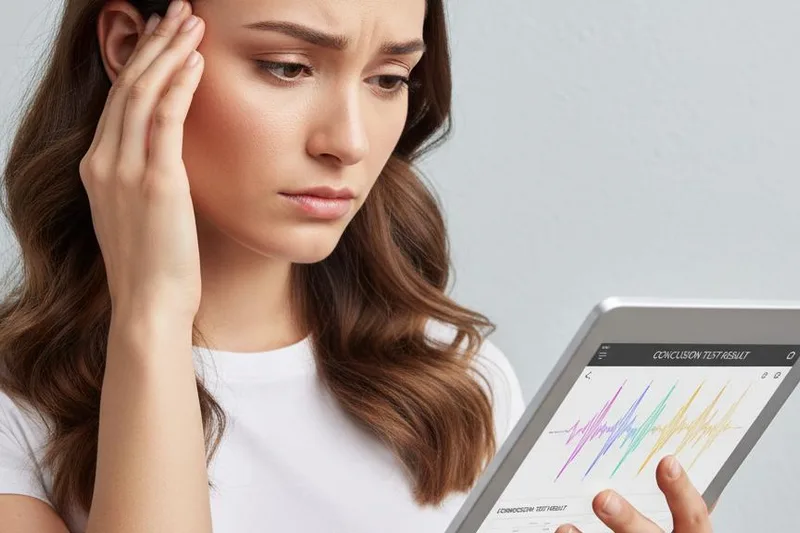
Imagine you get hit on the head by a ball while playing cricket, or your little one falls off a bike and hits their head hard. We often think, "Oh... it's just a bruise, it'll be fine in a moment." However, even a minor blow to the head can sometimes be serious. In such cases, it's important for us all to be aware of the temporary damage to the brain, called a 'concussion', which can save lives.
Simply put, what is this concussion?
Concussion is a temporary disruption of normal brain function caused by a strong blow, jolt, or impact to the head. Medically speaking, this is a mild traumatic brain injury . Just as a bottle of water is shaken violently, the water inside it is shaken when the head is hit. This jolt causes temporary damage to brain cells, disrupting the communication between them for a while.
A common misconception is that you have to lose consciousness to have a concussion. This is completely wrong. In fact, most people who get a concussion never lose consciousness. So don't think, "I didn't lose consciousness, so it's okay" after hitting your head. Even a minor blow can be serious, so it's always wise to see a doctor and get checked out.
What are the symptoms of a concussion?
There are many symptoms that can indicate a concussion in someone who has suffered a head injury. Some of these symptoms may appear immediately after the injury, while others may appear hours or even days later. Therefore, it is important to monitor a person who has suffered a head injury for several days.
To make it easier to understand, let's divide these symptoms into several categories.
| Symptom category | Visible features |
|---|---|
| Physical characteristics |
|
| Changes in thinking and memory | |
| Mental and behavioral changes |
When should you get checked for a concussion?
The simple answer is: Any time there's a significant blow to the head . It could be from playing sports, being in a car accident, or falling while doing household chores. A concussion test is a procedure that looks at how your brain's ability to think and process information is affected after a blow to the head.
It is very important to get these tests done quickly because if a concussion is diagnosed early, the necessary rest and management can be done properly. This can help the brain heal faster and prevent further damage.
These tests will be repeated at a later date to determine how well your brain has healed and whether you can return to normal activities (school, work, sports).
What does a concussion test look at in the brain?
There are many different types of concussion tests. Some are very simple, even a sports coach can do them. Some are complex tests that doctors do. All of these involve testing various brain functions through talking, writing, or using computerized tests.
The main things that are tested are:
- Alertness and Attention: How well are you paying attention?
- Memory: How is short-term and long-term memory?
- Speed of thinking: How long does it take you to answer a question or understand something?
- Recall: Can you recall and repeat something you have just said?
- Vision: Are the eyes working properly?
- Balance and Coordination: Can you stand on one leg and maintain your balance?
- Reflexes: How are the body's automatic responses?
What are the most commonly used concussion tests?
There are several named concussion screening methods used around the world. Most of these are questionnaires or symptom lists. They also have scoring systems.
A very important warning: These tests are not a substitute for a medical examination. Especially if a child under the age of 18 suffers a head injury, it is strictly forbidden to let them play again that day. The child should be removed from the game until a doctor has examined them and given the "clearance to play" clearance.
Here are some examples:
Tests on the playground
- SAC Test (Standardized Assessment of Concussion): This is used to quickly assess the mental status of an athlete on the field or in the emergency room (ETU). It asks simple questions about things like date and time, memory, and attention.
- SCAT 5 Test (Sports Concussion Assessment Tool 5): This is a more detailed test than the SAC. It is given to people over the age of 13. It checks many things, such as neck position, body balance, and a list of symptoms. There is also a separate (pediatric) version for children.
- King-Devick Test: This involves reading a series of numbered cards as quickly as possible. This is done before the start of a game and the time is recorded. This is done again after the head injury. If it takes 5 seconds or more longer than before, it may be a sign of a concussion.
Balance Tests
- BESS test (Balance Error Scoring System): This measures your balance. You are asked to hold various positions on a stable surface and an unstable surface (e.g., on a foam mat) with your eyes closed for 20 seconds. You are scored based on how much you sway or fall.
Symptom Scales
- ACE (Acute Concussion Evaluation): This is a questionnaire used by doctors. It collects a lot of information about 22 symptoms, how the accident happened, whether there have been previous head injuries, and other medical conditions.
- PCSS test (Post-Concussion Symptom Scale): In this, the patient rates 21 symptoms according to how severe they are (not at all, mildly, severely).
Computerized Neurocognitive Tests
- ImPACT Test (Immediate Post-Concussion Assessment and Cognitive Test): This is a computerized test for athletes over the age of 12. It's like a video game. It can measure many things, including visual and verbal memory, reaction time, and the speed at which the brain processes information.
Regardless of which test is performed, a doctor will examine you thoroughly before reaching a final conclusion. If necessary, they may also order an MRI or CT scan to check for bleeding or bruising on the brain.
What to do if you suspect a concussion at home?
First of all, remember that only a doctor can diagnose and confirm a concussion . However, if someone close to you (a child, a parent) falls and hits their head, there are some things you can gather before you go to the doctor. These will be a big help to the doctor in making a diagnosis.
Never do these things and just stay home and say, "Oh... it's okay." Don't take any blow to the head lightly. See a doctor immediately.
You can observe the following things and share that information with your doctor:
- Ask simple questions: ask him his name, where he is, the time, the date, and what happened just now.
- Test your memory: Ask the other person to say a simple word (e.g. "world").
- Ask about symptoms: Ask if you have a headache, dizziness, or nausea.
- Watch eye movements: Look at your finger and ask it to move both eyes in the direction it moves. See if both eyes move together properly.
- Changes in the body: Ask if there is any numbness or a feeling of lifelessness anywhere on the body.
- Change in speech: See if the story gets muddled or if the person is speaking in a non-normal manner.
- Pupil: Check to see if both pupils are the same size or if one is larger than the other.
- Behavioral changes: See if he seems more restless, agitated, or confused than usual.
What happens according to the test results?
If the doctor confirms that you have a concussion, he or she will give you a recovery plan. This plan will mainly include the following:
- Rest: You need to rest and sleep better than usual. But that doesn't mean staying in bed all day. Your brain needs rest too. That means limiting the time you spend watching TV, using your phone, reading books, and playing computer games.
- Avoiding things that trigger symptoms: Find out what things make your headaches and dizziness worse, and stay away from those things for a while.
- Gradual recovery: As symptoms subside, you can gradually return to normal activities. If you have a child, follow your doctor's instructions about how to return to school and when to return to sports.
- Coordination: You need to talk to the school's teachers and sports coaches, explain the child's condition, and follow the doctor's instructions.
Take-Home Message
- Any blow to the head can be serious. Never ignore it as "just a bruise."
- A concussion does not necessarily require loss of consciousness. Brain damage can occur even without loss of consciousness.
- If you hit your head, especially if you have symptoms such as headache, vomiting, dizziness, or memory loss, see a doctor immediately.
- The best way to recover from a concussion is physical and mental rest. Follow your doctor's instructions exactly.
- Do not return children to sports, especially those who play sports, until a doctor says they are "fully recovered."




💬 Comments (0)
No comments yet. Be the first to share your thoughts here.
Add Your Comment