
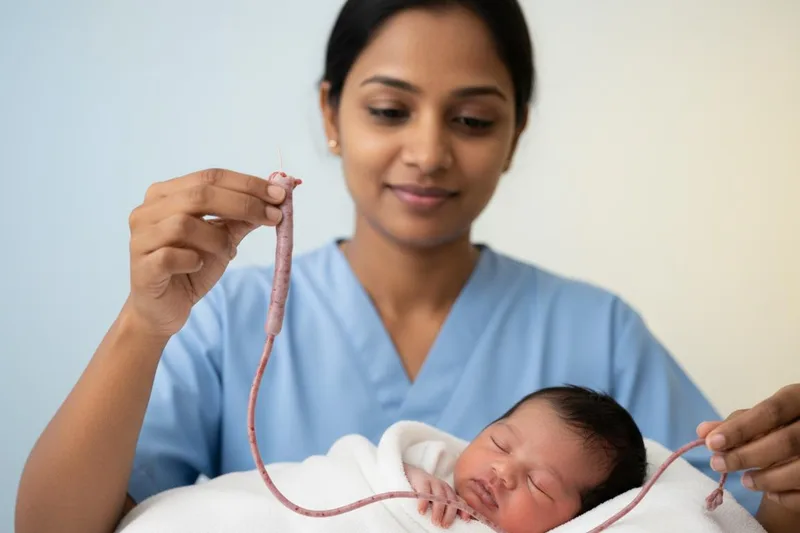
You and your family are eagerly waiting for your little one to come into this world, aren't you? So, during this time, how many things do you think and research about the baby's safety and health? Well, today we are going to talk about a very important decision you can make after the baby is born. That is, collecting and storing the blood left in the baby's umbilical cord, which is called `(Cord Blood Banking)`. Maybe you have heard about this, or this may be something new. However, don't worry, we will talk about everything clearly and simply.
First, let's see, what is cord blood?
Simply put, after the baby is born, the umbilical cord is cut and removed. At that time, the blood left inside the umbilical cord and in the placenta is called ``cord blood.'' This is not taken from the baby's body, so it will not harm the baby or you.
This blood is just like the normal blood in our body. It also has everything like red blood cells, white blood cells, platelets, and plasma. But this ``(cord blood)`` contains something very special and very valuable. And that is Stem Cells.
So what are these stem cells?
Think of it like magic. Stem cells are a type of "basic cell" in our bodies. That means these cells can develop into any type of blood cell our body needs (for example, a white blood cell, a red blood cell). It's like making different shapes of pots from the same lump of clay.
A healthy person's body produces these stem cells in sufficient quantities. However, in people with certain serious illnesses, the body is unable to produce healthy stem cells. In such cases, these valuable stem cells obtained from umbilical cord blood can even help save that person's life.
The most important thing is that if the umbilical cord blood is not collected after the baby is born, it will be wasted along with the placenta. That means something very valuable is wasted.
What are the benefits of collecting and storing this blood (Cord Blood Banking)?
Stem cells from umbilical cord blood can be transplanted into people with serious illnesses to help them create new, healthy cells in their bodies. Researchers have identified nearly 80 diseases that could be treated with this method.
These are some of the main conditions treated with stem cell transplants:
| Medical condition | A simple explanation |
|---|---|
| Types of cancer (e.g. Leukemia, Lymphoma) | These are cancers of the blood or lymphatic system. Stem cell transplants destroy diseased cells and stimulate the production of new, healthy blood cells. |
| Bone marrow diseases | In cases where the bone marrow is unable to produce healthy blood cells, transplanting these stem cells can restore that process. |
| Types of anemia (e.g., sickle cell disease) | These are genetic diseases that affect red blood cells. Healthy stem cells help the body produce normal, healthy red blood cells. |
| Immune system weaknesses | Some people may be born with weak immune systems. Transplanting these cells can strengthen that system. |
In addition, researchers are continuing to study whether these stem cells can be used to treat a number of other diseases, such as Parkinson's disease and diabetes.
What are the methods for cord blood banking?
If you want to store your baby's cord blood, there are two main ways to do it. These are public banks and private/family banks. There are some big differences between these two methods.
| Feature | Public Banks | Private Banks |
|---|---|---|
| Cost | Usually completely free. (If your hospital provides this service) | It is very expensive . There is an initial fee to collect blood and an annual fee to store it. |
| Ownership | You donate that blood. You don't have the right to it. | You have full ownership of the blood. |
| Usage | It can be used for any suitable patient (anywhere in the world) or for medical research. | Can only be used by your family . |
| Who is best suited for? | For anyone who wants to contribute to a great cause of saving someone else's life, at no cost. | It is most beneficial if another child or someone in the family already has a medical condition (e.g., a genetic disease) that requires a stem cell transplant. |
A little more about Public Banks...
This is like donating blood. You donate your baby's cord blood at no cost. The bank then stores it and gives it to a patient somewhere in the world who matches those cells to save their life. It's completely anonymous. That means no one knows who got your baby's blood, or who you got it from. Many doctors recommend this method because it allows you to help someone else without any risk.
A little more about private banks...
What happens here is that you pay money to have your baby's cord blood stored for your family to use only. But it's very expensive. You have to pay a lot to collect the blood first, and then you have to pay a lot to store it every year.
Many people think, "If my baby gets sick in the future, I can use it." But in reality, in many cases, a child may not be able to use their own stem cells (especially in the case of a genetic disease). Therefore, this method is often not very useful unless another family member has a specific disease. Often, the blood stored in this way is wasted without ever being used.
When should a decision be made about this?
This is not something to leave until the last minute. It is best to make a decision about this before you are 34 weeks pregnant .
There are several reasons for that:
- Some hospitals do not always have cord blood collection kits. You need to bring them in advance.
- You will need time to fill out the relevant consent forms and answer questions about your health history.
- If you choose a private bank, you will have to make the initial payments before the baby is born.
Therefore, it is wise to discuss this with your doctor and find out the necessary information, just like in the second trimester of your pregnancy.
How does the blood collection process work?
This is a very simple and safe procedure. After your baby is born and the umbilical cord is clamped and cut, the doctor or trained staff uses a needle to collect any remaining blood from the umbilical cord into a special bag.
This will not cause any pain, harm or discomfort to you or your baby. This is because the blood is not taken from the baby's body, but from the cut umbilical cord. The entire process takes only a few minutes. The hospital then sends the blood sample to the appropriate ``cord blood`` bank. There, the blood is tested, sorted and stored in a freezer (``cryogenically frozen``).
Can anyone donate this blood?
No. Not everyone can donate blood. You have to meet certain qualifications. You will have to answer a questionnaire about your and your family's health history. Based on those answers, it will be decided whether or not your baby's blood is suitable for donation.
Here are some things that are usually considered:
- Mother's age over 18 years.
- The expectation is to have only one baby (not twins).
- The baby does not have any currently identified genetic diseases.
- Have not had any tattoos or body piercings using unsterilized equipment within the past 12 months.
- The mother has not been exposed to diseases such as Hepatitis B, C, and (HIV).
- The mother had not received chemotherapy for cancer.
You will be asked a few questions about these things. These questions are to ensure the safety and quality of the blood sample being collected.
The method of your delivery (vaginal delivery or C-section) does not prevent you from collecting this blood. It can be done either way.
Ultimately, this is a completely personal decision. You may feel that storing blood at a private bank at a high cost is right for your family. Or, you may feel that donating blood at a public bank at no cost and contributing to saving a stranger's life is worth it. Talk to your family, especially your doctor, about this and make the decision that is best for you and your family.
Take-Home Message
- The blood left in a baby's umbilical cord is a rich source of valuable stem cells that can cure serious diseases such as cancer.
- Donating blood to a public bank is usually completely free of charge, and it can help save the life of an unknown patient.
- Storing blood in a private bank is very expensive, and it is only most useful if another child or close family member already has a medical condition that requires stem cells.
- The blood collection process is not painful or harmful to the mother or baby. It is completely safe.
- This is a very important personal decision, so be sure to discuss all the details with your doctor and make the best decision.


💬 Comments (0)
No comments yet. Be the first to share your thoughts here.
Add Your Comment