
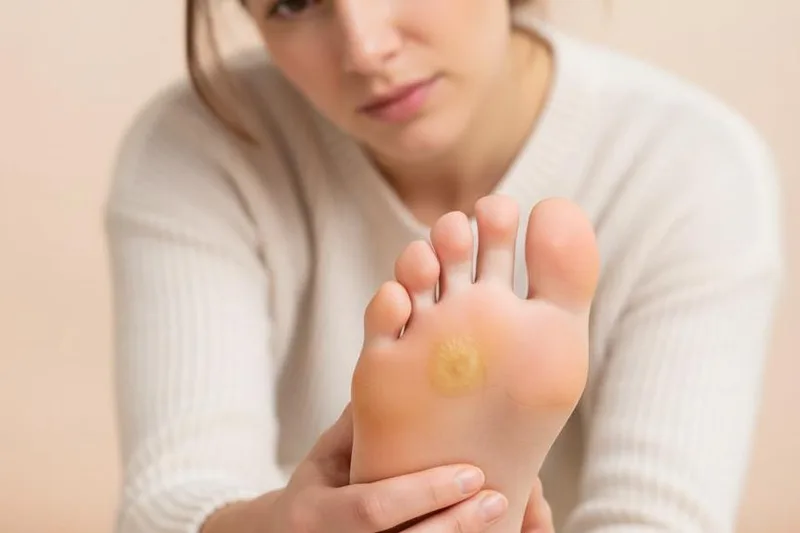
Have you ever walked a short distance in a nice new pair of shoes and noticed a small sore spot on your toe? Or after a long day of gardening, the skin on your hands where you used to hold a hoe becomes rough and feels different when you touch it, even though it doesn't hurt? We're talking about corns and calluses, which are common problems for many people, but they can be very easy to control if you understand them properly.
Simply put, what are corns and calluses?
Both of these are caused by continuous pressure or friction on the same area of our skin, causing the skin to thicken and become hard. To be precise, this thickened layer of skin forms like a natural shield to protect the delicate tissues inside our body. However, there are slight differences in the appearance and location of these two.
Look at this table, you can easily understand the difference.
| Characteristic | Corns | Calluses |
|---|---|---|
| Size and shape | Usually small, round in shape. May have a hard part in the middle. | Relatively large, flat, and has no specific shape. |
| Most visible places | On the toes, on the sides of the toes, between the toes. | On the soles of the feet (heels, under the big toe), palms, fingertips. |
| Pain | It is often painful when pressed or pressured. | Usually less painful and less sensitive than the surrounding skin. |
Are there types of corns?
Yes, we are talking about three main types of corns:
- Hard Corns: These are the most common. They are small, hard, thickened areas of skin that form on the bony areas of the toes .
- Soft Corns: These are whitish to gray in color and have a rubbery texture to the touch. They form when the skin is wet with sweat, especially between the toes.
- Seed Corns: These look like small seeds and often form on the underside of the skin.
Why do we get these? What are the main reasons?
The main cause of this problem is prolonged pressure and rubbing on the same area. See if these reasons apply to you too.
- Wearing ill-fitting shoes: This is the number one culprit! When you wear shoes that are too small for your feet, your toes get pinched together and rub against the inside of the shoe. Also, women who wear high heels are more likely to develop calluses because they put too much pressure on the front of their feet.
- Work style and hobbies : Think of the fingertips of someone who plays the guitar, the palms of someone who hoes in the garden, the palms of someone who lifts weights... Calluses form in all of these areas due to constant rubbing.
- Putting on shoes without socks: This condition can occur when you put on shoes without socks, as the skin on your feet rubs directly against the shoe.
- Walking incorrectly: Some people put too much weight on the inside or outside of their feet when walking. This increases the chances of calluses forming in the areas where that weight falls.
- Foot bone abnormalities: Some people may have a misalignment of the bones in their feet, either due to birth defects or conditions that develop later in life (e.g., bunions , hammertoes ), which can cause abnormal rubbing of the skin inside the shoe.
What can be done to treat this at home?
Most of the time, these are not serious conditions. So there are some simple things you can do at home. But before you do these, make sure you don't have diabetes or a circulatory problem (we'll talk about that later).
1. Soak your feet: Add a little salt to a basin of lukewarm water and soak your feet in it for about 10-15 minutes. This will soften the calloused skin.
2. Gently remove: Wet a pumice stone or emery board with water and gently rub it over the softened skin in one direction. This will gradually remove the dead skin.
Warning: Never cut or scratch these with a sharp object like a razor blade or scissors. Doing so can cause bleeding and a serious infection.
3. Moisturize: After thoroughly drying your legs, apply a good moisturizing cream to the areas where the skin is thick. Creams containing Urea or Ammonium Lactate are best for this. Applying these daily has softened the skin.
4. Use protective pads: There are donut-style adhesive pads available at pharmacies that have a hole in the middle. When you stick these over the corn, they will help to reduce the pressure from your shoe by moving the corn into the hole.
When should we definitely see a doctor?
This is the most important part. Although these are usually harmless, in some cases it is essential to seek medical advice.
| When to see a doctor immediately | |
|---|---|
| If you have diabetes | Diabetic patients may experience reduced sensation in the nerves in their feet (Peripheral Neuropathy). As a result, pain may not be felt properly, and even a small wound can develop into a major infection. Also, wound healing is delayed due to poor blood circulation. Therefore, if you have diabetes, do not treat any foot problems at home, but see a doctor. |
| If there are signs of infection | If the skin around the corn or callus becomes very red, swollen, painful , or oozes pus , it may be infected. See a doctor immediately. |
| If you have blood circulation problems | If you have conditions that reduce blood flow to your legs, even a minor injury can be dangerous. Therefore, it is wise to seek medical advice. |
| If home treatment does not help | If you have been treating your condition at home for a few weeks and there is no improvement or the condition is getting worse, see a doctor. |
How can I prevent these from happening again?
Prevention is better than treatment. To do this, make these simple things a habit.
- Choose the right shoes: Wear shoes that fit your feet well, are roomy, and soft. Shoes that don't constrict your toes and are well-ventilated are best. Since your feet swell a bit at the end of the day, it's best to go shopping in the afternoon.
- Always wear socks: Don't forget to put on two cotton socks when putting on your shoes.
- Keep your feet clean and dry: Wash your feet with soap every day and dry them thoroughly, especially between the toes.
- Use a moisturizer: Applying a good moisturizer to your legs before going to bed at night can help keep the skin soft.
- Cut your nails properly: When your nails grow too long, they can get stuck in your shoes. So, cut your nails straight across. Don't cut the corners crookedly.
Remember, your legs carry you everywhere you go, so it's worth taking a little care of them.
Take-Home Message
- Corns and calluses are thickenings of the skin caused by constant pressure and rubbing on the same area.
- The main reason for this is wearing shoes that are tight and do not fit the foot.
- In most cases, these can be controlled by soaking in lukewarm water, gently rubbing with a pumice stone, and applying a moisturizer.
- Never cut or scratch these with sharp objects.
- If you have diabetes , do not treat any foot problems at home and see your doctor immediately.
- It is essential to seek medical advice even in such cases, as severe pain, swelling, redness, or pus may be signs of infection.
Corns, Calluses, Rough Skin on Legs, Corns on Hands, Tight Shoes, Diabetes and Legs, Foot Health


💬 Comments (0)
No comments yet. Be the first to share your thoughts here.
Add Your Comment