
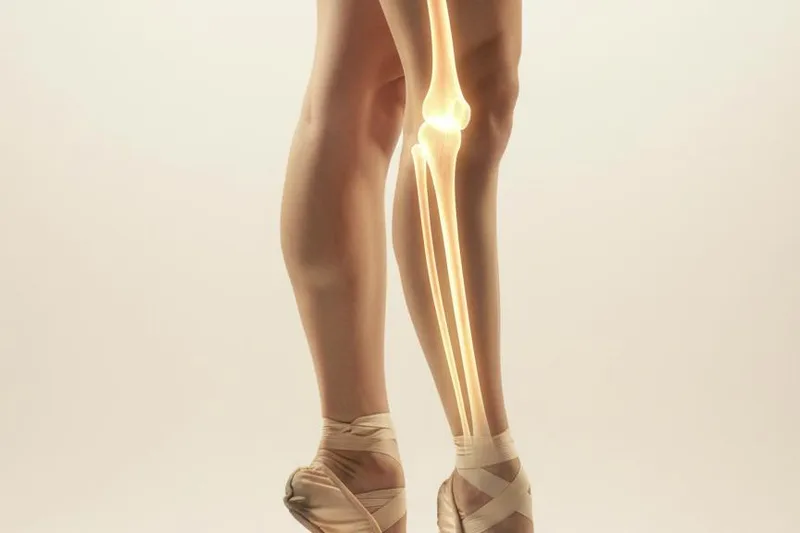
Did you know that there are two bones in your leg below the knee? Most people only know about the larger, stronger bone in the front. But on the other side of it, in the shin area, there is another very important bone. Today we are going to talk about the fibula. Although it is small, it provides great support for our leg's balance, ankle function, and even walking, running, and jumping.
What exactly is a fibula?
Simply put, the fibula is the bone in your shinbone. It's the smaller, thinner bone in your leg below your knee. It gives shape to your shinbone and is also involved in forming the top of your ankle bone below.
Imagine, the large bone at the front of your leg (the tibia) is the main weight-bearing bone. The fibula bone is a small, lateral support that provides stability and support to that main bone. Also, many important muscles, tendons, nerves, and ligaments in our leg and ankle are attached to this bone.
Because the fibula is not as strong as the femur or tibia, it is more susceptible to fracture. If this bone is broken in any way, it may require surgery to repair it and physical therapy to regain strength and mobility.
Like all other bones, the fibula can be affected by the bone thinning disease, or osteoporosis .
What is the difference between Fibula and Tibia?
Now you might be wondering what the difference is between these two bones. Although they are both located in the lower leg below the knee, their functions are very different. Let's look at it as a table.
| Characteristic | Tibia - knee bone | Fibula - shin bone |
|---|---|---|
| Location | It is located on the front and inside of the leg. | It is located on the outer side of the leg, parallel to the tibia bone. |
| Size | The fibula is longer and thicker than the tibia. | The tibia is thinner and smaller than the femur. |
| Carrying a load | This bone supports the weight of your body when you stand and walk. This is a weight-bearing bone. | The baby, which weighs only a very small amount (about 10%) of its body weight, is not primarily weight-bearing. |
| Main function | Supporting the body weight by supporting the knee and ankle joints. | Providing structure to the tendon, providing stability to the ankle joint, and allowing for muscle attachment. |
What are the main functions of the fibula bone?
Even though this bone is broken, there are several things that can be done:
- Giving shape and structure to the hip area and the outer side of the leg: This bone determines the shape of your hip.
- Supporting the ankle joint: The outer, knobby part of the ankle is formed from the lower end of the fibula bone. This provides great stability to the ankle.
- Serving as an attachment point for the muscles and tendons of the leg and ankle: Many important muscles that help raise, lower, and rotate the leg and foot are attached to this bone.
- Knee ligaments connect to the lower body: Some ligaments that are important for knee stability attach to the upper end of this bone.
What is the location and appearance of the fibula bone?
The fibula bone starts just below the knee and runs all the way to the ankle. It is located on the outside of the leg.
Although this bone is continuous, doctors divide it into several parts and call them segments.
- Fibula head: This is the top end of the bone. It connects to the tibia bone, just below the knee.
- Fibula shaft: This is the longest, central part of the bone. It gives the fibula its shape.
- Fibula distal aspect: This forms the upper part of the ankle. This is the knob-like part that fits on the outside of the ankle.
These may sound a little complicated, but don't worry, these are the words that doctors usually use. They can help you tell exactly where you're hurting and what kind of injury you have.
Common diseases and conditions affecting the fibula bone
There are two main problems that affect this bone: fractures and osteoporosis.
Fibula Fractures
A fracture is what we commonly call a broken bone. When a fibula bone breaks, you may see symptoms like these.
| Symptom | Description |
|---|---|
| Severe pain | Severe, unbearable pain at the site of the accident. |
| Swelling | Swelling around the fracture site. |
| Tenderness | Feeling severe pain when touching the broken area. |
| Inability to move the leg | Inability to move the leg or ankle as usual. |
| Bluish discoloration or discoloration | Bruising or a blue/purple color due to bleeding under the skin. |
| A distorted vision | The shape of the leg changes, with an unusual lump or fold appearing. |
Sometimes this bone breaks in a slightly different way. It's called an 'avulsion fracture.' This happens when the muscles or ligaments that are attached to the bone are suddenly pulled too hard. Then, a small piece of the bone comes off with the stretching tissue. This type of fracture can happen in situations like twisting your ankle while playing sports.
Very important: If you have had an accident and think you have a broken bone, or if you have pain or swelling, go to the nearest hospital's Emergency Department (ETU) immediately. Getting timely treatment can prevent complications.
Osteoporosis
This is a bit of a silent disease. Osteoporosis is a condition in which the density of our bones gradually decreases, they become weak, become hollow inside, and break very easily. Think of it like a good brick wall that gets eroded and weakened over time.
Many people don't know they have this condition until they break a bone from a sudden fall or a minor injury. It usually doesn't cause any major symptoms. Women and people over 50 are especially at risk. You can talk to your doctor about getting a bone density screening.
How do you check the health of the fibula bone?
The main test to check the health of your fibula (and other bones) is a bone density test . Also called a DEXA or DXA scan , this test uses low-level X-rays to measure how strong your bones are and how much bone mass has decreased with age.
If you somehow break your fibula, your doctor may need imaging tests like these:
- X-rays
- Magnetic Resonance Imaging (MRI)
- CT Scan (CT Scan - Computed Tomography Scan)
What are the common treatments for the fibula bone?
Typically, the fibula bone does not require special treatment unless there is a fracture or a condition such as osteoporosis.
Treatment for fractures
Treatment varies depending on how and why the bone was broken. In order for the bone to heal, the area must be immobilized . This may be done with a plaster of Paris (POP) or a splint. In some serious fractures, surgery may be needed to realign the bone fragments.
Treatment for osteoporosis
Treatments may include exercise, vitamin and mineral supplements, and medications. In most cases, exercise and nutritional supplements such as calcium and vitamin D are enough to prevent this condition. However, your doctor will assess your condition and develop a treatment plan that is right for you.
How do you keep your fibula bone (and other bones) healthy?
By following a good diet and exercise plan, as well as getting regular medical checkups, you can keep your bones (and your entire body) healthy. Follow these tips to stay safe.
- Wear a seatbelt whenever you are in a vehicle.
- Wear appropriate safety equipment when playing sports and other activities.
- In your home and workplace, don't leave things on the floor that could trip you over. Keep them tidy.
- Always use the correct equipment (such as a ladder) to reach things from above. Never climb on chairs or tables to reach things from above.
- Eat a diet rich in calcium and vitamin D to help maintain good bone health. Exercise.
- If you have difficulty walking, or are at risk of falling, use a cane or walker for support.
Even though the fibula bone doesn't directly bear your weight, it's a very important part of your leg. Anything you do to improve your overall health will also help keep your bones strong. Talk to your doctor about your risk of osteoporosis and learn about ways to protect your bones as you age.
Take-Home Message
- The fibula is the thin bone on the outside of your leg, just below your knee. It is important for ankle stability and hip structure.
- Because it does not bear the weight of the body like the tibia bone, it is more susceptible to fracture in accidents.
- If you suspect a broken bone with severe pain, swelling, or deformity in your leg, go to a hospital's Emergency Department (ETU) immediately.
- Osteoporosis, a bone-thinning disease, can also cause weak bones. Talk to your doctor about this, especially if you are over 50.
- A balanced diet, regular exercise, and protection from accidents can keep all of your bones healthy.


💬 Comments (0)
No comments yet. Be the first to share your thoughts here.
Add Your Comment