
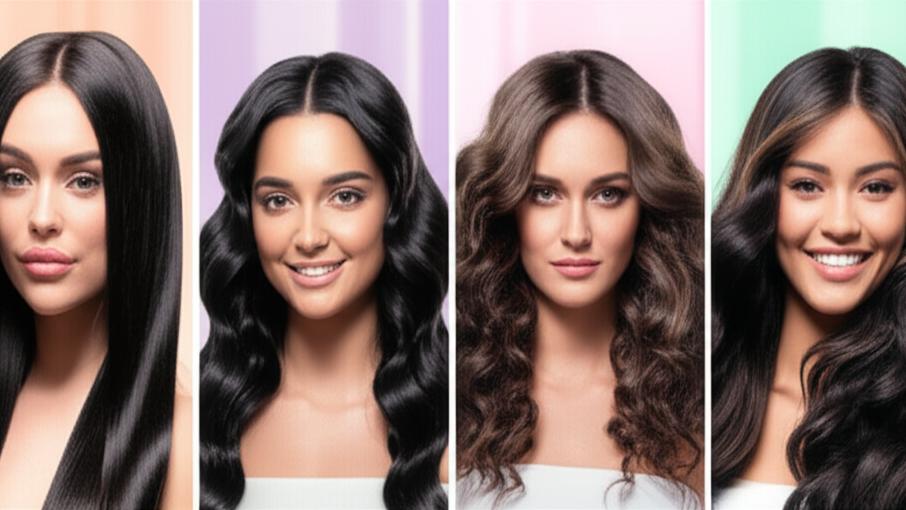
Have you ever wondered why your hair looks and feels the way it does? Some people enjoy naturally straight and shiny locks. This others have gorgeous waves or bouncy coils. You might even find that a shampoo or conditioner that works wonders for your friend leaves your own hair feeling dry, limp, or frizzy.
The secret lies in understanding your specific hair type. When you know your exact hair type, choosing the right products and building a simple daily routine becomes wonderfully easy. Let us explore the fascinating world of hair types and learn how to give your hair the exact care it deserves.
Key Takeaways for Healthy Hair
- Your unique hair type is determined primarily by your genetics and the shape of your hair follicles.
- Hair is generally divided into four main categories: straight, wavy, curly, and coily.
- Straight hair tends to get oily quickly. This curly and coily hair types need extra moisture.
- A simple air-dry test after washing helps you accurately identify your natural hair pattern.
- Embracing your natural hair texture and using proper care protects it from damage and breakage.
BMI Calculator
Know your body mass index (BMI) and weight classification
What Are the Main Hair Types?
To put it simply, hair falls into four primary categories. Each category represents a unique texture and growth pattern.
The four main hair types are:
- Type 1: Straight Hair.
- Type 2: Wavy Hair.
- Type 3: Curly Hair.
- Type 4: Coily Hair.
Every single one of these categories further breaks down into sub-categories labeled A, B, and C. These sub-categories depend on how fine or thick the hair strand is and how tight the wave or curl pattern appears.
Your hair texture, whether straight, wavy, or curly, is determined mainly by your genetics passed down from your parents. The shape of the tiny pore inside your scalp where each strand grows, known as the hair follicle, also plays a huge role. For instance, people with curly and coily hair have hook-shaped follicles. This people with straight hair have round follicles.
The most important thing to remember is that no matter your hair type, it is uniquely yours. Always wear your natural texture with pride and confidence.
How to Find Your Exact Hair Type
Finding your hair type at home is surprisingly easy. You can run a quick, natural test yourself.
Start by washing your hair thoroughly with a gentle shampoo. Afterward, do not use any heat styling tools or hair dryers. Instead, simply let your hair air-dry naturally at room temperature. Once your hair is completely dry, stand in front of a mirror and observe its natural pattern.
- Type 1: If your hair dries completely straight without any waves or bends, it is straight hair.
- Type 2: If your hair forms a gentle wave, often shaped like the letter S, it is wavy hair.
- Type 3: If your hair forms clear, distinct spring-like loops or spirals, it is curly hair.
- Type 4: If your hair forms very tight, small, densely packed coils or zig-zags, it is coily hair.
Let us now look at each of these four main hair types in detail and learn how to care for them properly.
| Hair Type | Appearance and Nature | Basic Care Tip |
|---|---|---|
| Type 1 (Straight) | Completely straight. Naturally shiny. Becomes oily quite fast. | Wash every two days. Use a lightweight, non-heavy conditioner. |
| Type 2 (Wavy) | Forms an S-shape wave. Can become frizzy on humid days. | Wash every three days. Use hydrating, moisture-locking products. |
| Type 3 (Curly) | Clear spiral curls. Often tends to have a dry texture. | Wash once a week. Deep conditioning treatments are essential. |
| Type 4 (Coily) | Very tight, small coils. Delicate and prone to breakage. | Provide deep moisture. Use leave-in conditioners and natural oils. |
Type 1: Straight Hair
This hair type lies completely straight without any natural curls or waves. The natural oils produced by your scalp, known as sebum, travel very easily down the hair shaft. Because of this natural oil flow, straight hair looks wonderfully shiny, but it also tends to get greasy rather quickly.
- 1A: Very fine and thin hair. It is usually quite difficult to curl with styling tools. This is the rarest hair type in the world.
- 1B: Slightly thicker than type 1A with a bit more volume and body. This is the most common straight hair type.
- 1C: The thickest and coarsest of the straight hair types. It is less prone to frizz than wavy hair.
How to Care for Straight Hair
Because straight hair gets oily fast, washing it every two days is a great habit. Choose a volumizing shampoo that does not weigh your hair down.
Pair it with a lightweight conditioner containing nourishing ingredients like coconut oil or jojoba oil. Apply conditioner mainly to the mid-lengths and ends rather than your scalp.
Type 2: Wavy Hair
Wavy hair sits right between straight and curly hair. It forms soft, gentle waves shaped like the letter S. In humid tropical climates, wavy hair can easily absorb moisture from the air and turn frizzy.
- 2A: Very fine and thin waves. You can easily straighten this hair or turn it into tighter curls with minimal effort.
- 2B: More defined waves with noticeable volume. This type is moderately prone to frizz.
- 2C: Thick waves that hold their shape well after drying. It has a higher tendency to frizz than 2A and 2B hair.
How to Care for Wavy Hair
Washing your hair every three days is usually plenty. Over-washing can strip away natural protective oils and cause dryness.
Use lightweight, hydrating hair products designed to enhance wave patterns. Applying a leave-in conditioner while your hair is damp gives your waves wonderful bounce and definition.
Type 3: Curly Hair
Now we arrive at curly hair, which features well-defined curls and ringlets. Because the natural oils from your scalp struggle to travel down the winding curves of each hair strand, curly hair often has a dry texture.
- 3A: Large, loose, well-defined S-shaped curls.
- 3B: Tighter, spring-like curls with a bouncy texture.
- 3C: Very tight, corkscrew curls that give your hair incredible volume and fullness.
How to Care for Curly Hair
Since curly hair tends to be naturally dry, washing it about once a week is ideal. Washing too often dries out the strands even further.
After every wash, treat your hair to a nourishing deep conditioning mask. Deep conditioning helps lock in hydration and keeps frizz under control.
Type 4: Coily Hair
Coily hair is the tightest and thickest curly hair type. While it may look robust, this hair type is actually made of very fine strands bundled closely together. Because of this delicate structure, coily hair breaks easily if handled roughly.
- 4A: Well-defined, tight coils shaped like miniature S letters.
- 4B: Sharp-angled coils forming a distinct Z-pattern shape.
- 4C: The tightest and most compact coils with minimal natural curl definition.
How to Care for Coily Hair
Coily hair requires maximum moisture to stay healthy and strong. Wash your hair with a gentle, sulfate-free shampoo to preserve natural oils.
Always follow up with rich conditioners, leave-in moisturizers, and natural butters like shea butter or argan oil. Be extremely gentle when brushing, detangling, or styling your hair to prevent unnecessary breakage.
Hair Appearance and Social Attitudes
We must also address the social and cultural aspects of hair types. Historically, natural curly and coily hair, especially among people of color, faced unfair social pressures and discrimination. People were often pressured to chemically alter their natural texture because society labeled natural hair as unprofessional.
Always remember that straight, wavy, curly, and coily hair are all uniquely beautiful. Never let narrow societal standards make you feel insecure about your natural appearance.
Loving your hair and taking care of it correctly is what truly matters. If you experience sudden hair loss, severe scalp irritation, or persistent dandruff, schedule an appointment with your doctor or a dermatologist for professional medical advice.
When to Consult a Doctor
While normal hair care can be managed at home, certain symptoms require professional medical evaluation. Seek prompt medical attention if you experience sudden patches of hair loss, severe scalp pain, bleeding, signs of fungal infection, or severe allergic reactions to hair products. If you experience a sudden medical emergency, call 911 (US/Canada), 999 (UK), or visit your nearest emergency room right away.
💡 Take-Home Message
Knowing your hair type helps you choose the right care products and routines.
Genetics and hair follicle shape determine your natural hair texture.
Straight hair needs frequent washing. This curly and coily hair requires deep moisture.
A simple air-dry test after washing reveals your natural hair type.
Embrace your natural hair, take good care of it, and seek professional medical advice for persistent scalp issues.






No comments yet. Be the first to share your question or experience below.