
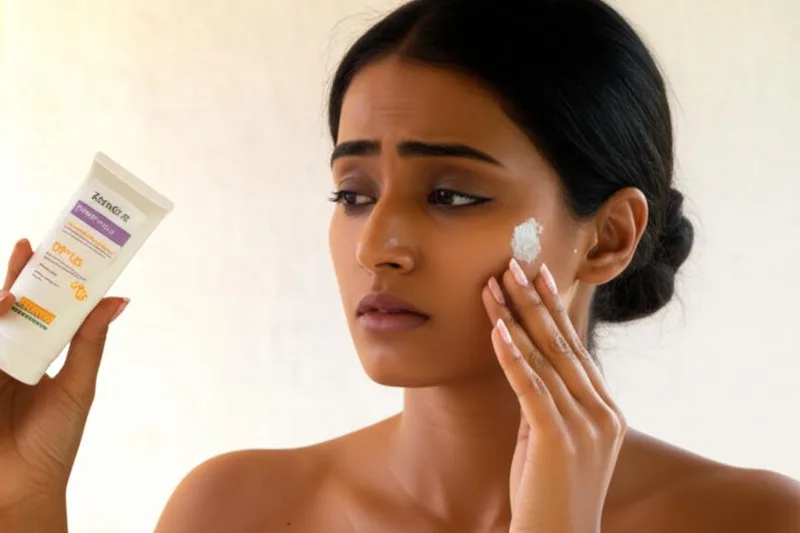
We all know that sunscreen is essential to protect our skin from the harsh sun. But, when you apply some sunscreens, your face turns a strange white color, as if you have sprinkled some flour on it. This is a bit of a bothersome problem, especially for those of us with dark skin. Sometimes, this is why some people even stop using sunscreen. Why does this really happen? Is there no solution to this? There is. Let's find out exactly about it today.
The relationship between two types of sunscreen and 'white cast'
First of all, we need to understand that not all sunscreens on the market are created equal. There are two main types of sunscreen. Whether or not your face turns white depends on the type you use.
Simply put, these two types are Chemical Sunscreens and Physical Sunscreens.
| Attribute | Chemical Sunscreen | Physical (Mineral) Sunscreen |
|---|---|---|
| How it works | This is absorbed into the skin, and when the sun's rays hit the skin, it absorbs those rays through a chemical reaction and protects the skin. | This acts as a protective layer on the skin's surface, reflecting the sun's rays back into the skin, like a mirror. |
| Main ingredients | Contains chemicals like Oxybenzone and Avobenzone. | Contains two minerals, Titanium Dioxide (TiO2) and Zinc Oxide (ZnO) . |
| The 'White Cast' | The face usually does not turn white because it is absorbed into the skin. | Since it stays on the surface of the skin, the face is more likely to turn white. This is what we call 'White Cast'. |
| For sensitive skin | May cause allergies or skin irritation in some people. | Generally best suited for sensitive skin and young children. Less likely to cause allergies. |
Now you probably understand that the main reason for the white color of the face is the mineral particles called `(Titanium Dioxide)` and `( Zinc Oxide )` contained in physical sunscreens. Since these particles sit on the surface of the skin and reflect light, the white color is visible, especially on darker skin tones.
How to Choose a Sunscreen That Doesn't Have a 'White Cast'?
Okay. Now that we know the problem, the next thing to do is to find a solution. Let's look at some of the options you have.
1. Choosing a Chemical Sunscreen
This is the easiest solution. Chemical sunscreens are absorbed into the skin, so they don't turn white. But there's a small catch. If you have very sensitive skin , acne, or are allergic to certain chemicals, these may not be suitable.
If you are unsure, before using a new chemical sunscreen, test it on a small area, like behind your ear, for a day to see if you have any allergic reactions. If you have any concerns , consult your doctor for advice.
2. Choosing the Right Physical Sunscreen
There are solutions for those who think, "Chemicals don't work for me, but I don't want my face to be white either." We need to think a little smarter here.
The main culprit behind the white color of physical sunscreens is the ingredient `(Titanium Dioxide)`. `(Titanium Dioxide)` reflects more light than `(Zinc Oxide)`. That means it is whiter.
So, if you choose a physical sunscreen, choose one that contains only `( Zinc Oxide)`. Many of the best sunscreens available today use only `(Zinc Oxide)` instead of `(Titanium Dioxide)`.
- Quantity is also important: A sunscreen that only contains `(Zinc Oxide)` should contain at least 15% - 20% `(Zinc Oxide)` to provide good protection (`SPF`). You can confirm this by looking at the ingredients list on the back of the bottle.
3. Tinted Sunscreens
This is also a very good solution. Some physical sunscreens come with a little color added to match our skin tone. These are called `(Tinted Sunscreens)`. Because of this color, that white color is almost completely covered. It also gives the face a little `makeup` `look`. What you need to do here is to choose a `shade` that matches your skin tone.
Let's use the sunscreen we found correctly.
Once you find the Suns CRE that suits you best, you need to use it properly to get the most out of it.
- Apply early: Apply sunscreen about 15 minutes before going out in the sun. This gives it time to set into the skin.
- Apply enough: Apply generously to the face, neck, hands, and any areas exposed to the sun. A little is not enough.
- Reapply: If you sweat or get in the water, you should reapply after wiping. Otherwise, reapplying every two hours is a good habit.
- Store well: Do not leave the sunscreen bottle in direct sunlight. Do not store it in a hot place, such as on the dashboard of a car. Doing so may cause the ingredients in it to lose their effectiveness. Store it in a shady place in your bag.
- Throw away after expiration: Like all products, sunscreens have an expiration date. Don't use anything past that date. It's usually best to buy a new one after three years.
Other safety measures besides sunscreen
If you find it difficult to find sunscreen, or if you just want extra protection, you can follow these steps.
- Stay in the shade whenever possible.
- Wear long-sleeved clothes and long pants.
- Wear a wide-brimmed hat to protect your face from the sun.
- Wear sunglasses to protect the skin around your eyes.
Take-Home Message
- No matter what your skin color, it's important to protect your skin from the sun's rays. Sunscreen is the best way to do that.
- The 'white cast' that makes the face appear white is mainly caused by the (Titanium Dioxide) and (Zinc Oxide) contained in physical sunscreens.
- To avoid 'white cast', use a chemical sunscreen if you have skin allergies.
- If you use a physical sunscreen, choose one that contains only (Zinc Oxide) and has a concentration greater than 15%.
- Tinted sunscreens are another great option to eliminate the 'white cast'.
- If you experience any allergies or problems with your skin, do not make decisions on your own but consult your family doctor for proper advice.


💬 Comments (0)
No comments yet. Be the first to share your thoughts here.
Add Your Comment