
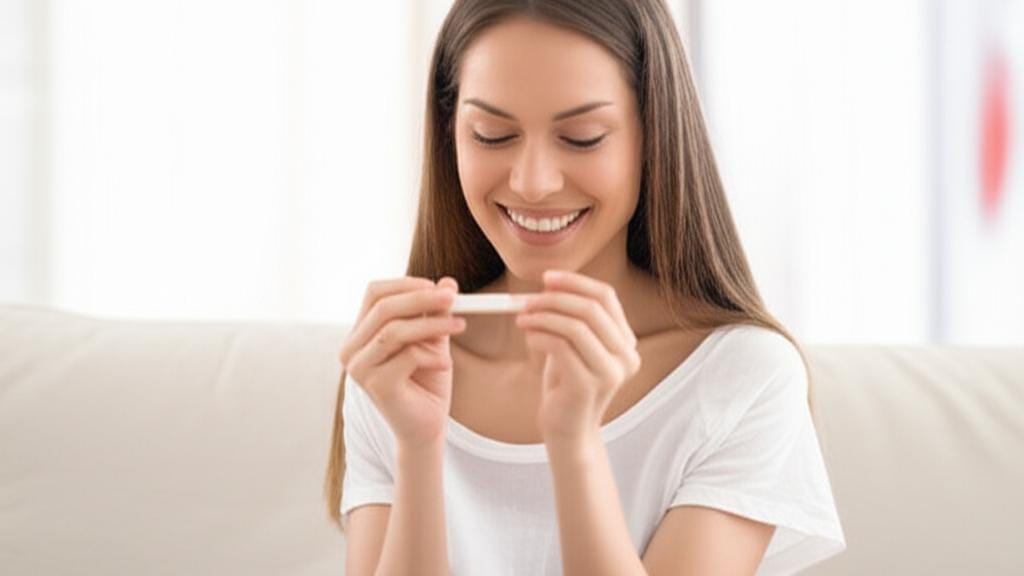
Are you and your partner hoping to welcome a baby into your family soon? If you are actively trying to conceive, you likely know how important it is to find your most fertile days each month.
Trying to guess your fertile window without any tools can feel stressful and confusing. Fortunately, there is a simple, affordable tool you can use right at home. It is called an ovulation test, and it acts very much like a home pregnancy test.
Understanding how to use an ovulation test correctly can take the guesswork out of family planning. Let us walk through everything you need to know to get clear, accurate results.
Key Takeaways for Your Fertility Journey
- Ovulation tests detect the luteinizing hormone (LH) surge that happens before an egg is released.
- Testing should begin a few days before your expected fertile window based on your cycle length.
- A positive test result means ovulation is likely to occur within the next 24 to 36 hours.
- Always use a dedicated home pregnancy test to confirm pregnancy, rather than relying on ovulation strips.
- Consult your doctor if your cycle is irregular or if you need guidance after several months of trying.
Ovulation days
Know the most suitable date for you to expect a child
What Is an Ovulation Test?
An ovulation test is a simple test you perform at home using a urine sample. It looks for specific chemical changes that tell you when your body is preparing to release an egg.
For a pregnancy to happen, one of your ovaries must release a mature egg. Doctors call this process ovulation. Just before ovulation happens, your body releases a rush of luteinizing hormone. Medical experts call this sharp rise in hormone levels an LH surge.
Ovulation test kits are designed specifically to catch that LH surge. When your test turns positive, it tells you that ovulation will likely happen in the next 24 to 36 hours. Having sex during this peak window gives you the highest chance of getting pregnant.
What Is Inside an Ovulation Test Kit?
When you visit your local pharmacy or order online, you will see several brands and types of ovulation tests available. They generally come in two main styles to suit your personal preference.
The first style is paper test strips. These boxes usually contain 20 to 50 small paper strips, a small collection cup, and a clear instruction sheet. They are economical and very popular.
The second style is a plastic test stick. These look very much like standard home pregnancy sticks. Many modern sticks are digital, meaning the screen shows a clear smiley face or words instead of faint colored lines.
Prices vary depending on the brand, the type of kit, and how many test strips are inside. You can find affordable options at most local drugstores and supermarkets worldwide.
When Is the Best Time and Day to Do the Test?
Timing is everything when you want to catch your LH surge. Knowing the length of your menstrual cycle helps you figure out the right day to start testing.
- Regular Cycles: If your monthly cycle consistently lasts between 28 and 32 days, your fertile window usually falls midway. Start testing between cycle day 11 and day 14, counting the first day of your period as day 1.
- Irregular Cycles: If your cycle length changes from month to month, tracking can be tricky. Talk to your doctor to determine the best day to begin testing.
Once you reach your estimated fertile window, test yourself once every day. Try to test around the same time each afternoon for the best consistency.
Important Tip: Avoid drinking large amounts of water or other fluids for about four hours before you test. Drinking too much fluid dilutes your urine. Concentrated urine helps the test detect the luteinizing hormone much more clearly.
How to Do the Test Correctly
Every test kit has slight differences in design. Always read the instruction leaflet inside your specific box before you begin.
Here are the standard steps most home ovulation tests require you to follow:
- Remove the test stick or paper strip carefully from its foil wrapper.
- Hold the absorbent tip directly in your urine stream for five to seven seconds while you use the bathroom. Alternatively, collect urine in a clean, dry cup and dip the strip into the sample for about 15 seconds.
- Place the test stick flat on a clean, dry surface with the display window facing upward. Put the protective cap back on if your kit includes one.
- Wait for the recommended time stated in your instructions, usually between three and five minutes, before reading your result.
Understanding Your Test Results
Test results vary depending on the kit you buy. Some use colored lines. This others use digital symbols.
| Test Result Appearance | What It Means for You |
|---|---|
| Faint Test Line The test line is lighter than the control line. |
Your LH hormone level is still low. Ovulation has not started yet. This is a negative result. |
| Dark Test Line The test line matches or is darker than the control line. |
You have caught your LH surge! Ovulation will happen within 24 to 36 hours. This is a positive result. Time to try for a baby. |
| Digital Smiley Face A blinking or solid smiley face appears on screen. |
This is a positive digital result. Your most fertile days have arrived. |
| Digital Empty Circle A blank circle appears on the digital screen. |
This is a negative result. Your LH surge has not been detected yet. Keep testing daily. |
Can an Ovulation Test Tell If You Are Pregnant?
Many people wonder if an ovulation test can double as an early pregnancy test. This is a very common question.
Ovulation tests are specifically designed to measure luteinizing hormone. Pregnancy tests are designed to measure a different hormone called human chorionic gonadotropin, known as hCG.
Because the chemical structures of these two hormones share some similarities, an ovulation test can sometimes react to high levels of pregnancy hormones. However, you should never rely on an ovulation test to check for pregnancy.
Advantages and Disadvantages of Using This Test
Like all medical and health tools, ovulation tests come with both benefits and limitations worth keeping in mind.
| Advantages | Disadvantages |
|---|---|
| Easy to Use: You can perform the test easily and privately in your own home. | Does Not Guarantee Ovulation: An LH surge happens before ovulation, but rare hormonal conditions mean an egg might not always release. |
| High Accuracy: Quality commercial tests are over 97 percent accurate at detecting LH surges. | Age Factors: Women over 40 or approaching menopause often have elevated baseline LH, which can cause confusing results. |
| Widely Available: You can buy them at any pharmacy without needing a doctor prescription. | Fertility Medicines: Taking certain hormone treatments to boost fertility can interfere with test accuracy. |
| Fast Results: You get clear answers in minutes without complex temperature charting. | Cost Over Time: Testing across several months can become expensive if cycles are long or irregular. |
💡 Take-Home Message
Using an ovulation test is a wonderful, practical way to pinpoint your most fertile days when you are trying to conceive.
- A positive test result means ovulation is coming within 24 to 36 hours, giving you the best window for intimacy.
- If your cycle is irregular or you never see a positive result, do not panic. Schedule a chat with your doctor for guidance.
- Always rely on a standard pregnancy test to confirm whether you have successfully conceived.
When to Call Your Doctor or Seek Emergency Help
While home ovulation testing is routine, you should speak with your doctor if you experience:
- Severe pelvic pain or sudden cramping during your cycle.
- Unusually heavy or painful periods lasting more than seven days.
- Inability to conceive after 12 months of trying (or 6 months if you are over 35).
- Signs of severe infection or high fever. Call 911 (US/Canada) or 999 (UK) or go to your nearest Emergency Department right away if you experience sudden, unbearable abdominal pain, fainting, or heavy bleeding.






No comments yet. Be the first to share your question or experience below.