

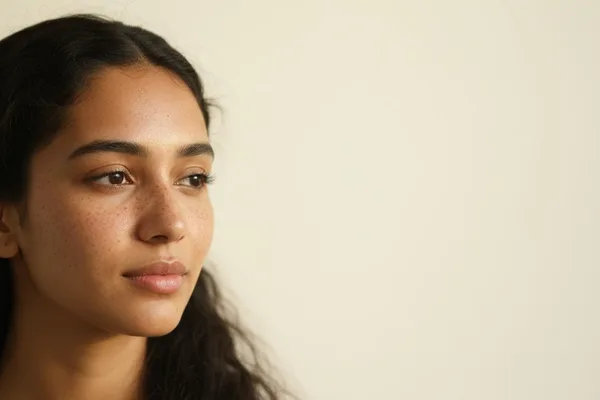
Hello! Have you ever wondered why some people get those little brown spots, or freckles, on their faces and hands? Some people love them, just like in the book "Freckle Juice" we read when we were kids. Some people even try to make freckles. But for others, they are a bit of a nuisance. But it is very important to know exactly what they are, why they occur, and whether they are dangerous or not.
What exactly are freckles?
Simply put, these spots are small, flat, brown spots on your skin. They are very small, sometimes no bigger than half a pea. But sometimes these small spots can grow together and look a little bigger. The most important thing is that these spots are not a disease or anything dangerous. They are just a little bit of pigment cells, called Melanocytes, that give your skin color, in one place.
Our skin is colored by a pigment called `(Melanin). The cells that produce that `(Melanin)` pigment are called `(Melanocytes). So, when these cells produce a little too much `(Melanin)` in some places, we see those spots as blemishes. They are usually light brown in color, but sometimes they can also be red. They are on the surface of the skin, not oval.
Why do only some people get these spots and not everyone?
You might be wondering, "Why is this happening to me alone? Or why does he/she have so many spots?" There are several reasons for this. Let's see what they are.
1. Genetic influence (that is, things that come from heredity)
This is the main reason. If your mother, father, or someone in your family has freckles, you are more likely to develop them too. Some specific genes, for example, the `(MC1R gene)`, have been found to be directly related to the development of these freckles. So this is something that is somewhat difficult for us to control. Just like our height, eye color.
2. Your skin type
Generally, people with very fair skin are more likely to develop freckles. Similarly, people with light-colored eyes (blue, green, gray) and red or light brown hair are more likely to see them. The reason is that the amount of `(Melanin)` naturally present in the skin of such people is low. `(Melanin)` is like a shield that protects our skin from the sun. So when that shield is weakened, freckles form in response to the sun.
3. Exposure to sunlight
This is also a very important factor. If you spend a lot of time in the sun, there is a high chance that new spots will form and existing ones will become darker. The harmful rays in the sun, especially `(UV rays)`, stimulate the cells called `(Melanocytes)` in our skin. Then those cells produce more `(Melanin).` However, in people with fair skin, this `(Melanin)` production is not spread evenly over the entire skin, but accumulates in small spots in places. That is how spots and blemishes are formed.
Think about it, when we go out in the sun, some people's skin gets a nice `(tan)`, right? That means the entire skin turns brown in a way. But for people with fair skin, that doesn't happen, and the skin color changes in spots and spots. It's like the skin is creating little `(Melanin)` umbrellas in different places.
Freckles and sunlight - a little more detail
We now know that sun exposure increases the risk of freckles. The UV-B rays in the sun are the main cause of these freckles. So, if you have freckles on your skin, it is a good indication that your skin has been exposed to the sun. It means that your skin is trying to protect itself from the sun's rays.
These common spots (also called ``Ephelides'' in medical science) tend to become darker during the sunny season and fade a little during the winter, when there is less sunlight. Often, when young children come home from playing in the sun, you can see that their faces have become more freckles, right? That's what it is. But some people's spots may remain the same throughout the year.
Do freckles change over time?
Yes, scars can undergo some changes over time.
- During the sunny season: The skin becomes darker, and new spots may appear.
- In winter: (due to less sunlight) they become lighter in color, and some may even disappear.
- As you age: Many people notice that their age spots gradually diminish and fade. This may be because the activity of the skin cells (melanocytes) decreases slightly as we age.
Are these spots dangerous? How can you tell them apart from other types of skin spots?
This is the biggest problem that many people have. No, these common spots (freckles) are not dangerous at all. They are not cancerous or a sign of any other serious disease. So there is no reason to be afraid.
However, not all spots on the skin are ``freckles.`` There are other types of spots that we should be aware of.
- Moles (or Nevi): These are usually darker than freckles and may be raised above the skin. They can be present at birth or develop later. Although most warts are not dangerous, it is important to seek medical advice if any of them change in shape, color, or size, or if they itch or bleed. This is because, very rarely, some warts can turn into skin cancer.
- Solar Lentigines (Age Spots/Liver Spots): These are a type of spot that usually develops in adulthood, due to years of sun exposure. They are slightly larger than ``Freckles'', have a different shape, and are darker in color. These are also not dangerous, but they can sometimes be confused with the early signs of skin cancer, so it is best to show them to a doctor if you have any doubts.
Most importantly: If you have any doubts about a mole on your skin, such as if it suddenly gets bigger, changes color, changes shape, has irregular edges, itches, or bleeds, see a dermatologist right away. It's the safest thing to do. Don't panic, but it's wise to get it checked out.
How to care for blemished skin?
Although sun spots are not dangerous, they do indicate that your skin is sensitive to the sun. Therefore, it is very important to protect your skin. Because prolonged exposure to the sun can cause premature aging of the skin and lead to serious conditions such as skin cancer.
Sun protection is the most important thing!
There are several ways to do this:
1. Sunscreen:
- Be sure to use a ``Sunscreen`` with an SPF (Sun Protection Factor) of 30 or higher. ``SPF 50+`` is even better.
- Choose a sunscreen that says "Broad Spectrum." This means it protects you from both UVA and UVB rays.
- Apply thoroughly 15-20 minutes before leaving the house.
- Reapply every two hours if you sweat, play in the water, or get wet with a towel.
- Apply it not only to your face, but also to any areas exposed to the sun, such as your neck, hands, and ears. It's also a good idea to use a lip balm with SPF on your lips.
2. Protective clothing:
- Wear long-sleeved clothing and long pants as much as possible. Dark, thick fabrics provide more protection from the sun's rays.
- Wear a wide-brimmed hat. This provides good protection for your face, ears, and neck.
- Use sunglasses with `UV protection`. This will protect the delicate skin around the eyes.
3. Go find shade:
- Minimize direct sunlight exposure, especially between 10 a.m. and 4 p.m. This is when the sun's rays are strongest.
- Try to stay in a shady place, like under a tree or an umbrella.
Do I really need to remove my blemishes? Is it a good idea to do so?
Some people may not be very happy with their scars. They may even wonder, "Can't I get rid of these?" In fact, there are cosmetic treatments that claim to reduce or remove scars.
- `(Laser Therapy)` (Laser Therapy)
- Chemical Peels (removing the top layer of skin using chemicals)
- `(Cryosurgery)` (a treatment using extreme cold)
- Some types of cosmetics (e.g., cosmetics containing `(Retinoid)`, serums containing `(Vitamin C)`)
But you should also be aware of these things:
- Some of these treatments are expensive.
- Not all treatments work for everyone. Some people may experience side effects (such as redness, swelling, and scarring).
- The important thing is that even if these treatments remove blemishes, if you don't continue to protect yourself from the sun, you won't be able to stop new blemishes from forming. This means that the treatment may be temporary.
So, rather than removing blemishes, the best thing to do is to learn to live with them and take care of your skin's health. Beauty is not a one-size-fits-all thing. Those little spots on your skin may be your unique beauty. They are part of your identity.
Please, don't make fun of freckles!
This is a very important thing. Sometimes, out of ignorance or for fun, we make fun of other people's appearance. But when someone makes fun of someone with blemishes, it can be very upsetting, especially for young children. It can also affect their self-confidence. We all need to respect each other and be kind. Avoid saying things that hurt someone's feelings. Everyone is beautiful in their own way.
Some of the most important messages to take home
Okay, so I hope you can remember some important points from what we've talked about.
- Freckles are a type of small, harmless spot that forms on the skin.
- These are mainly caused by genetic factors and sun exposure.
- Having spots and blemishes is neither a disease nor something to be afraid of.
- However, having spots means that your skin is sensitive to the sun. Therefore, it is very important to protect yourself from the sun. Make it a habit to apply sunscreen, wear hats, and stay in the shade.
- The blemishes on your skin are part of your identity. Don't worry about them.
- If you notice a change in a spot on your skin (size, shape, color), if there is any itching or bleeding, be sure to seek medical advice.
So, if you have blemishes too, look at them with love, and don't forget to take good care of your skin!
` keyword1: Freckles keyword2: Freckles keyword3: Skin health keyword4: Sunlight keyword5: Sunscreen keyword6: Melanin keyword7: Skin protection




💬 Comments (0)
No comments yet. Be the first to share your thoughts here.
Add Your Comment