
Is this the cause of your hiccups? Let's talk about the diaphragm!

Is this the cause of your hiccups? Let's talk about the diaphragm!

Have you ever had the hiccups? Those insufferable, sometimes laughable hiccups? Don't worry, they're normal. Most of the time, it's down to a surprising, but often overlooked, part of your body. Today, we're going to talk about a hidden hero inside our bodies that's essential to both our hiccups and our ability to breathe. That's the diaphragm , or diaphragm .
What is the diaphragm? Where is it located?

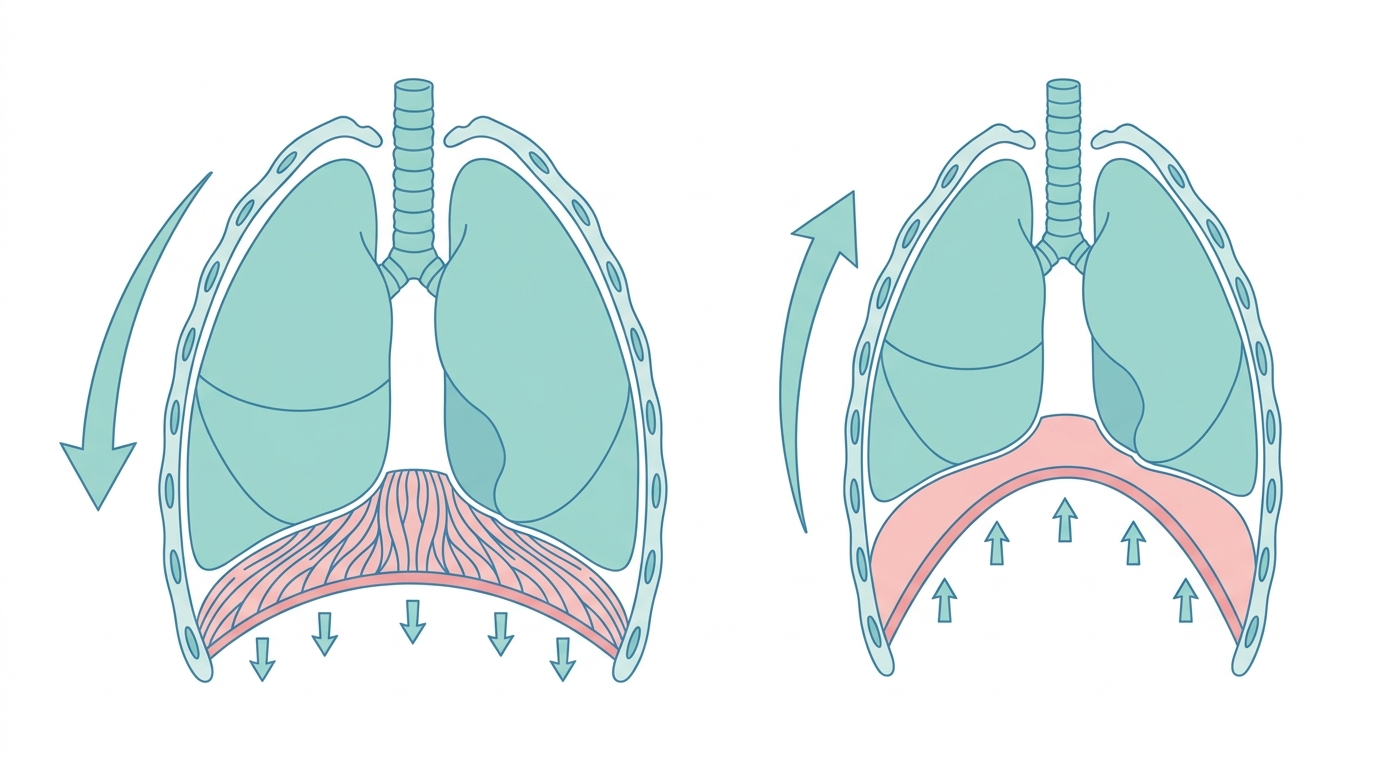
Simply put, the diaphragm is a strong, flap-like muscle that separates our chest cavity (what we call the thoracic cavity) from our abdominal cavity (what we call the abdominal cavity ). Think of it as a thin, dome- shaped piece of muscle between your chest and your stomach. It's located just below your lungs, above your abdominal organs like your liver and stomach. It's a very special muscle, because without it, we couldn't breathe.

The main function of the diaphragm is breathing.

Now look at how important this diaphragm is. Our main job, that is, to breathe , is indispensable. Think of a syringe. Just as medicine comes in when we pull the back of the syringe, air comes into the lungs when the diaphragm moves down.

Inhalation

When you inhale, this muscle called the diaphragm contracts . It loses its upward curve and flattens out, or rather, goes down. This increases the space inside the chest cavity. This allows the lungs to expand, and the pressure inside the lungs decreases, allowing air from outside to flow into the lungs through the nose. Isn't this process amazing?

Exhalation

When you exhale, the opposite happens. The diaphragm muscle relaxes and relaxes . It then rises back up and returns to its curved shape. This reduces the space in the chest cavity, compresses the lungs, and increases the pressure inside the lungs, forcing the air (often carbon dioxide ) out. This happens naturally most of the time, without us having to exert much effort.

How do hiccups occur? The relationship between the diaphragm and hiccups

Okay, now let's get back to hiccups. What are these hiccups? Why is it caused by the diaphragm?

Hiccups are a sudden, uncontrolled contraction of the diaphragm, like a spasm.Something like that. It's like a muscle suddenly contracting. When the diaphragm suddenly contracts and goes down, air rushes into the lungs. At the same time, a small flap over our vocal cords (we call it the epiglottis) suddenly closes. That's when that 'hiccup' sound comes out. Think of it like the sound a door makes when it suddenly closes.

Things that can cause hiccups:

Here are some things that can cause hiccups:

  • Eating quickly, eating a lot at once.
  • Drinking fizzy drinks.
  • Eating/drinking something hot or cold suddenly.
  • Sometimes it can happen when you laugh out loud or when you're upset.
  • People who smoke and drink alcohol are also more likely to get hiccups.
  • It may also be due to some medications.

Should you be afraid of hiccups?

Hiccups usually go away in a few minutes, sometimes a few hours. There is nothing to worry about. However, if hiccups persist for more than two days (48 hours) , or if they occur frequently and severely, it may be a sign of another medical condition. In such cases, it is best to seek medical advice.

Does the diaphragm have other functions besides breathing?

Breathing is the main function of the diaphragm. But this muscle helps us in other ways. It's a lot more than you might think!

  • Coughing and sneezing : When we cough or sneeze, the diaphragm contracts suddenly, helping to expel air from the lungs. This is what expels unwanted substances and germs from the respiratory tract.
  • Vomiting and defecating: When we vomit or defecate, the diaphragm also helps increase the pressure in the stomach. This is why these things come out easily.
  • Speaking and Singing: The diaphragm is important for controlling our breathing when we speak and sing. This muscle also requires strength for that.
  • Core stability: This indirectly helps keep our spine straight and our core strong.
  • Esophagus and diaphragm: The tube that carries food from our throat to our stomach, the esophagus , connects to our stomach through the diaphragm. There is a special hole in the diaphragm called a hiatus . Sometimes, part of the stomach can protrude through this hole. We call it a hiatal hernia .

Other problems that may occur with the diaphragm

In addition to hiccups, there are other health problems that can occur related to the diaphragm. It's good to know a little about these as well.

  • Diaphragmatic paralysis: If the nerve that controls the diaphragm, the phrenic nerve , is damaged, the diaphragm may not function properly. One or both sides may become paralyzed. This can cause difficulty breathing , fatigue, and chest pain.
  • Hiatal Hernia: As I mentioned earlier, part of the stomach pushes through a hole in the diaphragm into the chest. This can cause chest pain ( like heartburn ), a feeling of being stuck in a lump, and food can come up.
  • Diaphragmatic flutter / Myoclonus: This is a condition in which the diaphragm beats rapidly and irregularly. This can cause shortness of breath and chest pain . This is a rare condition.
  • Referred Pain: Sometimes shoulder pain can be caused by a problem with the diaphragm. Because the nerves to the diaphragm and shoulder start from the same place, the brain cannot pinpoint where the pain is coming from.

How to keep our diaphragm healthy? What is diaphragmatic breathing?

It's important to keep this important muscle of ours healthy. One of the best ways to do this is to practice diaphragmatic breathing , also known as 'belly breathing .'

Advantages of diaphragmatic breathing:

  • Reduces stress and relaxes the mind.
  • Helps the body absorb more oxygen .
  • It can help control blood pressure.
  • Helps make breathing easier for people with respiratory diseases (e.g. asthma, COPD).
  • Increases the efficiency of the entire respiratory system.

How to do it? (Simple method):

1. Sit comfortably in a chair or lie down on a bed. Keep your back straight.

2. Place one hand on your chest and the other on your stomach (more precisely, slightly above your rib cage, where the diaphragm is).

3. Breathe in slowly through your nose. As you breathe, try to keep your chest as still as possible, and breathe in such a way that only the hand on your stomach comes forward (inflates your stomach). This means that you are pushing your diaphragm down and filling your stomach with air. Breathe in for a mental count of four.

4. Hold your breath for a while (1-2 seconds if possible).

5. Then slowly exhale through your mouth (pursing your lips like a trumpet). You should feel your stomach go in. Breathe out slowly for a mental count of six or eight.

6. It is very good to do this for about 5-10 minutes a day, two or three times a day.

"This may seem a little difficult at first, but once you get used to it, it's very easy. Have you ever seen a baby breathe? They breathe from their stomachs. That's how it is."

When should you see a doctor?

There's no need to rush to the doctor for a simple hiccups. However, it's wise to seek medical advice in cases like these:

  • If the hiccups last more than two days (`48 hours`), or if they are frequent and severe.
  • If hiccups are accompanied by difficulty breathing, chest pain, or heaviness.
  • If you have hiccups with difficulty swallowing food.
  • If you have difficulty breathing for no reason, or feel tired even after walking for a short while (this may be due to a weakness in the diaphragm).
  • If you experience frequent heartburn and feel like food is coming up (this could be a symptom of a Hiatal Hernia).
  • If you feel like you are suffocating in your sleep.

What to remember from what we talked about (Take-Home Message)

So, you probably understand now that the diaphragm is a small but very important muscle in our body. It is not just for hiccups, but for the most important thing we do to live, breathing, and many other things. Therefore, let's take care of the diaphragm and keep it healthy. Practicing simple things like diaphragmatic breathing can bring us great health benefits. If you have any difficulties or doubts, never be afraid to see a doctor and seek advice. Stay healthy!

👩🏽‍⚕️ Additional questions (FAQs)

💬 What organ in our body is the diaphragm?

This is a large piece of muscle that goes up and down between the lungs and the stomach. It is this diaphragm that helps the lungs when we breathe in and out.

💬 How does this diaphragm contribute to hiccups?

If, for some reason, this diaphragm suddenly spasms, our body suddenly draws in a little breath. When that spasm occurs, the larynx in the throat closes, which is why the 'hiccup' sound is made.

💬 Why do hiccups occur when you eat too fast or when you eat too much?

When we eat, a large amount of air goes into the stomach along with the food, causing the stomach to become very large. When the stomach becomes large, it hits the diaphragm directly above it, causing the diaphragm to spasm and we start to get hiccups.


` Diaphragm, Hiccups, Breathing, Respiration, Muscles, Lungs, Diaphragmatic breathing, Hiatal Hernia

⚠️ Important: The medical articles and information on Nirogi Lanka are for general awareness only, and are by no means a substitute for professional medical advice, diagnosis, or treatment. For any medical problem you have, consult a qualified physician immediately.

💬 Comments (0)

No comments yet. Be the first to share your thoughts here.

Add Your Comment

Please calculate: 6 + 3 =
Is this the cause of your hiccups? Let's talk about the diaphragm!
Root of the MatterMarch 31, 2026

Is this the cause of your hiccups? Let's talk about the diaphragm!

Have you ever had the hiccups? Those insufferable, sometimes laughable hiccups? Don't worry, they're normal. Most of the time, it's down to a surprising, but often overlooked, part of your body. Today, we're going to talk about a hidden hero inside our bodies that's essential to both our hiccups and our ability to breathe. That's the diaphragm , or diaphragm .

What is the diaphragm? Where is it located?

Simply put, the diaphragm is a strong, flap-like muscle that separates our chest cavity (what we call the thoracic cavity) from our abdominal cavity (what we call the abdominal cavity ). Think of it as a thin, dome- shaped piece of muscle between your chest and your stomach. It's located just below your lungs, above your abdominal organs like your liver and stomach. It's a very special muscle, because without it, we couldn't breathe.

The main function of the diaphragm is breathing.

Now look at how important this diaphragm is. Our main job, that is, to breathe , is indispensable. Think of a syringe. Just as medicine comes in when we pull the back of the syringe, air comes into the lungs when the diaphragm moves down.

Inhalation

When you inhale, this muscle called the diaphragm contracts . It loses its upward curve and flattens out, or rather, goes down. This increases the space inside the chest cavity. This allows the lungs to expand, and the pressure inside the lungs decreases, allowing air from outside to flow into the lungs through the nose. Isn't this process amazing?

Exhalation

When you exhale, the opposite happens. The diaphragm muscle relaxes and relaxes . It then rises back up and returns to its curved shape. This reduces the space in the chest cavity, compresses the lungs, and increases the pressure inside the lungs, forcing the air (often carbon dioxide ) out. This happens naturally most of the time, without us having to exert much effort.

How do hiccups occur? The relationship between the diaphragm and hiccups

Okay, now let's get back to hiccups. What are these hiccups? Why is it caused by the diaphragm?

Hiccups are a sudden, uncontrolled contraction of the diaphragm, like a spasm.Something like that. It's like a muscle suddenly contracting. When the diaphragm suddenly contracts and goes down, air rushes into the lungs. At the same time, a small flap over our vocal cords (we call it the epiglottis) suddenly closes. That's when that 'hiccup' sound comes out. Think of it like the sound a door makes when it suddenly closes.

Things that can cause hiccups:

Here are some things that can cause hiccups:

  • Eating quickly, eating a lot at once.
  • Drinking fizzy drinks.
  • Eating/drinking something hot or cold suddenly.
  • Sometimes it can happen when you laugh out loud or when you're upset.
  • People who smoke and drink alcohol are also more likely to get hiccups.
  • It may also be due to some medications.

Should you be afraid of hiccups?

Hiccups usually go away in a few minutes, sometimes a few hours. There is nothing to worry about. However, if hiccups persist for more than two days (48 hours) , or if they occur frequently and severely, it may be a sign of another medical condition. In such cases, it is best to seek medical advice.

Does the diaphragm have other functions besides breathing?

Breathing is the main function of the diaphragm. But this muscle helps us in other ways. It's a lot more than you might think!

  • Coughing and sneezing : When we cough or sneeze, the diaphragm contracts suddenly, helping to expel air from the lungs. This is what expels unwanted substances and germs from the respiratory tract.
  • Vomiting and defecating: When we vomit or defecate, the diaphragm also helps increase the pressure in the stomach. This is why these things come out easily.
  • Speaking and Singing: The diaphragm is important for controlling our breathing when we speak and sing. This muscle also requires strength for that.
  • Core stability: This indirectly helps keep our spine straight and our core strong.
  • Esophagus and diaphragm: The tube that carries food from our throat to our stomach, the esophagus , connects to our stomach through the diaphragm. There is a special hole in the diaphragm called a hiatus . Sometimes, part of the stomach can protrude through this hole. We call it a hiatal hernia .

Other problems that may occur with the diaphragm

In addition to hiccups, there are other health problems that can occur related to the diaphragm. It's good to know a little about these as well.

  • Diaphragmatic paralysis: If the nerve that controls the diaphragm, the phrenic nerve , is damaged, the diaphragm may not function properly. One or both sides may become paralyzed. This can cause difficulty breathing , fatigue, and chest pain.
  • Hiatal Hernia: As I mentioned earlier, part of the stomach pushes through a hole in the diaphragm into the chest. This can cause chest pain ( like heartburn ), a feeling of being stuck in a lump, and food can come up.
  • Diaphragmatic flutter / Myoclonus: This is a condition in which the diaphragm beats rapidly and irregularly. This can cause shortness of breath and chest pain . This is a rare condition.
  • Referred Pain: Sometimes shoulder pain can be caused by a problem with the diaphragm. Because the nerves to the diaphragm and shoulder start from the same place, the brain cannot pinpoint where the pain is coming from.

How to keep our diaphragm healthy? What is diaphragmatic breathing?

It's important to keep this important muscle of ours healthy. One of the best ways to do this is to practice diaphragmatic breathing , also known as 'belly breathing .'

Advantages of diaphragmatic breathing:

  • Reduces stress and relaxes the mind.
  • Helps the body absorb more oxygen .
  • It can help control blood pressure.
  • Helps make breathing easier for people with respiratory diseases (e.g. asthma, COPD).
  • Increases the efficiency of the entire respiratory system.

How to do it? (Simple method):

1. Sit comfortably in a chair or lie down on a bed. Keep your back straight.

2. Place one hand on your chest and the other on your stomach (more precisely, slightly above your rib cage, where the diaphragm is).

3. Breathe in slowly through your nose. As you breathe, try to keep your chest as still as possible, and breathe in such a way that only the hand on your stomach comes forward (inflates your stomach). This means that you are pushing your diaphragm down and filling your stomach with air. Breathe in for a mental count of four.

4. Hold your breath for a while (1-2 seconds if possible).

5. Then slowly exhale through your mouth (pursing your lips like a trumpet). You should feel your stomach go in. Breathe out slowly for a mental count of six or eight.

6. It is very good to do this for about 5-10 minutes a day, two or three times a day.

"This may seem a little difficult at first, but once you get used to it, it's very easy. Have you ever seen a baby breathe? They breathe from their stomachs. That's how it is."

When should you see a doctor?

There's no need to rush to the doctor for a simple hiccups. However, it's wise to seek medical advice in cases like these:

  • If the hiccups last more than two days (`48 hours`), or if they are frequent and severe.
  • If hiccups are accompanied by difficulty breathing, chest pain, or heaviness.
  • If you have hiccups with difficulty swallowing food.
  • If you have difficulty breathing for no reason, or feel tired even after walking for a short while (this may be due to a weakness in the diaphragm).
  • If you experience frequent heartburn and feel like food is coming up (this could be a symptom of a Hiatal Hernia).
  • If you feel like you are suffocating in your sleep.

What to remember from what we talked about (Take-Home Message)

So, you probably understand now that the diaphragm is a small but very important muscle in our body. It is not just for hiccups, but for the most important thing we do to live, breathing, and many other things. Therefore, let's take care of the diaphragm and keep it healthy. Practicing simple things like diaphragmatic breathing can bring us great health benefits. If you have any difficulties or doubts, never be afraid to see a doctor and seek advice. Stay healthy!

👩🏽‍⚕️ Additional questions (FAQs)

💬 What organ in our body is the diaphragm?

This is a large piece of muscle that goes up and down between the lungs and the stomach. It is this diaphragm that helps the lungs when we breathe in and out.

💬 How does this diaphragm contribute to hiccups?

If, for some reason, this diaphragm suddenly spasms, our body suddenly draws in a little breath. When that spasm occurs, the larynx in the throat closes, which is why the 'hiccup' sound is made.

💬 Why do hiccups occur when you eat too fast or when you eat too much?

When we eat, a large amount of air goes into the stomach along with the food, causing the stomach to become very large. When the stomach becomes large, it hits the diaphragm directly above it, causing the diaphragm to spasm and we start to get hiccups.


` Diaphragm, Hiccups, Breathing, Respiration, Muscles, Lungs, Diaphragmatic breathing, Hiatal Hernia

⚠️ Important: The medical articles and information on Nirogi Lanka are for general awareness only, and are by no means a substitute for professional medical advice, diagnosis, or treatment. For any medical problem you have, consult a qualified physician immediately.

💬 Comments (0)

No comments yet. Be the first to share your thoughts here.

Add Your Comment

Please calculate: 6 + 3 =