

You must be constantly concerned about your little one's growth and development, right? Sometimes children may have certain developmental differences or health problems that are different from other children. This is when we need to be aware of a pediatric endocrinologist . Don't worry, let's talk about this simply.
Who is this Pediatric Endocrinologist?
Simply put, this is a doctor who specializes in hormone-related diseases in infants, toddlers , and young children . Just as adults have a hormone specialist, there is a separate specialist for children. This is because children's bodies are very different from adults' bodies, and so are their hormones.
So, what are these hormones?
Think of it this way: hormones are little messengers inside our bodies. They are produced by various glands in our bodies, travel through the bloodstream, and give instructions to different parts of the body, such as "do this" and "stop that."
For example, these hormones are responsible for many things, such as growing taller, getting bigger, losing weight, going through puberty, controlling our emotions , digesting food, and sleeping.
If these hormones do not work properly, many functions in the body can be disrupted.
What is the Endocrine System?
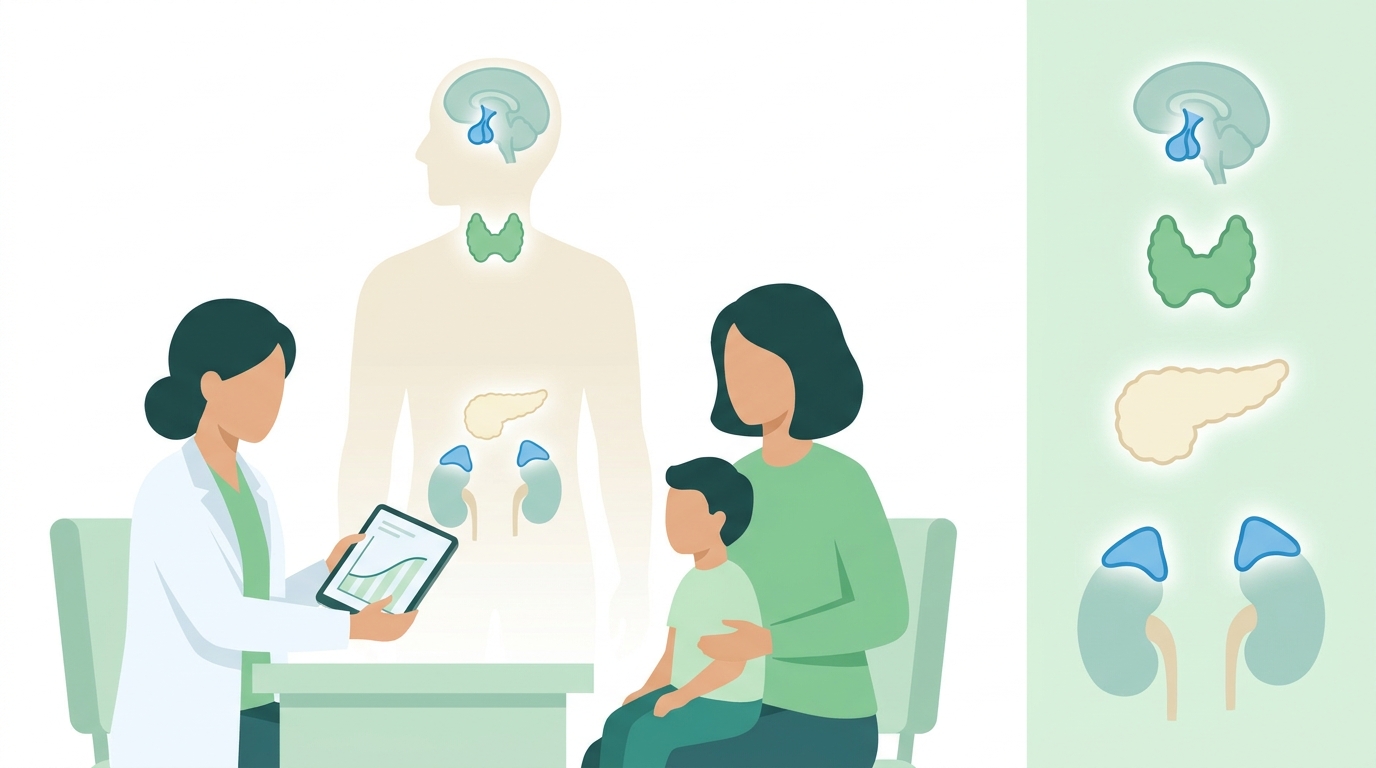
The endocrine system is the system that is formed when all these hormone-producing glands in our body come together. This mainly includes glands like the Thyroid Gland , Pituitary Gland , Adrenal Glands, and Pancreas . All these glands are connected to each other and work together like a musical ensemble. If one instrument is not playing properly, the whole song will be distorted.
What kind of illnesses does a pediatric hormone specialist help with?
A pediatric hormone specialist treats many hormone-related problems that affect children. Let's look at some of the main ones:
- Diabetes Mellitus:
- You probably know about diabetes. Children can also develop diabetes. There are two main types.
- Type 1 Diabetes:What happens in this is that the body's production of the hormone insulin is almost completely lost. Insulin is what helps us send the sugar (glucose) in our blood into the cells and create energy. So when insulin is lost, the blood sugar level rises very high. This requires lifelong insulin injections.
- Type 2 Diabetes: This used to only affect adults, but is now also seen in obese children. What happens here is that the body produces insulin, but it cannot use it properly, or the amount produced is not enough.
- Growth Problems:
- Short Stature: If a child is significantly shorter than other children of his or her age, it could be due to a hormonal problem, particularly a deficiency in Growth Hormone.
- Tall Stature: Sometimes children can grow much taller than their age. This can also have hormonal causes.
- Precocious Puberty: If a girl shows signs of puberty (e.g., breast development, genital development, armpit hair) before the age of 8, or a boy before the age of 9, it may be precocious puberty.
- Delayed Puberty: If a girl is not showing signs of puberty by the age of 13 or a boy is not showing signs of puberty by the age of 14, that is also something to look into.
- Thyroid Gland Disorders:
- The thyroid gland is a small, butterfly-shaped gland located at the front of our neck. The hormones it produces are very important for things like our body's metabolism, growth, and brain development.
- (Hyperthyroidism): When the thyroid gland is overactive, it produces too many hormones. The child may become thin, have a fast heart rate, sweat, and become restless.
- Hypothyroidism: When the thyroid gland is not working properly, there is not enough hormone. This can cause stunted growth, constipation, dry skin, and excessive sleepiness. Newborns can also be affected by this condition, which is why babies are screened for thyroid problems after birth.
- Adrenal Gland Problems:
- These are two glands that look like two caps on top of our kidneys. They produce several hormones that are essential for life. For example, hormones that help us cope with stress , and hormones that control salt and water levels. Problems can arise if these glands are overactive or underactive.
- Pituitary Gland Problems:
- Although this is a small gland located under our brain, it is also called the "Master Gland". Because it controls many other hormonal glands. Many important hormones, such as growth hormone and thyroid stimulating hormone, are produced here. So if there is a problem with this, a lot of things can go wrong.
- Disorders of Sex Development (DSD):
- Sometimes a child's genitals may not develop normally. Or they may look like a girl, but have male characteristics on the inside. Pediatric hormone specialists also treat such complex conditions. These are very sensitive matters, so expert help is essential.
- Calcium and Bone Disorders:
- Calcium and Vitamin D are very important for keeping our bones strong. Deficiencies in these can cause bones to become weak and brittle, especially in young children. An example is a disease called Rickets . Hormones secreted by the parathyroid glands are also involved in this.
- Hormone-related Obesity:
- Not all obesity is caused by hormones. But sometimes, children can become overweight due to hormonal imbalances.
- Low blood sugar (Hypoglycemia):
- Low blood sugar levels are also a dangerous condition, especially for young babies. This can also have hormonal causes.
How do you know if your child needs to see a pediatric hormone specialist?
Your child's pediatrician will be the first to suspect something like this and refer you to a pediatric hormone specialist if necessary. However, as a parent, it's a good idea to be aware of these symptoms:
- Growth is either too low or too high (compared to other children of the same age).
- If you are showing signs of early or delayed puberty .
- Drinking a lot of water and urinating frequently (these can be symptoms of diabetes).
- If you lose or gain weight for no reason .
- If you always seem overly tired, or if you are overactive and restless.
- If your newborn baby has jaundice that lasts more than two weeks (this may be a sign of a thyroid problem).
- If there is any abnormality in the appearance of the genitals .
- If you frequently break bones (especially from minor accidents).
- If anyone in the family has hormone-related diseases (e.g. diabetes, thyroid disease).
Remember, don't panic just because you have one or two of these symptoms. However, if you have any concerns, it's best to talk to your pediatrician.
What happens when you go to see a doctor?
When you see a pediatric hormone specialist, the doctor will first ask you and your child (if the child can talk) a lot of questions.
- About the child's health history.
- About illnesses in the family.
- About the child's growth, eating, and habits.
- Ask for details about the symptoms you are experiencing.
After that, the doctor will examine the child carefully. They will measure height and weight. They may also check sexual development (this is done with the support of the parents, so that the child does not feel uncomfortable at this time).
Next, you may be asked to do some blood tests . These check things like hormone levels and sugar levels. Sometimes, you may also need urine tests , X-rays (especially an X-ray of the arm to check the age of the bones), or scans (CT scan, MRI scan) .
All this is done to find out exactly what the problem is.
What is the importance of these treatments?
Since hormones control many important things in our bodies, it is very important to get the right treatment as soon as possible if there is a problem related to this. Otherwise, there may be long-term effects on the child's growth, intelligence, and future health.
But the good news is that there are now effective treatments for many hormonal disorders. Some may require pills, some injections, and some may require lifestyle changes (diet, exercise).
Finally, things to remember (Take-Home Message)
- A pediatric endocrinologist is a specialist who treats hormone-related problems in children.
- If you think your child's growth, puberty, or other health problems may be related to hormones, don't be afraid to talk to your pediatrician.
- Early diagnosis and initiation of appropriate treatment go a long way in helping the child live a healthy, happy life.
- When dealing with situations like this, you as a parent may also need support. Talk openly with the doctor, ask questions, and share what's on your mind.
Remember, you are not alone. Doctors are always with you to give the best to your child.
` Pediatric Hormones, Pediatric Endocrinologist, Diabetes, Growth, Thyroid, Puberty, Hormonal Diseases
Doctor's Note
A pediatric endocrinologist is a doctor who specializes in the development, sexual maturity, and hormonal conditions of children. Hormones are chemical messengers in the body that affect growth, weight control and metabolism. The help of this doctor is needed in cases of short stature, diabetes (Type 1 Diabetes), thyroid gland problems or premature puberty (Precocious puberty).
❓ Some more questions you may encounter (FAQ)
What problems do you see a Pediatric Endocrinologist for?▼
The doctor is seeing the child for not growing in height for his age, the child has diabetes (Type 1 Diabetes), and hormonal imbalances.
Is early puberty in children a hormonal problem?▼
Yes, children may experience precocious puberty due to earlier-than-normal sex hormone activation and may require hormone therapy.
How are hormone tests performed?▼
Generally, blood tests measure the levels of various hormones and glands in the body.


💬 Comments (0)
No comments yet. Be the first to share your thoughts here.
Add Your Comment