
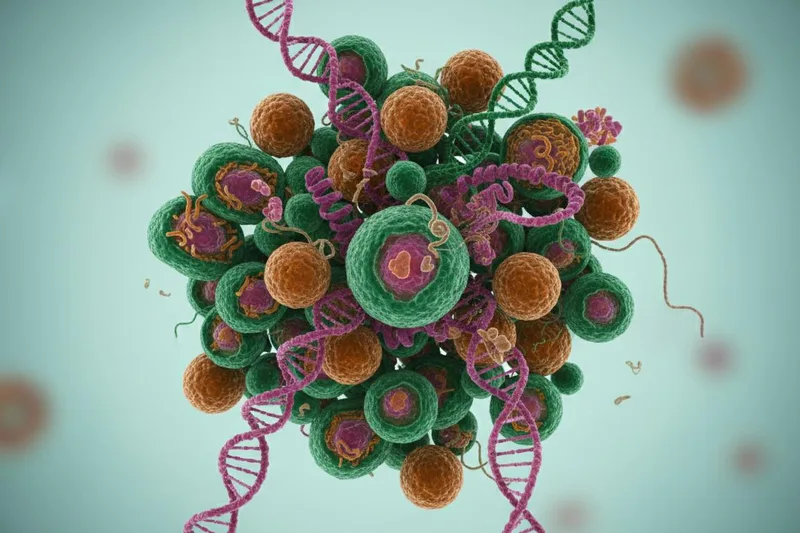
Have you ever thought about an amazing device that can see the smallest things that our eyes cannot see? That's what this microscope is called. It's like a very powerful magnifying glass. This is an indispensable thing for our doctors or scientists. Let's talk about this amazing device today.
What is a microscope, simply put?
Simply put, a microscope is a device that helps us see very small things, things that are too small for our eyes to see, very large and clearly. Imagine that you have a super-powered magnifying glass. That's what this is like. But it can magnify things thousands of times, maybe hundreds of thousands of times, even smaller.
Even the smallest cell inside our body (the basic building block of our body) or even a tiny organism in a drop of water can be seen beautifully with this. So, a microscope is an indispensable friend to learn about the smallest things in this world that are a mystery to our eyes and to discover their secrets. With the advancement of science, this instrument has also improved a lot.
Why is the microscope so important to medicine?
Now you might be thinking, "Okay, it makes small things look bigger. So what's the use of that for doctors?" Actually, a microscope is not just a tool. It's like a doctor's third eye . You know what? Our bodies are made of, and we often get sick because of small things that our eyes can't see.
Imagine, our body is like a big house made of millions of tiny bricks. These tiny bricks are what we call cells . As long as these cells are healthy, we are healthy. But if there is any change in these cells, if they develop any disease, then that is when we also develop disease. So, to find the changes in these cells and the symptoms of diseases, a microscope is indispensable.
Not only that, we also use it to identify small organisms like bacteria , viruses (some large viruses can be seen with these, but most viruses require electron microscopes), and fungi . We can see exactly what damage they do to our bodies. That is why it is very helpful in making an accurate diagnosis.
What diseases can be detected with a microscope?
Using a microscope, we can find out information about many diseases. Let's see what the main ones are.
Testing Blood Samples
Have you ever had a blood test? Most often, a portion of the blood sample is examined under a microscope. This is called a peripheral blood film test.
- Red Blood Cells: These are the cells that carry oxygen throughout our bodies. You can check their size, shape, and color to see if you have anaemia . Some genetic conditions, such as thalassemia, can also cause specific changes in red blood cells.
- White Blood Cells: These are like the soldiers in our body. They fight disease. If the number and type of these (e.g. Neutrophils, Lymphocytes) changes, it can give a clue about infections ( bacterial, viral infections) and possibly even blood cancers like leukemia .
- Platelets: Small cell fragments that help blood clot. If these are low, bleeding can occur. These are especially important in diseases like dengue .
- Sometimes parasites in the blood, for example the Plasmodium parasite that causes malaria , or the worms that cause filariasis, can be found under a microscope.
Tissue Samples (Biopsy) Testing
Have you ever heard of the word 'biopsy'? It means that when there is a suspicion of a disease somewhere in our body (e.g. skin, tumor, internal organ), a small piece of tissue is taken from that area and examined under a microscope. This is very important for diagnosing cancer .
Cancer cells are cells that behave differently and look different from healthy cells. So, by looking at these cells under a microscope, we can find out a lot of important information, such as whether it is cancer or some other problem (e.g., an infection, swelling), and if it is cancer, what type it is, how severe it is, and how far it has spread. We call the specialists who perform these tests pathologists . They are the ones who understand the secrets of this microscopic world and tell us about the disease. For example, in the Pap smear test, which is done to detect cervical cancer in women, the cells are also examined under a microscope.
Identifying germs that cause disease
By examining samples of mucus, urine, feces, and pus from wounds under a microscope, it is possible to determine whether they contain disease-causing organisms such as bacteria , fungi , and some parasites .
Imagine you have a cough, and they take some phlegm and test it. If they look at it under a microscope and find that it contains a specific bacteria (e.g., the bacteria that cause tuberculosis), it will be easier for the doctor to prescribe the right medicine. Or sometimes, when a skin disease develops, a microscope can help to know exactly whether it is a fungal infection or something else. In the case of urine infections, a urine sample is also checked for bacteria and pus cells. The branch of medicine that does these tests is called microbiology .
How do doctors use this microscope?
Now you might be wondering, how do you do this and what do you do? This is a bit of a complicated process, but there are people who have received special training to do it.
1. Obtaining the sample: First, the material to be tested (such as blood, urine, a piece of tissue, or sputum) is obtained from the patient.
2. Preparing the Slide: Next, the sample is placed on a specially prepared thin piece of glass (we call this a slide) and sometimes stained with special colors . These colors are used to make it easier to see different parts of cells, such as bacteria, when viewed under a microscope. When different parts of cells are seen in different colors, it is easier to see the differences. For example, bacteria can be classified using a Gram stain.
3. Looking through a microscope: Then, the prepared slide is placed on the microscope and viewed through the lenses of different magnification powers. The microscope has lenses of different powers. First, you look at it with low power, and then, if necessary, with high power, to find out exactly what is there.
4. Analysis and Report: Based on what is seen under the microscope, a pathologist or trained medical laboratory technologist analyzes it and creates a report. That report is what your doctor receives to make a decision about your illness.
Are there different types of microscopes?
Yes, there are different types of microscopes. We usually see light microscopes in medical laboratories. These use light to magnify the image. These are good for looking at things like bacteria and cells. There are also more specialized sub-types of these like fluorescence microscopes and phase contrast microscopes.
But to see even smaller things, for example viruses (many types of viruses), very small structures inside cells (organelles), we need even more powerful microscopes. They are called electron microscopes . These use a beam of electrons instead of light. They are very large and expensive, so they are mostly used for specialized research and some complex disease diagnostics. But what helps us to diagnose diseases most of the time is the light microscope that I mentioned earlier.
What you need to know about this
So, the next time your doctor asks you to do a blood test or some other sample test, remember that part of it will probably be looked at under a microscope. That can give the doctor a lot of information about the smallest things inside your body.
This is nothing to be afraid of. A microscope is like a friend who can quickly identify your illness and help you recover quickly.
If you don't understand something in your lab report, be sure to ask your doctor. Don't be afraid to ask, "Doctor, can you explain this to me?" You have every right to be informed about your health. Got it?
Finally, what to remember
Okay, so from what we've talked about today, you can probably understand how valuable and indispensable a microscope is in medicine.
- It allows us to see the smallest things that our eyes cannot see, from cells to bacteria .
- This helps in early detection of many diseases like cancer , infections , and anemia .
- This is a great strength for doctors to give an accurate diagnosis and start the correct treatment accordingly.
- The microscope is like a silent hero in healthcare. The information it provides is often the life-saving tool.
So, the microscope is not just a piece of iron, it is a miracle of science that helps save lives! If you have a little understanding of that, that is the joy of this story.
` Microscope, Cells, Diagnosis, Medical Tests, Pathology


💬 Comments (0)
No comments yet. Be the first to share your thoughts here.
Add Your Comment