

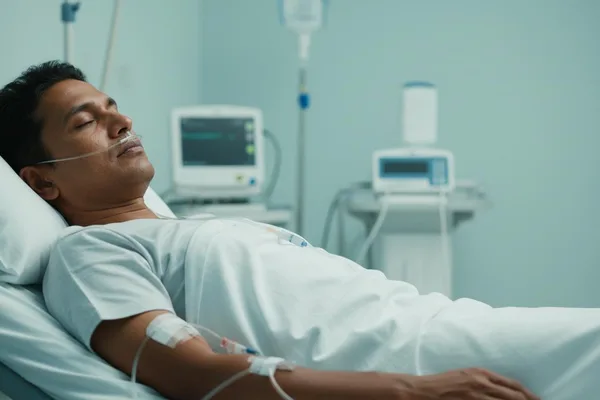
Many of us have seen someone in the intensive care unit (ICU) of a hospital, connected to various machines, breathing through tubes, and feeding through other tubes. When we see these things, we feel a little scared and anxious. We usually refer to this situation as being on 'life support'. When we hear this word, we immediately think of a very serious, critical condition. That's true. But what exactly is this 'life support'? What happens with it? Why is it used? Today, let's talk very simply and cordially about this somewhat sensitive topic that many people have questions about.
Simply put, what is life support?
Think of our body as a complex machine with many different parts that work together. Our lungs breathe, our heart pumps blood, and our kidneys clean it. But what happens if one or more of these organs stop working properly, such as due to a serious illness or an accident? The entire body system can break down.
Life support is the use of an external device, machine, or medical procedure to maintain a function of the body that has stopped functioning. Simply put, it is a way of 'helping' the body do something that it cannot do on its own. This is like giving a car a 'jump start' from another battery when the battery is dead. This helps the body recover and recover.
The important thing is that life support is not a 'medicine' that cures a disease. It is a 'support system' that artificially maintains the body's functions.
This is often temporary. For example, if the lungs are unable to breathe properly due to severe pneumonia, a ventilator may be used for a few days. During this time, antibiotics will be given to help the lungs recover and the lungs will start working on their own again. The ventilator will then be removed.
But sometimes, the body may not be able to function on its own again. Then you have to rely on life support for a long time. Making decisions about this is the most sensitive and difficult thing.
At what times is life support started and stopped?
This is a question that many people have. How are these decisions made? Who has the authority to make them?
Starting life support
Doctors only start life-support treatment if they determine that it is absolutely necessary for the patient's body. That is, if the patient's life could be harmed if that support is not provided at that moment.
However, life support will not be started in cases like these:
- If the patient has refused it: Some people may have an advance directive in which they are informed in advance that they will not be given certain treatments if they become unconscious. Although this is not very common in our country, doctors respect it if the patient has made such a statement while he is conscious.
- If the family refuses on behalf of the patient: If the patient is in a critical condition where they cannot make a decision, his/her closest relatives can make that decision.
- If there is no medical benefit: Sometimes, if the patient is terminally ill, providing life support may only prolong the dying process for a few more days. If it would cause the patient more pain and suffering, and there is no hope of recovery, the doctors and family may decide not to treat the patient.
Stopping life support
This is the most difficult and sensitive decision for anyone. A person can be on life support for weeks, even months. Doctors constantly monitor the patient's condition and explain to the family whether there is any hope of recovery.
Sometimes the body may not fully recover, but if there is a chance that it will return to a level where it can lead a somewhat meaningful life (for example, living a normal life while on dialysis), doctors recommend continuing treatment.
However, in cases where the brain has been severely damaged and there is no chance of regaining consciousness (brain death), doctors may recommend that there is no point in continuing to keep the body alive with machines.
Making the decision to stop treatment at a time like this is a very personal one. Legally and ethically, it is not wrong to stop treatment that does no further good to the patient and prolongs their suffering.
Remember this: When life support is withdrawn, it is not the cessation of treatment that causes death. It is the patient's underlying, incurable condition that causes death. Removing support simply allows for what should happen naturally.
What are the main types of life support?
When we think of 'life support', we often think of a machine that helps us breathe, but it's much broader than that. Anything that helps a process in the body from the outside can be life support. Let's look at some of the main types.
| Support Method | Simply explained |
|---|---|
| Mechanical Ventilation | This is what we call a ventilator. When the lungs are not working properly, this machine pumps air in and out of the lungs. This involves inserting a tube through the mouth or nose into the windpipe (intubation). It is used temporarily after major surgery or in cases of severe lung infections. |
| ECMO (Extracorporeal Membrane Oxygenation) | This is a more advanced method than a ventilator. It involves taking the patient's blood out of the body, using a machine to add oxygen to it, remove carbon dioxide, and pump it back into the body. It is used in very severe cases where both the lungs and heart have failed. |
| Cardiopulmonary Resuscitation (CPR) | CPR is the process of trying to restart someone's heart and breathing when they have stopped. It involves chest compressions, defibrillation, and medication. In cases of sudden cardiac arrest or drowning, providing CPR quickly can save a life. |
| Artificial Nutrition and Hydration | Feeding patients who are unable to eat or drink by mouth through a tube. This tube can be given through the nose into the stomach (tube feeding) or sometimes directly into a vein (TPN - Total Parenteral Nutrition). This is essential to sustain life until the body heals. |
| Kidney Dialysis | When the kidneys fail, they are unable to remove toxins and excess fluid from the body. The dialysis machine removes blood, cleans it, and returns it to the body. It acts as a substitute for the kidneys. It does not cure kidney disease, but it helps to maintain life. |
What are BLS and ALS?
You've probably heard these two words. They're also related to life support.
Basic Life Support (BLS)
These are basic life-saving techniques that anyone can be trained to perform in an emergency. For example:
- Performing CPR when someone has a heart attack and falls unconscious.
- Helping someone with something stuck in their throat.
Anyone can get training in these things. There are times when this knowledge can save a life.
Advanced Life Support (ALS)
This is a step up from BLS. It is performed only by highly trained health professionals like doctors and nurses. In addition to things like CPR,
- Intubation to help with breathing
- Giving special medications to restore heart function
- Treatment by monitoring the heart rhythm
Complex things like this are done. This treatment method for infants and young children is called Pediatric Advanced Life Support (PALS) .
In conclusion, there is no need to be afraid of life support. With the advancement of medical science, it is something that helps save many lives. Also, sometimes it can only prolong the dying process. The most important thing is to talk openly with your doctor about your or your loved one's condition, the treatments being offered, and their pros and cons. Every decision should be made with full understanding and with the consent of the family.
Take-Home Message
- Life support is not a cure for a disease, but a support system that temporarily assists a dysfunctional process in the body.
- This gives the body the time it needs to heal, and can sometimes help save a life.
- However, in cases where there is no hope of recovery, it can unnecessarily prolong the dying process.
- Decisions about starting, continuing, or stopping life support are very personal and sensitive.
- Before making any decisions regarding your or your loved one's condition, talk to your doctor thoroughly and gain a full understanding of the pros, cons, and options.




💬 Comments (0)
No comments yet. Be the first to share your thoughts here.
Add Your Comment