
If you have been researching surgical fixes for stubborn heartburn, you have probably come across the LINX Reflux Management System (Magnetic Titanium Ring): Post-Op Eating Exercises, Solid-Food Dysphagia & 1.5T MRI Rules and wondered why recovery works completely backwards compared to almost every other stomach operation. Be honest—when you hear "food pipe surgery," you automatically picture weeks of clear broths, jelly, and blended soups, don't you? With a magnetic ring implant, we doctors actually ask you to chew real, solid meals starting the very day of your procedure.
Why does chronic acid reflux—known medically as gastroesophageal reflux disease (GERD)—push so many people beyond daily acid-blocking tablets in the first place? Tablets like proton pump inhibitors (PPIs) lower the acid level in your stomach, yet they cannot tighten a loose muscular valve at the bottom of your swallowing tube. If stomach liquid keeps splashing upward into your chest or throat every time you bend over to tie your shoes or lie flat in bed, fixing that mechanical barrier becomes key.
Understanding how this tiny bracelet of magnets behaves inside your chest takes the mystery—and the worry—out of recovery. Let us walk through how the ring stops reflux, why regular bites of food act like physiotherapy for your swallowing muscles, how to handle temporary food sticking, and which strict MRI scanner rules protect your implant for decades to come.
📌 Key Takeaways at a Glance
- Mechanical reflux barrier: The LINX ring wraps around a weak lower esophageal sphincter (LES), using magnetic attraction to hold the valve shut at rest while opening smoothly when you swallow, belch, or vomit.
- Solid food starts Day 1: Eating small, solid bites every 1 to 2 waking hours stretches healing scar tissue around the ring—skipping solid food actually worsens stiffness!
- Peak tightness is temporary: Solid-food swallowing difficulty (dysphagia) commonly peaks between weeks 2 and 8 post-op as a natural tissue capsule forms, then steadily eases by months 3 to 6.
- Check your MRI implant card: Newer blue-card LINX devices are safe only up to 1.5 Tesla (1.5T), older white-card models only up to 0.7 Tesla (0.7T), and 3.0 Tesla (3T) MRI scanners are strictly off-limits.
- Pre-op testing is mandatory: You need strong natural swallowing squeeze confirmed by esophageal manometry before any surgeon can safely place the ring.
What Is the LINX Reflux Management System and How Does the Magnetic Titanium Ring Work?
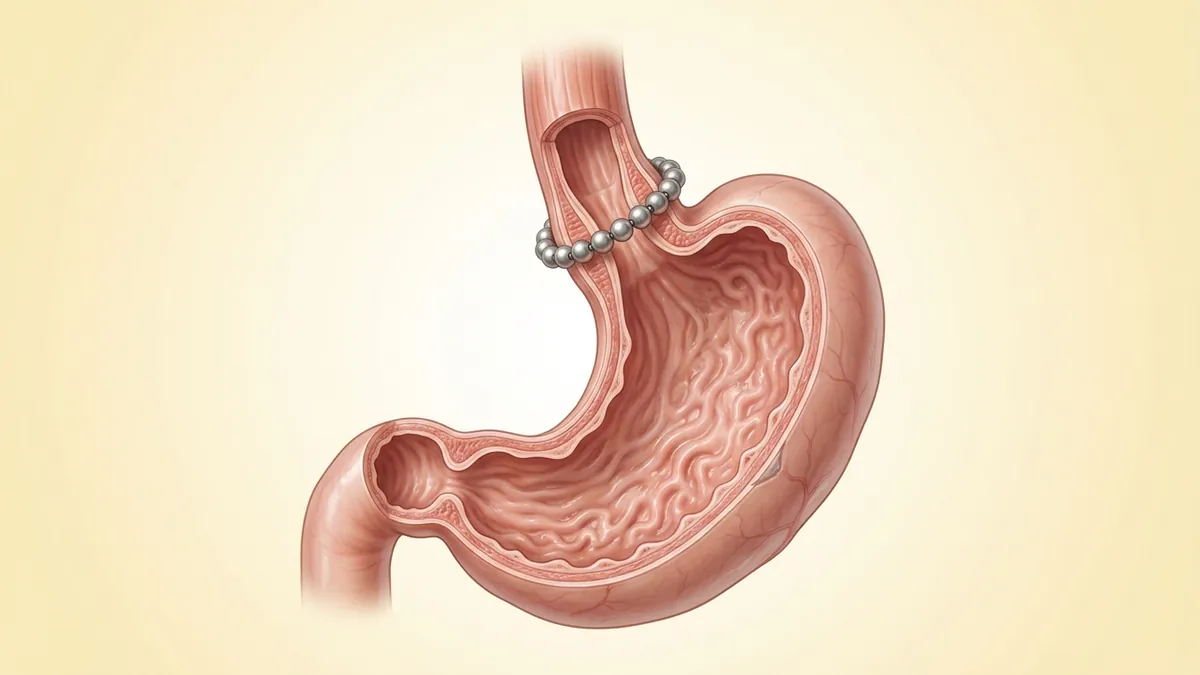
The LINX Reflux Management System is a flexible ring of interlinked titanium beads with magnetic cores placed via keyhole surgery around a weak lower esophageal sphincter (LES). Magnetic pull keeps the valve closed against stomach acid at rest, while normal swallowing pressure pushes the beads apart so food passes freely.
Think about it for a second: at the exact spot where your food pipe (esophagus) meets your stomach sits a muscular ring called the lower esophageal sphincter. In healthy digestion, that muscle acts like a firm one-way trapdoor. When GERD wears that muscle out, stomach acid and digestive juices wash upward, burning delicate lining tissue. During a 30-to-45-minute keyhole procedure called laparoscopic magnetic sphincter augmentation (MSA), an upper gastrointestinal surgeon wraps this custom-sized titanium bead bracelet around the outside of that weakened valve without cutting or sewing your stomach out of shape.
Have you ever wondered why patients often compare LINX with a traditional stomach-wrap surgery called Nissen fundoplication? In a full fundoplication, the top of the stomach is wrapped tightly around the food pipe, which stops reflux well but frequently causes gas-bloat syndrome and leaves you unable to burp or vomit when you catch a stomach bug. Because the LINX titanium wires slide smoothly between each bead, strong stomach pressure from a burp or vomiting still pops the magnets open momentarily before they click softly shut again. Pretty clever engineering, right?
Who Qualifies for the LINX Procedure and Which Diagnostic Tests Do You Need First?
Before your Primary Care Physician (PCP) or family GP refers you to a reflux surgeon, we doctors always emphasize one golden rule: the magnetic ring never squeezes food downward for you—your own food pipe muscles have to push each bite open! Look at what happens if someone with a weak, sluggish swallowing tube gets a magnetic ring placed around the bottom: food simply piles up above the magnets because the esophagus lacks the horsepower to separate the beads. Makes sense, right?
To make sure your swallowing muscles are strong enough and your anatomy fits safely, a specialist team runs four essential diagnostic checks:
- High-resolution esophageal manometry (swallowing pressure test): A thin pressure sensor measures your swallowing waves. Surgeons typically look for at least 70% effective peristaltic swallows and healthy squeeze strength (distal contractile integral above 450 mmHg·s·cm) to prove you can easily open the beads.
- Upper GI endoscopy (gastroscopy): A tiny camera checks your food pipe lining. Unrepaired large hiatal hernias wider than 3 centimeters, severe Grade C or D erosive esophagitis, or precancerous Barrett's esophagus usually require preliminary treatment or a different surgery first.
- Ambulatory pH or impedance-pH monitoring: Measures actual acid exposure over 24 to 48 hours off medication, confirming genuine acid reflux rather than functional heartburn or esophageal spasms.
- Metal allergy screening: You cannot receive a LINX ring if you have known allergies or sensitivities to titanium, stainless steel, nickel, or ferrous (iron-containing) materials.
Why Do Post-Op Eating Exercises Prevent Solid-Food Dysphagia After LINX Surgery?
Here is the single biggest surprise for almost every patient we counsel: liquid-only or pureed diets after LINX surgery are actually harmful to your recovery! We rarely stop to think about how the body reacts to any medical implant, do we? Immediately after surgery, your immune system recognizes the titanium ring and begins weaving a smooth, thin fibrous scar capsule around the outside of the device over the first 6 to 12 weeks. That capsule holds the ring securely in place so it does not slip.
Now imagine what happens if you only sip smoothies, protein shakes, and soup for a month. Liquids trickle straight past the valve without ever pushing the magnetic beads apart! If those beads stay parked together 24 hours a day, your healing fibrous capsule shrinks tightly around a closed ring—almost like wet leather drying around a clenched fist. Once that tissue hardens tight, trying to swallow solid roast chicken or toast weeks later feels like hitting a brick wall, causing troublesome solid-food difficulty swallowing (post-operative dysphagia).
See? That is exactly why surgical teams prescribe structured post-op eating exercises—essentially physical therapy for your esophagus! Starting the afternoon of surgery, you take a small bite of moist, well-chewed solid food—such as scrambled eggs, yogurt with soft fruit, oatmeal, tender pasta, or soft whole-wheat toast—every 1 to 2 hours while awake. Every solid swallow stretches the beads apart by several millimeters, keeping that healing tissue supple, elastic, and flexible.
What Happens Timeline-Wise During Recovery and When Does Difficulty Swallowing Peak?
Even when you follow your hourly snacking routine faithfully, recovery is rarely a straight line—and knowing the calendar ahead of time prevents unnecessary panic! During days 1 through 10, swallowing often feels surprisingly easy because post-operative surgical swelling has barely started and fibrous scar formation hasn't kicked in yet. Many folks think, "That was effortless, I'm completely healed!" and slack off on their eating exercises right when they matter most.
Between weeks 2 and 8, normal scar remodeling reaches peak tension. Around 40% to 68% of patients notice temporary tightness, mild chest pressure behind the breastbone, or food pausing briefly before dropping into the stomach. Sipping warm water or herbal tea right before each bite relaxes the smooth muscle of your lower food pipe and helps your swallow wave glide past the ring. What do you think happens if you rush a bite of dry white bread, cold leftover pizza, or tough steak while scrolling on your phone? It stalls right at the junction!
If swallowing becomes stubbornly tight during weeks 4 to 8 despite careful chewing and hourly snacks, your surgeon or gastroenterologist has straightforward solutions. First, a brief 5-to-7-day oral steroid taper (such as prednisone) often calms local tissue inflammation rapidly. Second, if tightness lingers past 8 to 12 weeks—which happens in roughly 6% to 15% of patients—an outpatient endoscopic balloon dilation gently stretches the scar capsule while you are comfortably sedated. By months 3 to 6, over 90% of patients swallow comfortably again, and surgical ring removal is needed in fewer than 3% to 4% of cases.
What Are the Strict 1.5T vs 0.7T MRI Compatibility Rules for Your LINX Implant Card?
Remember how we talked at the beginning about tiny permanent magnets sitting inside every titanium bead? Whenever magnets enter a hospital magnetic resonance imaging (MRI) room, strict physics rules apply! Before you leave the hospital after your procedure, your surgical team hands you a wallet-sized LINX Implant Card and recommends wearing a medical alert bracelet or tag. Never toss that card into a drawer at home—snap a clear photo on your smartphone and keep the physical card right behind your driver's license or health card.
LINX devices carry an "MR Conditional" safety rating, meaning an MRI scan is safe only when the radiology department matches the scanner's magnetic strength (measured in Tesla, or T) to your exact model generation:
- Blue LINX Implant Card (Current 1.5T Model, implanted mid-2015 onward): Safe ONLY in MRI scanners rated up to 1.5 Tesla (1.5T) or lower.
- White LINX Implant Card (Legacy 0.7T Model, implanted prior to May 2015): Safe ONLY in open or low-field MRI scanners rated up to 0.7 Tesla (0.7T) or lower.
- 3.0 Tesla (3T) or Higher MRI Scanners: STRICTLY FORBIDDEN for every single LINX patient! Entering a high-field 3T scanner—which many major hospitals now use for detailed brain, spine, prostate, or knee scans—can permanently demagnetize the beads so reflux roars right back, overheat the metal ring, or tug dangerously on your food pipe tissue.
The good news? Standard X-rays, computed tomography (CT) scans, ultrasounds, mammograms, bone density (DEXA) scans, and airport security body scanners do not affect your magnetic ring at all.
How Do Normal Post-LINX Healing Signs Compare With Problems That Need Medical Care?
During the first couple of months at home, telling the difference between normal healing sensations and complications that warrant a quick call to your family GP or surgical clinic makes day-to-day life much calmer. Use this quick reference chart whenever a new sensation crops up after a meal:
| Post-Op Symptom or Situation | Clinical Meaning & Practical Next Step |
|---|---|
| Mild food pause or slow passage (Weeks 2–8) | Expected peak scar-capsule remodeling around your titanium beads as your body heals. What you should do: Take a warm sip of water before bites, chew every mouthful 20+ times, keep eating small solid snacks every 1–2 hours, and mention it at your routine surgical follow-up. |
| Shoulder-tip ache in the first 3–5 days | Harmless referred nerve irritation from carbon dioxide gas used to inflate your abdomen during keyhole surgery. What you should do: Walk gently around your home every couple of hours, apply a warm heating pad to your shoulder, and use doctor-approved acetaminophen or paracetamol. |
| Brief chest cramp ("esophageal spasm") when swallowing | Your swallowing muscle is working briskly against the magnetic resistance of the ring, especially with icy drinks or rushed bites. What you should do: Avoid ice-cold beverages, pause 30 seconds between bites, sip warm chamomile tea or warm water, and ask your surgeon if a short course of muscle-relaxing drops or steroid tablets could help. |
| Progressive solid-food dysphagia lasting past 8–12 weeks | The fibrous tissue capsule may have healed slightly too snugly around the closed beads, limiting full ring expansion. What you should do: Contact your reflux surgeon or gastroenterologist promptly to discuss an evaluation (barium swallow X-ray or gastroscopy) and gentle endoscopic dilation; never let your weight drop from skipping meals. |
| Scheduled MRI for a knee, back, or brain issue | Many modern imaging centers automatically book patients into powerful 3.0T MRI machines unless warned early. What you should do: Show your Blue (1.5T max) or White (0.7T max) LINX Implant Card to both your Primary Care Physician / GP when ordering the scan and the MRI radiographer before stepping near the scan room. |
| Complete food blockage (unable to swallow your own saliva) | Acute food bolus impaction above the magnetic ring—or rarely, device migration or mucosal erosion. What you should do: Do NOT force down more food or fizzy drinks to "push it through." Go straight to the nearest hospital Emergency Room (ER / A&E) for safe urgent endoscopic clearing. |
✔️ What You Should Do & ❌ What to Avoid
- ✔️ DO keep small solid snacks handy all day: Pack soft diced chicken, cheese cubes, banana slices, crackers with hummus, or yogurt with granola so you hit your 1-to-2-hour waking eating exercises during the first 8 weeks.
- ✔️ DO sip warm liquid before meals: Two sips of warm water or tea right before your first bite moistens your esophagus and relaxes smooth muscle spasms.
- ✔️ DO chew thoroughly and sit upright: Put your fork down between bites, chew food to an applesauce-like consistency, and sit tall for at least 30 minutes after eating.
- ✔️ DO carry your LINX Implant Card everywhere: Alert every doctor, dentist, Urgent Care clinician, and MRI technologist before any diagnostic imaging.
- ❌ DON'T revert to an all-liquid diet: Smoothies and soups fail to open the magnetic beads, letting scar tissue tighten around a shut ring.
- ❌ DON'T tackle sticky, dry, or tough foods early on: Hold off on doughy white bagels, crusty baguette ends, dry chicken breast, tough steak, stringy celery, and fizzy sodas during weeks 1 through 8.
- ❌ DON'T ever enter a 3.0T MRI scanner: High-field 3T magnets permanently damage the LINX device and put your esophagus at serious risk.
🚨 When to Seek Immediate Emergency Care (Red-Flag Symptoms)
If you or someone near you develops any of these red-flag symptoms, do not wait — call 911 (US & Canada), 999 or 111 (UK), or 000 (Australia) immediately or go straight to the nearest hospital Emergency Room (ER / A&E):
- Inability to swallow liquids or your own saliva (drooling or spitting up foam): Signals a complete food blockage above the ring requiring urgent hospital removal.
- Severe, worsening chest or upper abdominal pain accompanied by fever, chills, or rapid heart rate: Can indicate an esophageal tear (perforation), surgical site infection, or acute complication.
- Vomiting bright red blood, "coffee-ground" dark material, or passing black, tarry stools: Warns of upper gastrointestinal bleeding or rare ring erosion through the esophageal wall.
- Sudden shortness of breath, painful breathing, or dizziness after forceful retching: Needs immediate emergency evaluation to rule out hiatal hernia recurrence or chest injury.
💡 Key Take-Home Message
- Your daily solid-food bites are medicine—stretching those magnetic beads every hour or two during the first two months builds a supple, comfortable scar capsule for life.
- Mild swallowing tightness between weeks 2 and 8 is part of expected healing, not surgical failure, and responds well to warm sips, slow chewing, and specialist guidance when needed.
- Protect your implant forever by checking your Blue (1.5T max) or White (0.7T max) LINX card before every MRI and steering completely clear of 3.0T scanners.





No comments yet. Be the first to share your question or experience below.