
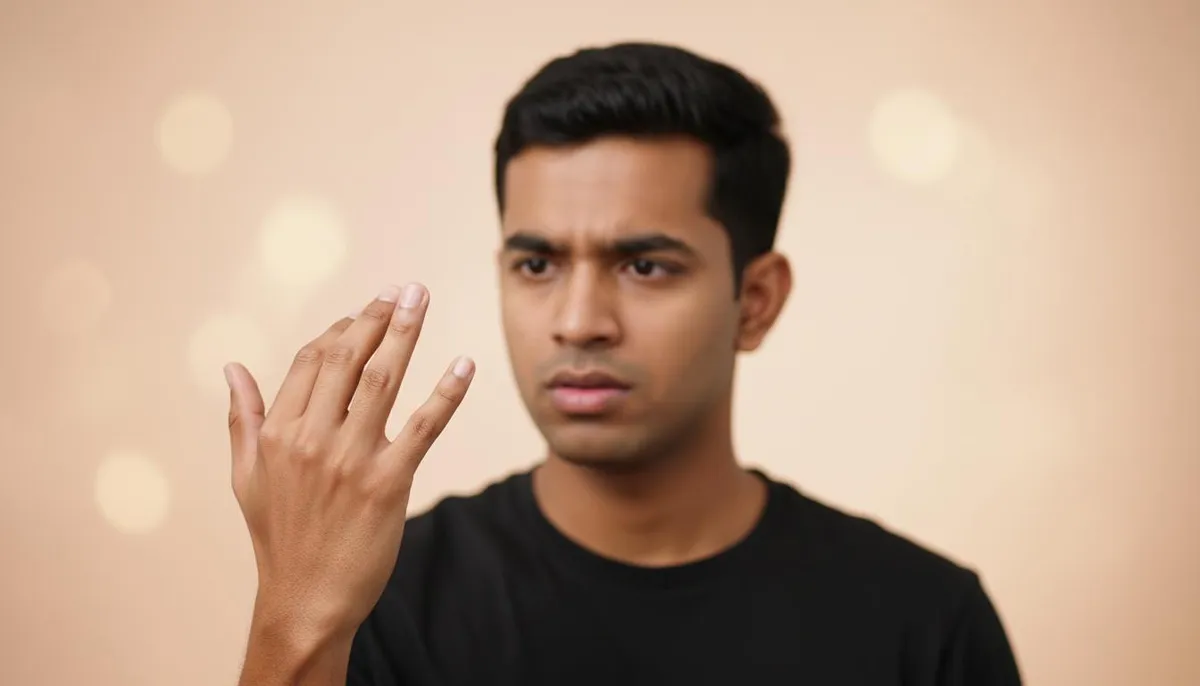
Did you just catch a hard knock to the tip of your finger while reaching for a ball, or accidentally jam it in a closing door? Now, no matter how hard you try, the very tip of your finger droops downward like a tiny hammer and simply refuses to straighten on its own. I see this exact scenario walk into my clinic almost every week, and almost everyone starts by saying, "I thought I just jammed or sprained my finger."
In medicine, we doctors call this condition mallet finger (sometimes called baseball finger or hammer finger). While it can look minor at first glance, a drooping fingertip is your body's clear signal that the delicate mechanism lifting the end of your finger needs prompt, proper care. Let's walk through what is happening inside your finger and how we get it back to normal.
📌 Key Takeaways at a Glance
- What it is: Mallet finger happens when the tendon that straightens your fingertip stretches, tears, or pulls off a tiny chip of bone.
- Signature sign: Your fingertip hangs down at the end joint and cannot lift on its own, though you can push it straight with your other hand.
- Primary treatment: Over 80% to 90% of cases heal without surgery by wearing a specialized finger splint 24/7 for 6 to 8 weeks.
- Why timing matters: Leaving it untreated—or bending the tip even once while cleaning—can lead to a permanent droop or secondary joint deformity.
What Is Mallet Finger and Why Is My Fingertip Bent Down?
Mallet finger is an injury to the terminal extensor tendon—the thin band of tissue that straightens the end joint of your finger—causing the fingertip to droop downward like the head of a hammer. When a sudden force bends an outstretched fingertip, the tendon either tears or pulls away a small bone fragment.
Think about it for a second. Unlike your palm, the back of your fingers has very little padding—just thin skin sitting right over bone and slender tendons. The tendon that runs along the top of your finger and attaches to the last bone, known as the terminal extensor tendon (extensor tendon), works just like a taut rubber band pulling your fingertip upright at the distal interphalangeal joint (DIP joint).
Look at what happens when something hard strikes the tip of your straight finger. That sudden impact forces the end joint downward faster than the muscle can relax. The rubber-band tendon snaps, stretches out, or yanks a tiny flake of bone right off its anchor point. Without that upward pull, the opposing tendon on the palm side wins the tug-of-war unopposed, leaving your fingertip hanging down.
What Are the Main Symptoms of Mallet Finger?
The unmistakable hallmark of mallet finger is a fingertip that bends downward at roughly a 30- to 45-degree angle and will not straighten when you tell it to move. You can easily lift the tip straight using your other hand, but the instant you let go, it drops right back down. Pretty surprising, right?
Alongside that telltale droop, we doctors look for several accompanying signs around the end knuckle:
- Localized pain and tenderness: A sharp ache right over the back of the end joint immediately after the impact, though surprisingly, some tendon-only tears hurt very little after the first few minutes.
- Swelling and redness: Puffiness around the top of the fingertip that can sometimes mask how far the joint is actually drooping.
- Delayed bruising: Within 24 to 48 hours, a dark blue or purple bruise often spreads across the back of the finger or around the nail fold.
- Nail changes: Blood pooling beneath the fingernail (subungual hematoma) or a nail lifting at its base, which can signal an underlying bone break.
What Causes Mallet Finger in Sports and Everyday Life?
Have you ever wondered why an injury nicknamed "baseball finger" happens just as often in the bedroom or kitchen as it does on a sports field? Any abrupt force that jams the tip of an extended finger downward can tear that delicate tendon, regardless of how athletic you are.
In sports across the US, UK, Canada, and Australia, mallet finger frequently strikes during baseball, softball, basketball, volleyball, cricket, netball, or rugby when a fast-moving ball catches the tip of an outstretched hand. Yet in our clinics, roughly half the patients we treat injured themselves doing completely ordinary household chores.
Tucking a tight fitted sheet under a heavy mattress, catching your finger on a coat pocket, slamming a car door, or bumping your hand inside a crowded kitchen drawer are classic everyday culprits. In older adults with wear-and-tear joint changes (osteoarthritis), the tendon can already be thinned, meaning even a gentle snag while pulling on socks or washing dishes can cause it to give way.
What Happens If Mallet Finger Is Left Untreated?
Be honest—when you first hurt your finger, you probably hoped it was just a simple jam that would walk itself off in a few days, didn't you? That is completely understandable, because everyday finger sprains usually improve with rest. With mallet finger, however, ignoring the droop carries real long-term consequences.
If the torn tendon ends or separated bone fragments are not held together promptly, scar tissue fills the gap and stretches out. Over time, that downward droop becomes permanent, making everyday tasks like typing on a keyboard, playing an instrument, buttoning cuffs, or reaching into tight pockets awkward for life.
Even more importantly, remember how we talked about the balance of tendons along your finger earlier? When the end joint stays bent, the middle joint gradually overcompensates and hyperextends backward. Over months, this imbalance can create a complex S-shaped curve called a swan-neck deformity (secondary joint hyperextension), causing stiffness and chronic arthritis. In children and teenagers, an untreated injury can also damage the delicate growth plate (physis) at the base of the fingertip bone, leading to stunted or crooked finger growth.
What Happens Before and After Meeting a Doctor?
If you cannot actively straighten your fingertip after an injury, you should have it evaluated by a medical professional within the first few days—ideally within a week. You do not usually need an ambulance for a simple closed injury, so booking an urgent appointment with your Primary Care Physician (PCP) / family GP clinic or visiting a local Urgent Care center is the best first step.
First Aid You Can Do Before Seeing a Doctor
While you are waiting for your appointment, taking four simple steps at home will protect the tendon and keep swelling under control:
- Remove rings immediately: Take off any rings on that hand right away before finger swelling traps them and restricts blood flow.
- Clean any open skin: If the skin is scraped, bleeding, or the nail is torn, wash it gently with mild soap and clean water and cover it with a sterile bandage.
- Ice and elevate: Wrap ice cubes or a bag of frozen peas in a clean kitchen towel and apply for 15 to 20 minutes at a time while keeping your hand propped above heart level.
- Apply a temporary splint: Gently rest the underside of your fingertip on a flat popsicle stick, tongue depressor, or padded aluminum splint so the tip stays straight, and secure it lightly with medical tape—leaving your middle knuckle free to bend.
How Do Doctors Diagnose Mallet Finger?
When you arrive at the clinic, we doctors start by asking exactly how and when the injury happened, because a fresh injury behaves differently from one that happened three weeks ago. Next, we perform a gentle physical check called the mallet finger test, supporting your middle joint while asking you to lift the very tip on your own.
Even when the diagnosis looks obvious from the outside, we almost always order a standard three-view X-ray (plain radiographs) of your finger. Why? Because an X-ray reveals whether you have a pure soft-tissue tendon tear or a bony mallet fracture (avulsion fracture) where the tendon pulled off a piece of bone, and confirms that the joint surfaces are still lined up properly.
Because different finger injuries can look surprisingly similar right after an accident, here is how we doctors distinguish mallet finger from related conditions:
| Finger Injury Type | Clinical Picture & Next Steps |
|---|---|
| Soft-Tissue Mallet Finger (Tendon tear without fracture) | The terminal extensor tendon snaps cleanly off the bone, leaving the fingertip drooping at 30–45 degrees with normal X-rays. What you should do: Have a medical splint fitted promptly and wear it continuously 24 hours a day for a full 8 weeks without letting the tip bend. |
| Bony Mallet Finger (Avulsion fracture at fingertip) | The tendon yanks away a small triangular chip of bone from the base of the end phalanx, often accompanied by deeper bruising. What you should do: Get an X-ray to measure fragment size; small aligned fractures heal in a splint for 6 to 8 weeks, while large displaced pieces need a hand surgeon. |
| Simple Jammed Finger (Collateral ligament sprain) | The middle or end knuckle aches and swells on the sides, yet you can still actively straighten the fingertip all the way up. What you should do: Rest, ice, and buddy-tape the injured finger to its neighbor for 1 to 2 weeks, seeing a doctor if pain persists. |
| Open or Nail-Bed Mallet Injury (Deep cut or crushed nail) | A laceration over the back knuckle or blood pooling under a detached nail suggests the tendon is severed or the fracture communicates with the outside skin. What you should do: Visit an Urgent Care center or hospital Emergency Room (ER / A&E) the same day to prevent bone infection and repair the tendon. |
What Are the Best Treatments for Mallet Finger?
The reassuring truth is that roughly 80% to 90% of mallet finger injuries heal completely without an operation. Whether your injury is tendon-only or involves a small chip of bone, the core goal is identical: holding the end joint completely straight (or slightly hyperextended) so the healing ends stay touching until they knit back together.
Treatment Without Surgery: Continuous Splinting
For uncomplicated injuries, your doctor or certified hand therapist will fit a lightweight plastic Stack splint (prefabricated extension splint) or custom-molded thermoplastic splint over the end of your finger. Notice that this splint only covers the tip—your middle knuckle stays completely free so your hand remains useful for daily life.
Here is the golden rule we doctors emphasize to every single patient: you must wear the splint 24 hours a day, 7 days a week, for 6 to 8 weeks. Think of newly healing tendon fibers like wet glue. If you take the splint off to shower and let your fingertip droop downward for even two seconds, that fragile bridge tears apart and resets your healing clock right back to Day 1.
Your clinician will show you the safe "tabletop method" for washing your finger daily: lay your hand flat on a firm table, slide the splint off while keeping the fingertip pressed straight against the surface, wash and dry the skin, and slide the splint back on without lifting or bending the tip. We often repeat an X-ray at 2 to 3 weeks to verify that bone fragments remain aligned.
Cases Where Surgery Is Required
While splinting works wonders for most people, we refer complex injuries to an orthopedic or plastic hand surgeon when conservative care cannot hold the joint safely. Surgery is typically recommended if:
- Large joint fracture: The broken bone chip involves more than 30% to 40% of the joint surface, causing the fingertip bone to slip out of alignment (volar subluxation).
- Open tendon laceration: A sharp knife, glass, or machinery cut severed the tendon through the skin.
- Splint failure or occupational need: Months of strict splinting failed to restore lift, or a patient's job (such as a surgeon or musician) makes wearing an external splint impossible.
If you do need surgery, take heart—it is almost always a brief outpatient procedure performed under a local nerve block that numbs just your finger or arm, so you go home the very same day. Surgeons commonly pass a hair-thin temporary metal pin called a Kirschner wire (K-wire fixation) across the joint to hold it straight from the inside for 6 to 8 weeks while the tendon or bone heals.
How Long Does Mallet Finger Take to Heal?
Most straightforward bony mallet injuries require 6 weeks of full-time splinting, while tendon-only tears usually need a full 8 weeks because tendon tissue has a slower blood supply than bone. More stubborn or delayed cases can occasionally take 10 to 16 weeks, including a gradual weaning phase where you wear the splint only at night for another few weeks.
Once the splint finally comes off, do not be alarmed if your fingertip feels stiff, slightly puffy, or reluctant to bend at first. Your doctor or hand therapist will guide you through gentle, progressive bending exercises to restore flexibility without overstretching the newly healed tendon. Full grip strength and smooth motion typically return over the following 4 to 8 weeks.
See? That's why patience pays off so well here. Even after complete recovery, it is very common to notice a tiny permanent bump over the top of the end knuckle or a slight 5- to 10-degree cosmetic droop, neither of which interferes with normal hand function.
✔️ What You Should Do & ❌ What to Avoid
- ✔️ Do keep the splint dry and clean: Moisture trapped inside a plastic splint softens the skin and causes soreness; dry your finger thoroughly after washing using the flat-table method.
- ✔️ Do move your middle knuckle regularly: Gently bending your uninjured middle finger joint and neighboring fingers prevents whole-hand stiffness while splinted.
- ✔️ Do contact your clinic if the splint loosens: As initial finger swelling goes down during week one, your splint may need downsizing so the tip stays snug and straight.
- ❌ Don't "test" your finger early: Never peek under the splint to see if your fingertip can lift on its own before your doctor clears you—that single test bend can undo weeks of healing.
- ❌ Don't smoke or vape during recovery: Nicotine constricts tiny blood vessels in the fingertips and dramatically slows tendon and bone healing.
🚨 When to Seek Immediate Emergency Care (Red-Flag Symptoms)
If you or someone near you develops any of these red-flag symptoms, do not wait — call 911 (or 999 in the UK / 000 in Australia) immediately or go straight to the nearest hospital Emergency Room (ER / A&E):
- Open wound or exposed bone: A deep cut over the back of the finger or crushed tissue where bone or severed tendon is visible.
- Severe nail-bed trauma: Blood pooling painfully beneath more than half the nail or a nail torn loose from its root, which often signals an open fracture needing urgent antibiotics.
- Loss of circulation or sensation: Your fingertip turns pale, blue, cold, or completely numb, especially after applying tape or a splint too tightly.
- Signs of spreading infection: Worsening throbbing pain, pus, red streaks spreading up the hand, or a fever following a cut or crush injury.
💡 Key Take-Home Message
- Never dismiss a droopy fingertip: If the end of your finger hangs down after an impact and won't lift on its own, treat it as mallet finger—not a routine sprain.
- Get an X-ray promptly: Checking for a bone fragment early determines whether simple splinting or a hand specialist review is safest.
- Commit to 24/7 splinting: Keeping the fingertip continuously straight for 6 to 8 weeks is the single most important factor for a full, lasting recovery.






No comments yet. Be the first to share your question or experience below.