

As your little one grows up, there's nothing more exciting than watching them grow up. Especially as they approach their second birthday, their language and communication skills improve at an incredible rate. It's like we've built a little talking machine in our house! Not only do they understand what we say, they also start to express themselves verbally, sometimes using gestures and gestures. Not only that, they also love to understand and do the little things we say. Sometimes they even come to us to give us commands, like "Give me a break!" and "Do this!" This is a wonderful time, let's talk about this a little more.
How do little ones talk to us? How do these little geniuses communicate?
At this age, children's language skills, that is, speaking and understanding, develop in ways that are unimaginable.
Stories told in words
Imagine, when your baby is about 15 months old, they start saying one or two more words besides "mama" and "dada." Maybe "baba" and "ball." By 18 months, they may have three or more of these words. By two years old, they will have learned many more words and will be able to put two words together to form short sentences. They will be able to say things like "I want milk," "Let's eat rice," and "Give me the ball." This is a big leap in their language world.
Understanding before words are spoken
But remember, they understand a lot of what you say even before they start saying their first words. Your little one should be able to understand and do simple things you say. For example, when you say, "Pass the ball to mommy," they should look at it and maybe even try to do it. They should be able to look at it and reach out when you say the name of an object we see and use often, such as a toy or a piece of food.
Stories told through hints
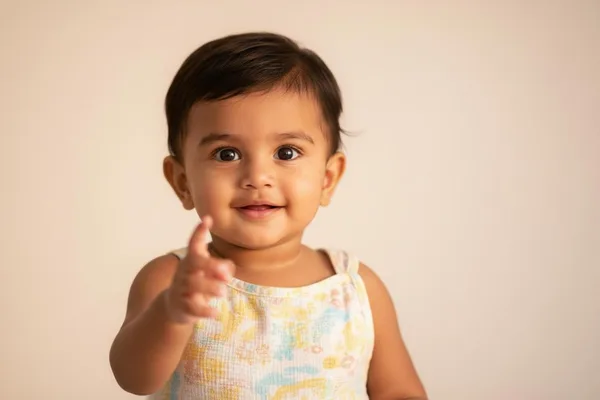
At this age, along with words, gestures, or hand-foot gestures, are their main way of communicating. They start to do things like blow a kiss, reach for something, and nod their head to say "yes." These gestures become more complex during this year. They start to use them to imitate what we do, express their feelings, and even play.
Small mistakes when pronouncing words
Although your little one's vocabulary increases rapidly, his pronunciation, that is, his ability to say words clearly, does not develop at the same rate. Even at two years old, we can only understand about half of what most little ones say. That is normal. However, when you talk to him, even if he makes a mistake, you should teach him the correct way to say the word. Without scolding, but lovingly. "Oh... did he say 'dootha' (milk)? Yes, this is 'milk'."
What can we do as parents to improve this conversation?
There are many things you can do to further develop and encourage your little one's language skills. These are very simple things that can be incorporated into your daily life.
Baby, no words, just say it.
Your little one is listening to every word you say, everything. Like a little sponge soaking up water, they are absorbing these words into their heads. So, instead of using "baby words" like "boo boo" and " pee pee, " use the proper names of people, places, and things whenever possible. When you do speak, speak slowly, clearly, and in simple words. For example, call a dog "dog" instead of "bowl." Call water "water" instead of "garden."
Respond to tips and tricks
As we've talked about before, cues are a very important part of language development. When we respond to our children's cues, they're more likely to join in the conversation. You can make a connection between their cues and language .
Imagine your little one reaching for the fridge. You ask, "What does my son/daughter want? Something to drink?" and wait for him/her to answer. Then ask again, "What do you want? Milk? Uh... okay, let's get some milk, shall we?" This way, you can translate their cue into words.
Let's sing songs and play word games to the beat.
Toddlers love to listen to songs and to hear things said in rhythm. Sing songs with your toddler, recite short poems in rhythm, and play rhyming games. They will love gesture games. Say songs like "Little Butterfly in the Hand" or "Tikiri Ting Ting" and show them with gestures.
Also, help them figure things out.
- Body parts ("Where is your ear?", "Try touching your nose")
- Pictures ("Who is this? What is this?")
- Toys ("Show me your ball")
- People who say they know ("Where is Grandpa?", "Show me Mom")
Read books with colorful, beautiful pictures.
It is very important to show children at this age books with colorful, large pictures, and to look at them with them. Help and encourage them to turn the pages of the book. Ask them to point out the things in the pictures ("Look at this beautiful colorful flower", "There's a dog there"). This not only increases their vocabulary, but also their knowledge of the world.
When should you seek medical advice?
Most children show these language skills within this time frame. However, we must remember that not all children are the same. Some children may take a little longer. However, we need to be a little more careful about some things.
If your little one doesn't show any of the following at the appropriate age, it's a good idea to talk to a doctor:
- If, at 15 months, your baby still doesn't try to say a single word or two other than "mama" and "dada."
- Even though it's been 15 months,If you don't look at something you see often and know (e.g., doll, milk bottle) or show no recognition when it is called by its name.
- If he doesn't say more than three words (other than "mama" and "daddy") by 18 months .
- Even at 18 months, you still can't understand and follow a simple command (e.g., "Give me the shoe") without being helped by your hands or feet.
- Even at 2 years old, when you ask him to do something in a book, he won't show even two parts of his body (e.g., ear, eye, nose).
- Even after 2 years, he still can't say a simple sentence, even with two words, like "I want milk" and "Let's eat rice."
A little bit about autism
Some parents are afraid that when a child is a little late in speaking, it is a condition like ``Autism Spectrum Disorder''. It is good to be aware of this. Usually, doctors pay attention to the child's development and such symptoms during every clinical checkup . Especially at 18 months and 2 years, they even do special ``Screening Tests'' in this regard.
Therefore, if you have any questions or concerns about your little one's speech or any other aspect of their development, please do not hesitate to talk to your family doctor. This will ease your burden and help you get help quickly if needed.
Finally, the most important message to take home
It's amazing how your little one's speech develops during this early age. Remember, every child develops at their own pace. So, don't compare yourself to other children and worry. But it's important to be aware of what you can expect at this age.
The most important thing is the time you spend with your little one.
- Talk to it.
- Listen to what he says and the hints he makes, and respond.
- Play with it, sing songs.
- Read books together.
Your love, your attention, every second you spend laughing and talking with your little one is the greatest thing he gets in this little world. It will make not only his conversation, but his whole life beautiful! You can show this little talker the way to a beautiful future.
👩🏽⚕️ Additional questions (FAQs)
💬 How many words should a child between 1 and 2 years old be able to speak on average?
A child usually says 2-3 words like 'mama' and 'datta' during the year. However, by the age of one and a half years (18 months), the child should be able to say about 20 words, and by the age of 2, the child should be able to say two-word sentences (e.g. 'eating rice', 'mom, let's go').
💬 Should I be worried if my child is still not talking after one year?
Children's development is different, so there's nothing to worry about. However, if your child is not saying a single word by 18 months and continues to use hand gestures, see a pediatrician.
💬 What can parents do to improve their child's communication?
Always talk to your child, show them picture books and teach them the names of animals, and make sure to look your child in the eye and tell them stories instead of handing them the phone.
Toddler Communication, Language Development, Children's Speech, 1-2 Year Olds , Parenting Advice, Medical Advice, Autism Spectrum Disorder




💬 Comments (0)
No comments yet. Be the first to share your thoughts here.
Add Your Comment