

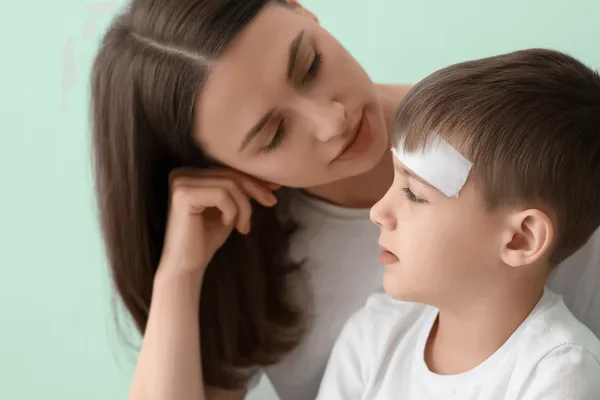
Imagine that your little one is playing, maybe riding a bike, or running around, and suddenly falls and hits his head hard. At such times, it is very normal for you, as a mother or father, to feel a little shocked and scared. Most of the time, it is a minor bruise or scratch that heals in two or three days. But sometimes, a head injury like this can be a little more serious than we think. That is what we call a ``Concussion'' in medicine, a condition in which the brain is affected by a specific blow to the head. This is like a small jolt from inside the brain .
So what exactly is this (Concussion)?
Simply put, a concussion is a temporary injury to the brain. It occurs when the head is hit, jolted, or shaken violently. This causes a small disruption in the brain's normal functioning. It's like a computer suddenly restarting, causing the brain to temporarily lose its ability to function . However, this usually doesn't cause significant, visible damage to the brain (such as bleeding). However, it does affect the delicate cells and nerve connections (the function of neurotransmitters ) in the brain.
Although this condition can happen to anyone of any age, the risk of concussion is slightly higher among young children who run and play sports. Therefore, it is very important to be aware of this.
What symptoms might a child experience during a concussion?
A child can have a variety of symptoms after a concussion. Some symptoms may start immediately after the injury, while others may not appear for several hours or even a day or two. Therefore, it is very important to pay close attention to your child after a head injury.
See if your child shows any of these symptoms:
- Headache : This is the most common symptom. It's not just a normal headache, it can be a bit more severe.
- Dizziness : It can feel like things are spinning around you.
- Confusion or difficulty concentrating: You may be confused about things like what happened or where you are. You may be slow to answer questions.
- Blurred vision or double vision: This can also affect the eyes.
- Fatigue and drowsiness: You may feel more tired than usual and feel sleepy all the time.
- Difficulty concentrating or remembering: You may not remember what you are studying or be unable to pay attention to what is being said.
- Light sensitivity: You may have difficulty looking at bright light, your eyes may become blue, and you may also be sensitive to noise.
- Feeling sad, getting angry quickly, being anxious: You may notice a change in your child's behavior and mood.
The important thing is that not all of these symptoms occur in every child. Some children may have only one or two of these, while others may have several. Also, the severity of the symptoms varies from child to child.
Most children with a concussion are able to return to school within a week or two. However, even after returning to school, some symptoms may persist for a while. Therefore, it is essential that your child receives special support at school and at home during these days.
What kind of help does a child recovering from a concussion need at school?
In other countries, doctors will only allow a child with a concussion to return to school if the child can tolerate the symptoms for about 30-45 minutes (which is usually the duration of one class period). So, a child who comes to school with such a concussion may need some comforting things like:
- Reducing the time spent at school: It may be difficult for a child to stay at school all day in the early days, so the number of hours per day can be reduced.
- Reducing the number of class periods: Perhaps only core subjects can be allowed to participate.
- Allowing extra time for homework, assignments, quizzes, and exams: Because it is difficult for a child to focus and remember, more time needs to be given to these.
- Extra tutoring or tutoring: You may need help to cover missed lessons.
- Class notes and study guides provided by the school: If your child has difficulty taking notes on their own, you can provide a copy of the teacher's notes.
- Breaks: You can give them the opportunity to rest their heads on the table for a while during class, or to be in a quiet place for a while.
- Taking a break from tasks that require more attention (e.g. exams, urgent papers) for a while.
- Allowing them to wear sunglasses if they are sensitive to light.
- Providing opportunities to complete missed schoolwork during the holidays.
What if the symptoms persist?
Sometimes, if your child's symptoms persist or get worse, the school may need special support. For example, a special education plan may be developed to ensure that the child is receiving the services they need. These are called ``504 plan'' or ``IEP - Individualized Education Program'' in other countries. Also, a ` `Response to Intervention'' method , such as ``RTI - Response to Intervention'', may be used to ensure that the child is recovering as expected. These may sound a bit technical, but in simple terms, they are used to ensure that the child is receiving the support they need and to monitor the child's progress in recovery. (These things are not done much in Sri Lanka.)
What can teachers/parents do if a child shows signs of concussion at school?
When a child returns to school after a concussion, there are things we, as teachers and parents, need to be aware of.
- If symptoms are mild: Encourage your child to try to stay in class for 30-45 minutes. You can also ask them to rest their head on the desk for a while.
- However, in cases like this, the child should be referred to a doctor:
- If symptoms last more than 30-45 minutes.
- If new symptoms appear, or if existing symptoms get worse.
- If the symptoms are too severe for the child to bear.
Very important: If your child's symptoms do not improve after about two weeks, the school teacher should definitely talk to the parents and help them decide whether they need to see a doctor again.
What else do we need to know about this (Concussion)?
It is also worth keeping these things in mind:
- Being cleared to return to school after a concussion does not mean your child is allowed to play sports, participate in physical education classes, or engage in other activities that could cause a head injury . It is important to follow your child's doctor's instructions until they are sure it is safe to return to sports and other activities. Never rush into it.
- If a child hits their head at school, while playing, or for any other reason, it is very important to report it to a doctor immediately and have the child examined . Even if it seems like a minor injury, it could be a ``concussion``.
- Every child recovers from a concussion differently and the time it takes is different. Some recover quickly, while others may take longer. So don't compare yourself to others.
- The support and understanding from family, friends, and teachers is invaluable as the child fully recovers and gradually returns to the daily activities and hobbies they were doing before the concussion.
Let us remember in summary (Take-Home Message)
Okay, so we've talked a lot about `(Concussion)`. Finally, keep these points in mind:
1. A concussion is not something to play with. It is a temporary injury to the brain.
2. Pay close attention to your child's symptoms after a head injury. Look for things like headaches, dizziness, confusion, and memory problems.
3. Even if your child starts school, they may need special accommodations and support in the early stages. Discuss this with the school.
4. Follow your doctor's instructions exactly. Don't rush into returning to sports and physical activities, especially.
5. Give your child love, support, and understanding. Remember that recovery is a gradual process.
I hope this information is useful to you. If something like this happens to your child, this knowledge will help you not to panic and act wisely!




💬 Comments (0)
No comments yet. Be the first to share your thoughts here.
Add Your Comment