
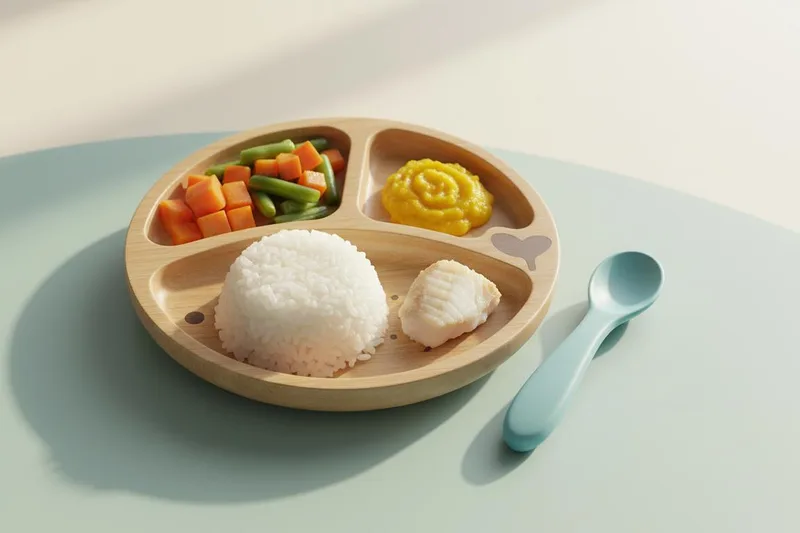
At about a year old, your little one is a bit older now, isn't he? He's probably starting to struggle to walk and is probably running around the house playing. The days of drinking only milk from a bottle are over. Now is the time for him to gradually get used to the food you eat, that is, home-cooked rice, vegetables, and fish. This time is really important. Because, as research has found, food preferences formed in childhood are the ones that last a lifetime. So let's see how to give this little one the best possible nutrition and delicious food. This may seem a bit difficult, but it's very easy once you know the right way.
What should you feed your baby at this age?
Now your little one is slowly starting to eat the same foods you eat. So this is the best time to introduce him to new tastes and new types of food (e.g. different vegetables, fruits, grains). It is much more important to have variety than to get him used to the same types of food. Think about it, we like the foods we like the most since we were little. And so do little ones. Therefore, if you get them used to nutritious, healthy foods at this age, it is like a big investment for their whole life. Then they will be motivated to choose healthy foods even when they grow up.
Young children have very small stomachs. That means they cannot eat large amounts of food at once. Therefore, the food we give them should be very nutritious. That means, it should contain essential nutrients like vitamins and minerals that their bodies need. For example, calcium is very important for bone growth, iron for blood, and vitamin A for eyesight. Only then will they grow up healthy and strong. At this age, we should reduce the intake of sweets, artificially sweetened foods, canned foods, and instant noodles, i.e. foods with empty calories, as much as possible. 'Empty calories' refers to foods that do not provide the body with the nutrients it needs. Because they do not provide the body with nutrition, can cause unnecessary weight gain, and can also reduce the appetite for good foods.
How is the sweet drink?
Another thing is that sugary drinks are not good for babies at all. Some of the sweet drinks we buy from the store, drinks labeled as 'juice' (Juice Drinks), carbonated drinks (Carbonated Drinks/Soda), sports drinks (Sports Drinks) , or flavored milks (Flavored Milks) are high in sugar. Giving these to the child does not provide any nutrition. Not only that, they can also cause tooth decay, childhood obesity, and later diabetes (Diabetes Mellitus).
'Oh, doctor, can't we give them some fruit juice? Homemade ones are better, right?' You might think so. It's okay to give them a little bit of homemade, unsweetened 100% fruit juice. But doctors say that you shouldn't give them more than 4 ounces (about 120 ml, or about half a small cup) of that a day. Because eating whole fruit provides more nutrients, such as fiber, than fruit juice. Also, when giving juice, don't give it in a bottle, give it in a cup. That way, they'll get used to drinking little by little, and they'll be less likely to drink a lot at once. The best thing is, the best thing you can give your child to quench their thirst is clean water.
Isn't the way food is served important?
Not only the food, but the way we feed the child that food is also very important. At this age, children really like to do things on their own. It's part of their development. So it's good to give them the opportunity to eat on their own.
How do you get used to eating alone?
Your little one will start eating with their fingers. This is normal, and they are called 'finger foods' . You can give them small pieces of carrot, bean pods, or boiled potatoes to eat with your hands. Give them a chance to do this. Some food will get everywhere, on their clothes, on the chair, and on the floor. But that is how they learn and develop their fine motor skills . Between 15 and 18 months, which is about a year and 3 to 6 months, they will gradually try to use a toddler spoon and maybe even a toddler fork.
At this time, you should give them the opportunity to practice eating on their own as much as possible. Sometimes they can get angry, when they can't do it properly, or when the food falls out. At such times, offer a little help, show them, 'Can we hold it like this, son/daughter?' But praise their efforts, encourage them by saying, 'You're very good, my child.' As they gradually become more skilled, you can let them do the task themselves. This will also increase their self-confidence, and they will feel 'I can do it'.
Imagine, your son is holding a plate of rice in front of him and eating it with his hands. Half of it is in his mouth, half on the floor. You might think, 'Oh, what are you doing, I'm wasting it all, I can easily feed myself.' But be patient at that time. He is trying to eat on his own. Don't stop him from trying. You can stay there until he eats, give him help if he needs it, but don't go and feed him the whole meal.
"I'll eat whatever I want!" - Should we give freedom to the little ones too?
At this age, little ones love to show their independence . They have a sense of 'I do what I want', 'I'm a big kid'. We can see this clearly at the dinner table. Sometimes they may reject the food you've prepared, they may say 'I don't want this, I want that', they may eat reluctantly, or they may even push the food aside. This is how they try to show that they too have the ability to make decisions, that they too have 'something to say'.
So what do we do? Let them feel some control. This means: You should prepare a variety of healthy food options for them. For example, rice with a side of broccoli, a little fish (with the bones removed), and a lentil soup. Or, for breakfast, a bowl of coconut milk soup with rice noodles and a small banana. Then, let them decide what they want to eat and how much of that food is served.
"Oh, how can that be? Then he'll be hungry, right? Or what if he eats only rice without eating any vegetables?" You might think so, and that's fair. Don't worry. Young children are very sensitive to their hunger and satiety. They eat when they're hungry. If we force them to eat, or if we say things like 'I'll give you a chocolate if you eat this,' food may become unpleasant for them, or they may develop negative attitudes about food. So, give them some healthy choices and give them the freedom to eat whatever they want, in whatever quantity they want. But it's important that all the choices you give them are healthy ones. If you put chocolate, a biscuit, or rice and say 'eat whatever you want,' it won't work, right? Then they will choose sweets. Therefore, it is your responsibility to bring nutritious food to the table, and it is your child's responsibility to eat from it.
So, what are the most important things to remember?
Putting all of this together and taking it as a summary, it's very important to keep these points in mind when feeding your one- or two-year-old.
- Variety is the most important thing: Introduce your little one to new tastes and different types of foods (vegetables, fruits, grains, meat, fish, dairy). Don't give him the same food all the time, but give him a variety. That way, he'll get used to eating everything and get a variety of nutrients.
- Think about nutrition: Make sure you are getting the most nutrition from the food you are giving. Avoid foods that are high in sugar, unnecessary oils, salt, artificial flavors, processed foods , and empty calories. Home-cooked, fresh foods are best.
- Avoid sugary drinks: Offer pure water instead of sugary drinks and store-bought juices. If you offer 100% fruit juice, limit it to half a cup (4 ounces) per day, and offer one cup.
- Encourage independent eating: Even if it's a little messy at first, give your little one the opportunity to grab and eat food on their own. Encourage them to use a spoon and fork. It's great for their development and self-esteem.
- Don't make mealtime a war: Offer a variety of healthy foods and let your child decide what to eat and how much. Don't force, scare, threaten, or punish. Make mealtime a pleasant experience.
- You are the best role model: If you eat nutritious food and the whole family sits down to eat together, your child is more likely to adopt those habits. 'What you do is more important than what you say' influences children.
- Patience is very important: Not all children are the same. Some children take a while to get used to new foods. It may take fifteen times for them to like a new food. So don't give up too quickly. Feed them with patience and love.
- Reduce unnecessary snacks between meals: If you want to be very hungry for the main meals, be careful about the snacks you give in between. Instead of sweets and biscuits, you can give something like fruit or yogurt.
Finally, this time can be a bit challenging, and you may feel tired at times. You may worry that 'my child is not eating properly'. But at the same time, this is a very beautiful and precious time. Your little one is learning new things about the world, as well as about the wonderful world of food. So, with patience, love, and proper guidance, you can go through this journey. If you have any questions or doubts, do not hesitate to seek advice from a pediatrician or a nutritionist. Good luck to you!
` Infant Nutrition, 1-2 Year Olds, Children's Food, Nutritious Food, Healthy Diet, Toddler Feeding, Child Health


💬 Comments (0)
No comments yet. Be the first to share your thoughts here.
Add Your Comment