

As your little one gets older, it's time to introduce new foods to their diet, right? By about 8 months, most babies are eating iron-fortified infant cereals and pureed foods. In fact, they're already getting used to drinking breast milk or formula with these foods. Now is the time for them to start trying home-cooked meals , which is the kind of food we eat all the time. This is a wonderful experience for you and your baby.
How do you know for sure if your baby is ready to eat at home?
There are a few small signs to look for to see if your baby is ready for this new challenge. If you recognize these correctly, you can start feeding your baby solid foods at a very early age.
- Can your baby sit up well? If your baby can sit up straight for a while without any help, that's a good sign. It's very important to stay upright while eating, or they could choke.
- Do you have good head control? If you can hold your head straight and turn it from side to side, that's also important.
- Does your baby look at the food with interest? When you eat, does your baby stare at it as if he's eating? Does he try to reach for your plate? That means your little one is interested in food.
- Do they put things in their mouths? Trying to put toys and other objects in their mouths is also something we see at this time. This shows that they are getting ready to explore things with their mouths and eat food.
- Has the tongue-thrust reflex decreased? In the early days, babies tend to push their tongue out when they put something non-liquid in their mouth (tongue-thrust reflex). If this gradually decreases and they start to swallow food while holding it in their mouth, that's also a good sign.
- Can he grasp small objects with two fingers? If he can use his thumb and index finger to grasp a small piece of food (pincer grasp), that means he's ready to pick up and eat food on his own.
Not all of these things have to happen at once, but if you see a few of these signs, you can start introducing new foods to your baby gradually.
What are the best foods to give to a baby during this time?
There are many foods that can be given to babies between 8 and 12 months. The main thing is variety and nutrition. Since their taste buds are developing during this time, it is very important to offer a variety of foods.
What should the texture of food be like?
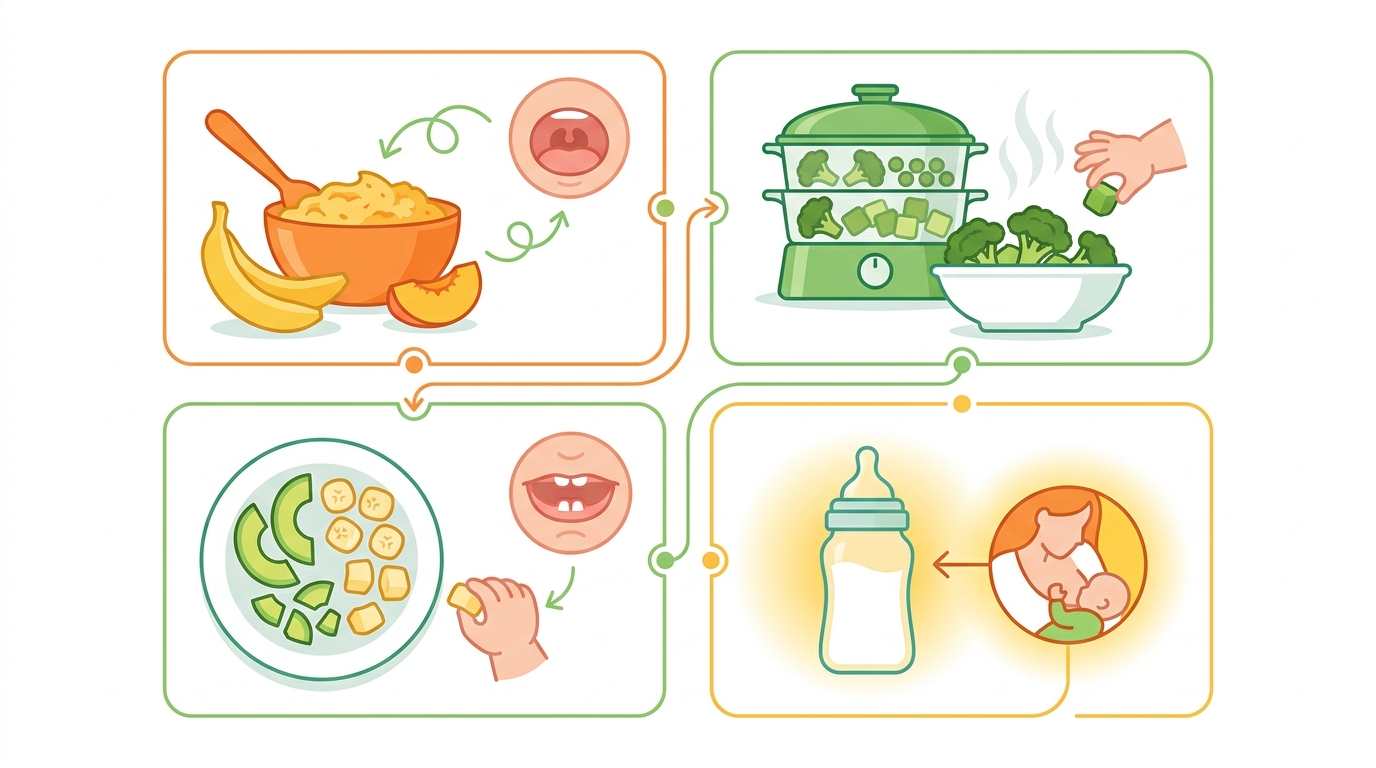
You should start with pureed foods (purées) and gradually change the nature of the foods.
- Mashed foods: Vegetables like potatoes, sweet potatoes, and pumpkin can be boiled and mashed. Fruits like bananas and avocados are also good to be given this way.
- Finely chopped or minced foods:When they are used to chewing small pieces, give them well-cooked meat, fish, and chicken, then cut or grind them into very small pieces.
- Soft finger foods: When your baby is ready to eat on their own, offer them soft finger foods. This will help them develop their chewing skills and fine motor skills .
Imagine what a new experience it will be for a baby when he first drinks things like porridge, then eats mashed food, and now eats small pieces on his own!
Here are some nutritious foods you can give your baby:
- Vegetables: Give well-cooked carrots, beans, pumpkin, sweet potatoes, potatoes, spinach, and cabbage, either mashed or cut into small pieces.
- Fruits : Give things like well-ripened bananas, mangoes, papayas, avocados, and apples (boiled/steamed and mashed).
- Grains: Boil rice well and mash it, make porridge from things like kurakkan and oats. Small pieces of bread (choose breads with less sugar, healthier than white bread).
- Protein -rich foods:
- Eggs: You can give the yolk of a well-boiled egg first, followed by the white (be careful about allergies).
- Fish : Well-cooked fish with the bones removed. You can also give a little bit of oily fish like salmon and mackerel (for Omega-3).
- Chicken/Meat: Boil well, cut into small pieces or grind them.
- Lentils and nuts: Grind well-cooked lentils, chickpeas, and green beans.
- Dairy foods: Yogurt (unsweetened), cheese (low-salt varieties, small amounts) can be given. Cow's milk should not be given as a drink until after a year, but it is okay to add a little when preparing food.
The most important thing: Introduce only one new food at a time. Wait 3-4 days and watch for any allergic reactions. For example, skin rashes, stomach upset, or vomiting. If you notice any of these, stop feeding the food and talk to a doctor.
You definitely need to think about these things when serving food!
While feeding a baby is a joy, there are several things we need to be careful about.
Safety comes first! Be careful of things that could get stuck.
At this age, babies aren't exactly used to chewing and swallowing, so there's a high chance of choking on some foods.
- Round, hard foods: grapefruit (whole),Never give sausage pieces (cut into rounds), nuts (like peanuts, cashews), or hard candies. If you do give something like grapes, cut them lengthwise into quarters.
- Sticky foods: Don't give things like peanut butter by itself with a big spoon. Spread it thinly on bread or a biscuit.
- Uncooked food: Do not give undercooked vegetables or pieces of meat.
- Small nuts: Be very careful with things like cherry pits and fish shells.
You should always be there when your baby is eating. Never leave your baby alone to eat. You should be able to act quickly in case of an emergency.
You also need to think about iron!
After 6 months, babies need more iron. The amount of iron they get from breast milk may not be enough during this time. Therefore, it is essential to provide iron-rich foods.
- Iron-fortified cereals
- Well-cooked red meat, chicken (especially the tenderloin parts)
- Green vegetables like lentils and spinach
- Egg yolk
To increase iron absorption, you can add fruits rich in vitamin C (like oranges, tangerines) to your diet. However, be careful with citrus fruits, as some babies may be allergic to them.
Don't overthink the amount of food you eat.
Not all babies eat the same amount. Some days they eat well, and some days they eat a little less. If your baby refuses to eat , don't force them to eat. This can create a bad attitude towards food. Your baby will let you know when he's hungry. Start small and give him the amount he wants.
Should we teach our baby to eat alone? Is that a good thing?
Yes, absolutely! By 8-9 months, babies are very interested in self-feeding. This is very important for their development.
- Fine motor skills develop: The muscles in their fingers and hands become stronger as they pick up small pieces of food and bring them to their mouths. That 'pincer grasp' mentioned earlier also helps with this.
- Hand-eye coordination improves.
- They learn to recognize their hunger and fullness.
- Interest in food and self-confidence increase.
Okay, it's going to be a little messy. Food will fall on the floor, clothes will get dirty. But that's part of the process. Put a large plastic sheet under the baby's chair. Dress him in clothes that can be easily washed. Let him enjoy this experience freely.
Things you can give as finger foods:
- Cut well-boiled carrots, beans, potatoes, and sweet potatoes into sticks.
- Small pieces of banana, mango, and avocado.
- Boiled pasta (without salt or sauce).
- Low-sugar biscuits or rusks.
- Small pieces of bread.
- Small pieces of well-cooked chicken or meat (only if you can chew them).
Don't forget about breast milk/formula, okay?
It is never a good idea to stop giving breast milk or formula just because you have started eating at home. Until the age of one, most of a baby's basic nutritional needs are met by breast milk or formula.
- For babies 8-9 months: Give solid foods first, then breast milk/formula.
- For babies 10-12 months: As the amount of solid food increases, the frequency of feedings may decrease slightly. However, it is important to feed several times a day.
Simply put, solid foods are complementary foods at this stage, not a replacement for milk.
What to do if the baby doesn't eat?
This is a problem that many mothers have. Some babies refuse new foods, or suddenly say no to foods they have been eating well for a while. This is called ``Picky eating''. Don't worry, this is normal.
- Be patient: Don't give the food back just because it's refused once. Try again after a few days. Sometimes you may have to try 10-15 times.
- Make mealtimes enjoyable: Don't get angry or yell while feeding. Feed while playing and talking.
- Eat meals together with your family: When your baby sees you eating, he or she will be more interested in eating.
- Prepare food in different ways: Prepare the same vegetable in different ways (boiled, mashed, as a soup).
- Serve food in an attractive way: Decorate the plate by adding colorful vegetables and fruits.
Remember, when a baby's stomach is full, he will stop eating. Don't try to feed him more at that time.
Don't forget to water!
It is also important to give your baby water when starting solid foods.
- Give some boiled water during or after meals.
- Practice giving from a cup or sippy cup.
- Giving fruit juice (especially packaged ones) is not a good idea. They contain a lot of sugar. It is best to give the fruit as is.
Don't give these things to your baby! (Foods to Avoid)
Some foods are not suitable for babies of this age.
- Honey: Do not give honey to babies under one year of age. It can contain a dangerous bacteria called ``Botulism.''
- Cow's milk: Do not give cow's milk as a main drink to babies under one year old. The nutrients in it are difficult for the baby to absorb, and can be a burden on the kidneys. It also reduces iron absorption. (It's okay to use a little to prepare food).
- Salt and sugar: Do not add salt or sugar to your baby's food. Their kidneys cannot handle it. Get them used to the natural flavors of food.
- Processed foods: Things like sausages, noodles (instant), and packaged soups are high in salt, sugar, and preservatives.
- Coffee, tea: These are not suitable at all.
A Take-Home Message
8-12 months is a very important milestone in a baby's eating habits. During this time, they begin to experiment with new tastes and textures of new foods.
- Patience and affection are the most important things. Not all babies are the same. Go at your baby's pace.
- Prioritize diversity . Introduce nutritious foods from each culture.
- Always be mindful of safety . Be careful of foods that can get stuck.
- Encourage your baby to eat on their own. It helps them a lot in their development.
- Don't stop giving breast milk or formula . It is still a major source of nutrition.
- If you have any questions or doubts, don't be afraid to talk to your pediatrician .
You are not going on this journey alone. We hope this new experience will be a joy for you and your baby!
` Solid foods, infant nutrition, 8-12 month old baby, home cooking, finger foods, allergies, breastfeeding
Doctor's Note
The period between 8 and 12 months is a very important transition period when the baby gets used to solid foods and different tastes. During this time, the baby can be given 3 main meals and 1-2 snacks a day in addition to breast milk. Baby-led weaning helps develop baby's chewing ability and fine motor skills. Remember not to add salt or sugar to food.
❓ Some more questions you may encounter (FAQ)
What are the best foods to give an 8-12 month old baby?▼
Boiled and mashed vegetables (carrots, brinjals, potatoes), fruits (bananas, avocados, papayas), boiled meat cut into small pieces, fish or egg yolks and rice are staples.
Is it safe to give baby finger foods?▼
Yes, it is okay to give soft foods (eg, well-ripened avocados, boiled carrot chunks) that the baby can hold and eat on their own. But stay close to the baby often to avoid choking.
Is it appropriate to drink cow's milk at this age?▼
no Cow's milk should not be given as the main drink until the age of 1 year. Because the baby's kidneys are still immature to digest the protein and minerals it contains.


💬 Comments (0)
No comments yet. Be the first to share your thoughts here.
Add Your Comment