
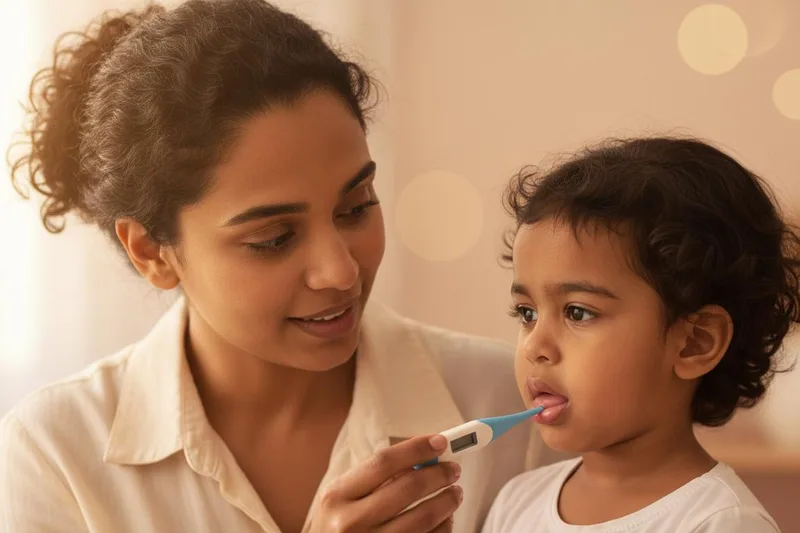
As a mother or father, sometimes you get a little scared when your child feels like they have a fever, don't you? Then the first thing we do is take a thermometer and check the child's temperature. But checking this temperature is also something that needs to be done correctly. There are a few things to be careful about, especially when checking the temperature through the mouth (oral temperature). Shall we talk about that today?
Why do we need to accurately measure a child's fever?
Simply put, fever is not a disease, but a sign of a disease. Fever occurs when our body is fighting an infection inside us. So, when we measure our child's fever accurately, we can understand how the child is doing. Also, this helps a doctor a lot in explaining the details about the child and deciding what kind of treatment is needed and what to do. Therefore, it is more important to check the temperature with a thermometer than just the temperature that you can feel with your hand.
What is the best age to take an oral temperature?
Most of the time, a child can take an oral temperature by the time they are 4 or 5 years old . It can be a bit more difficult for younger children.
Imagine, if we tell a small baby, “Open your mouth, put this under your tongue, don’t chew,” it’s hard for them to understand and stay that way, isn’t it? They try to chew the fever needle, put it out, and play with it. That’s why it’s said that when the child is a little older, understands what we say, and has enough patience to keep the fever needle in their mouth, taking the temperature through the mouth is more successful. For children younger than that, other methods such as the armpit (axillary) can be used to take the temperature.
Consider these things before checking your mouth for fever
There are a few things we need to be careful about before taking a temperature through the mouth. Only by doing these things correctly will we be able to measure the temperature accurately.
What kind of thermometer should I use?
This is very important. You should definitely use a digital thermometer.
In the past, there were glass bamboo skewers that contained mercury. They are not recommended for use now. Because, if such a bamboo skewer is accidentally broken, the mercury in it is very toxic and dangerous. Therefore, they are not recommended now.
Digital thermometers are easy to use, safe, and display the temperature clearly in numbers. Some even change color if the temperature is too high.
How long after eating and drinking should I take my temperature?
You should wait at least 20 to 30 minutes after your child has eaten or drunk anything (hot or cold) before checking their temperature by mouth.
Imagine, what happens if you take a child's temperature in the mouth after they have eaten a large amount of ice cream? Because of the cold inside the mouth, the thermometer shows a lower temperature than the actual temperature. Or, if you take a child's temperature after they have drunk hot tea or milk, the thermometer shows a higher temperature than the actual temperature because of the heat in the mouth. Then we cannot get an accurate measurement. That is why we say to wait a while and take the temperature after the oral temperature has returned to normal.
See if there is anything else in the mouth.
Before taking the temperature, if the child has anything in their mouth, such as chewing gum, toffee, or bulto, they should be removed. When these things are in the mouth, the thermometer will not be positioned properly under the tongue, and there is a high chance of the temperature reading being inaccurate.
Okay, now how exactly do you check for fever in the mouth?
Okay, let's now see how to accurately take a child's temperature by mouth. If you follow these steps, you too can accurately measure a child's temperature.
1. Check the tip: First, check that your digital thermometer is clean. It is important to clean the tip of the thermometer before and after use by wiping it with lukewarm water and soap or an alcohol swab that you can buy at the pharmacy. This will help prevent the spread of germs.
2. Prepare the child: Talk to the child and familiarize him/her with something like, “Son/daughter, let's take a look at the fever from the mouth now. Don't be afraid, it won't hurt at all. Mom/Dad will help.” Then he/she will be able to sit without getting nervous.
3. Place the thermometer under the tongue: Now place the metal part (sensor tip) of the thermometer exactly under the child's tongue . It is best if you can place it on one side of the tongue, a little inside (in the sublingual pocket), not exactly in the middle of the tongue. Because that is where the body temperature is best and most accurately sensed.
4. Tell your child to close their lips: After placing the thermometer under their tongue, tell them to close their lips tightly , as if they were trying to squeeze the thermometer inside their mouth. But you should also make it clear that they should not chew on it . Even digital thermometers can break if they are chewed on, or they will not get an accurate reading.
5. Relax and breathe through your nose: Tell your child to breathe slowly through their nose without talking or chewing on the bottle. If they breathe through their mouth, the air outside can enter their mouth and change the temperature reading. So, tell them to relax and not worry.
6. Wait for the “beep” sound: Most digital thermometers will beep when they measure your temperature. Wait for the beep. Some thermometers take 10-30 seconds, while others take up to a minute. Check the manual for the thermometer you are using to find out how long it usually takes.
7. Read the temperature: After the “beep” sound, slowly take out the thermometer and read the temperature on the digital display. It’s a good idea to write it down somewhere, especially if you need to tell a doctor.
When you are shown how high the fever is, what should you understand by that?
Okay, now you've taken your temperature. The thermometer shows a number. What does that mean?
- The normal oral temperature of a healthy person is between 36.5°C and 37.5°C (97.7°F and 99.5°F) . However, this can vary slightly from person to person and depending on the time of day. Body temperature may be slightly higher in the evening than in the morning.
- If the oral temperature is 38°C (38 degrees Celsius) or higher (that is, 100.4°F or higher), we consider it a fever.
When should I see a doctor?
There's no need to be afraid of a fever all the time. But in cases like these, it's best to definitely see a doctor and get advice:
- If a baby under 3 months old has a fever of 38°C (100.4°F) or higher, you should see a doctor immediately. A fever in a baby this age can be a sign of a very serious infection.
- If an older child has a fever and other dangerous symptoms such as difficulty breathing, stiff neck (difficulty bending the neck), sudden rash, excessive sleepiness or restlessness, refusal to eat or drink, or seizures/fits , no matter how high the fever is, see a doctor immediately.
- If the fever persists for more than two or three days, if the fever does not go down even after you give a medicine like Paracetamol as advised by a doctor, or if the child is not eating or drinking and is very lethargic and lethargic, it is best to see a doctor.
- Even if your child's fever is down, if their behavior is not normal, or if you have any doubts or fears, never hesitate to seek advice from a doctor.
Remember, if you have any doubts or concerns about your child's fever or their health, it's never too late to seek medical advice. It's the best thing you can do for your child.
What do you do after checking your temperature?
Even after the fever subsides, there are still a few things to do.
- First, clean the bamboo skewer thoroughly as mentioned earlier, put a small cover on it if you have one, and store it in a safe place where little ones can't get to it.
- Thank your child for their patience in helping you check their fever, and praise them. Ask something like, "It's over now, didn't it hurt?"
- If there is a fever, you can give a dose of Paracetamol that is appropriate for the child's weight, as previously advised by a doctor. But remember, do not give medicines like Aspirin to young children without a doctor's advice, especially during a viral fever. It can cause a very dangerous and life-threatening condition called Reye's Syndrome.
- Give a child with a fever plenty of fluids to drink, such as water, fruit juice, and herbal teas. This is very important to prevent dehydration.
- Dress the child in light, cotton clothes. Make sure he gets plenty of rest.
Don't make these mistakes!
When taking a temperature from the mouth, we can sometimes make small mistakes without even realizing it. So be aware of these things:
- Taking a temperature after eating or drinking, especially after consuming something hot or cold.
- Placing the bamboo skewer above the tongue (it should be placed exactly under the tongue).
- Trying to check the temperature when the child talks, chews on the thermometer, or moves around.
- Using broken, old, or battery-operated bamboo skewers.
- Sharing a bamboo skewer without cleaning it.
Summary: Take-Home Message
We hope that you have gained a good understanding of oral temperature from what we have discussed. Finally, let's remind ourselves of these points:
- The best age for a child to take an oral temperature is usually after 4-5 years of age.
- Be sure to use a digital thermometer . Never use a glass mercury thermometer!
- You should wait at least 20-30 minutes after your child has eaten or drunk something before taking a temperature from their mouth.
- Place the tip of the thermometer under the tongue, to one side , and tell the child to close their lips, breathe through their nose, and not chew.
- Be patient until the bamboo skewer makes a "beep" sound or until the allotted time has passed.
- An oral temperature of 38°C (100.4°F) or higher is considered a fever.
- If a baby under 3 months old has a fever, or if the fever is accompanied by other dangerous symptoms (difficulty breathing, seizures, excessive sleepiness), or if you have any doubts, see a doctor immediately.
- Clean the bamboo skewer thoroughly before and after use.
If you follow these tips, you can accurately measure your child's fever and provide the care they need. As always, don't hesitate to ask a doctor if you have any concerns.


💬 Comments (0)
No comments yet. Be the first to share your thoughts here.
Add Your Comment