
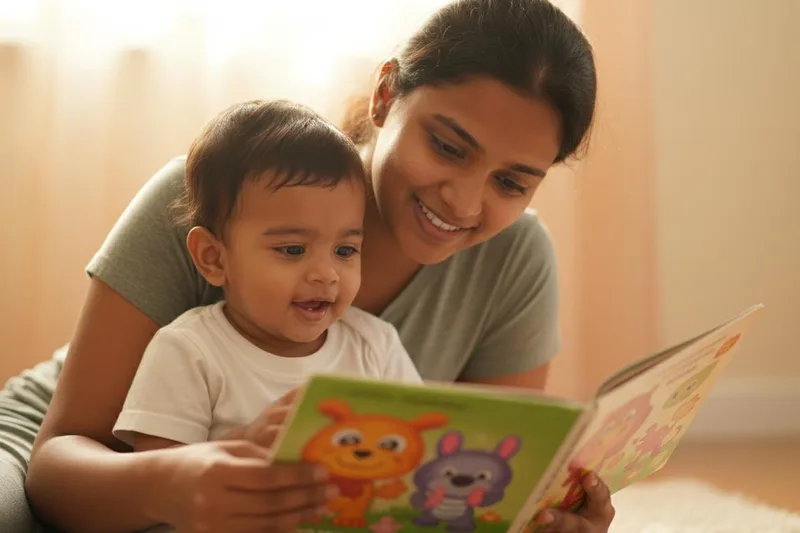
As your little one grows, their little brains pick up on things very quickly. So the good habits we instill in them at this time will be a great help for their whole lives. One such valuable habit is reading books to them from an early age. Some parents may think, "Oh, what will this little one understand by reading books?" But, there is more to it than you think! Today, let's talk about the amazing benefits of reading books to your little one, and how exactly to do it.
What are the benefits of reading books to children? Why is this so important?
Simply put, children who are exposed to language from a young age are more likely to do well in school. One of the best ways to get them to hear the language is to read books to them.
Think about it, before a child can start reading a book on their own, they need to have some basic reading skills (early literacy skills) . These are the most important ones:
- Knowing a lot of words and being able to use them. Just like playing with a new toy when you find it, words are like new toys for them.
- Understanding that words are made up of small sounds put together is called phonemic awareness . For example, they gradually understand that the word "baby" is made up of the two sounds "ব" and "বা".
- Understanding that the things on a page of a book represent letters and words. They recognize that these lines and circles represent something.
- Recognizing the letters of the alphabet.
Now you might think that teaching these things requires big toys and flashcards. No way! The best way to help them learn to read on their own is to read to them as much as possible.
How do they get help from books when they are little?
Between the ages of one and three, when your little one is a toddler, there are a lot of big changes in their lives. Some things are very exciting, but there are also some challenges. So, it's great for them to hear stories about how other little ones have dealt with their problems, fears (like being afraid of something under the bed!), or how they learned to use the potty.
This is when their vocabulary suddenly increases by a huge leap. They also learn about letters, shapes, colors, weather, animals, and seasons. All of this comes to mind more and more when they read books. It's a good idea to choose books that have good pictures and that you can point to and say.
But more than anything, even though they are eager to learn about the world and experience it, the bond they have with you is very important. Reading books together regularly strengthens that bond. It makes the little one feel safe and relaxed.
When and how should a child read books?
If possible, it's a good goal to read at least once a day. Especially when you set aside specific times, like before a nap or before bed, it helps your little one get used to sitting down with a book and relaxing. But you can also read books whenever your little one seems to be interested in reading.
If your little one likes it, hold him on your lap while you read the book. This will make him feel safe, happy, and relaxed. It will also show him that you are giving him your full attention as you show him new things. This will make him more interested in participating in more things.
Toddlers love to do their own work. So, put out three or four books and say, "Choose one of these." Whatever book he chooses, praise it. Ask him to help you turn the pages, and ask for help finding things on the page. When there are familiar, repetitive sentences, such as nursery rhymes, your toddler will love to complete the sentences. When you get to that point, stop and let him finish.
Keep these things in mind when reading books:
Here are some other important points:
- Read any book your little one asks for. It doesn't matter if it's the same book they ask for every night for weeks, maybe months. If they love it, it means there's something special about it for them.
- Please read the story to understand it.
- Read with good expression. Use different voices for different characters, raising and lowering your voice where necessary.
- Choose thick cardboard books (board books) or cloth books. That way, you can let your little one touch and play with them without worrying about the pages tearing.
- Use puppets, finger toys (like "Itsy Bitsy Spider"), or show small objects related to the story while reading books.
- Encourage them to clap their hands and sing along when reading books that have rhythmic, song-like lyrics.
- Talk about pictures. Point to things and name them. Then ask your child to name them along with you, and praise them when they answer.
- Ask open-ended questions: "Why do you think the lion is going into the forest? What do you think will happen next?" This will encourage them to think about the story a little and ask questions.
- Have your little one read to a character in the book named after them. It will be so much fun for them!
- Make it fun! Show your little one that reading books is a joy.
Isn't the kid just sitting there and listening? Don't worry!
Trying to read to a toddler who won't sit still can be frustrating at times. But be patient and keep trying. Find a book or a few pages that interest him. If it doesn't work, don't force him to read, but don't forget to try again later. Remember, toddlers love the same things - if your toddler doesn't seem interested in books, find a book he likes and keep reading it, over and over again.
Some very naughty children like to stand and listen while you read books. Others like to look at a page or two and move on to something else. But leave the book there - the child may come back to look at it again, and encourage him to do so.
It doesn't matter if your little one doesn't sit still for the entire book - their attention span is gradually increasing. It's a good idea to continue reading the book even if your little one moves around. Especially at night before bed, let them hold and play with their favorite toys while you read the book. Your voice will be a comforting reminder that it's bedtime and that reading is part of that routine.
You may notice that while you are reading a book, your child is listening intently, either while coloring or playing with a favorite toy. Some children may not look at you or the book, but that doesn't mean they are not interested or listening.
You want to develop a positive, positive attitude about reading to your child. If you feel stressed or your child is not interested in the book, put the book aside and come back to it later.
There are other things you can do to build your little one's early literacy skills besides reading books:
- Talk to your little one throughout the day.
- Sing songs together, play games with rhymes, and make up your own stories together.
- Give your little one paper and colored pencils to practice writing.
Also, consider limiting screen time (TV or other electronic devices).
What kind of books are good for little ones to read?
Little ones like to feel like they matter, that they can do things too. So, choose books that they can grab and go, especially those with familiar or repetitive words, so they can fill in the words too. Choose books with fewer words per page, on topics that your little one is interested in, to keep them interested.
For toddlers 1-2 years (12-24 months):
Thick cardboard books are suitable for toddlers this age. It is best if they have pictures (especially photos) of everyday activities that young children do. Books about bedtime, bath time, mealtimes, and saying hello and goodbye are good choices. Choose books that have flaps that can be lifted up and different surfaces to touch to keep little hands busy.
For toddlers 2-3 years (24-36 months):
At this age, little ones are starting to turn the pages of regular paper. So, this is a good time to move beyond cardboard books. Choose books that are easy to read and remember, so they can join in on the "reading" too.
By now you've probably started to get a sense of what your little one likes. Look for books about trains, unicorns, or teddy bears. Little ones this age also like books about babies, families, and animals.
Toddlers love to have people they know, to look at homemade books, scrapbooks, and photo albums (with a simple description). Poetry books and songbooks are great for this age group. Maybe book reading time can even be song time!
Easy ways to keep books close at hand
Kids love to choose their own books. Put some books in a basket on the floor or on a shelf that is easy for them to reach. Then they can pick them out on their own. Keep a few books in the car, for when they go to the doctor, or in their bag at all times to give to them when they are in line at the store.
Go to the library or bookstore and let your little one choose books to read at home. Many libraries and bookstores have storytimes for little ones, which kids love. Also, let your little one see you reading books for fun. That's a great way to set a good example for your little one to read books.
The most important thing for you to remember is
So, you probably understand how valuable it is to read books to your little ones from a young age. This not only helps with their brain development, language skills, and schoolwork, but it also helps strengthen the bond between you and your little one.
Sharing a book with a child is like giving them knowledge, joy, and love all at once. So never miss this small, yet powerful habit. Find some time every day to read books together with your child. It will be a very valuable experience for both of you!
` Young children, reading books, early literacy, parents, child development, language development, Sri Lanka


💬 Comments (0)
No comments yet. Be the first to share your thoughts here.
Add Your Comment