

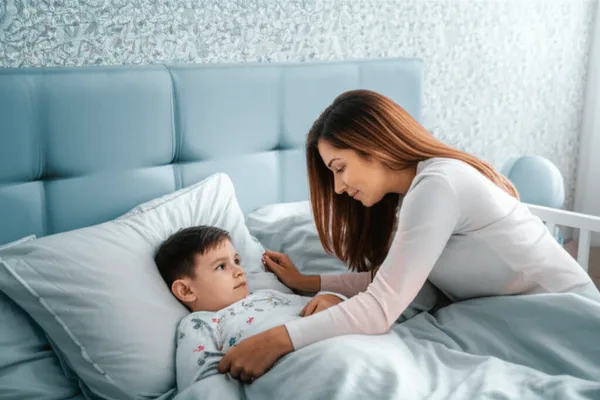
Is your child not sleeping well at night? It is normal for both young and older children to have trouble sleeping at night. But when this happens every day, it worries you as a mother, doesn't it? Good sleep is very important for a child's development, learning, and happiness throughout the day. So, if you take a little care about good sleep habits, that is, healthy sleep hygiene , you can find a solution to this problem to a great extent. These habits are especially helpful for children suffering from insomnia . Let's see what these are?
How to help children get good sleep?
Try these habits to help your child sleep well at night:
1. Follow a specific bedtime routine
Simply put, this means doing the same calming routine every night before going to bed. Imagine, if you suddenly tell a child who has been tired from playing and working at school all day, “Go to sleep!” it would be hard for them, wouldn’t it? It’s like trying to stop a fast-running machine. That’s why it’s important to create a little preparation before bed, that is, a routine. This will prepare both the child’s mind and body for sleep.
So what can this do?
- You can take a bath or shower with lukewarm water . This will make your body feel good.
- You can listen to calm, sweet music .
- It is also good to give them a mild herbal tea (with less sugar ) like chamomile.
- You can do some deep breathing exercises . Say, "Take a deep breath and exhale slowly" with your child.
- You can also do some simple light stretching exercises that will make your body feel lighter.
The important thing is that you can incorporate anything that makes your child feel calm and relaxed. It doesn't have to be a lot of work, just one or two will do. The important thing is to do it in the same order every day.
2. Limit bright lights and electronics at night
Our bodies have a hormone that regulates sleep, called melatonin . Exposure to bright light, especially blue light, reduces the production of this hormone, which means that sleep is delayed.
- Try to reduce the amount of light in your home in the evening and at night. If possible, use dimmable lamps or warm-colored bulbs.
- Limit bright light and blue light from electronic devices like TVs, phones, and tablets. Many phones have a “night setting,” use it.
- Experts say that all screens should be put aside at least an hour before bedtime . Instead, read a book or, as mentioned earlier, direct your child to do something calming.
3. Establish a Regular Sleep Schedule
This is very important. Going to bed and waking up at the same time every day helps our body's natural clock (Circadian rhythm) function properly. Then, at the right time in the evening, the hormone Melatonin is produced and sleep begins to occur.
- Unless your child is sick or has a particularly bad night's sleep, try to wake them up at the same time on weekends and holidays . It's okay to sleep in for up to 30 minutes longer. Sleeping in longer than that can disrupt their sleep pattern during the week.
4. Keep the bedroom cool, dark, and quiet.
The bedroom environment also has a great impact on good sleep.
- Keep the room a little cool . You can use an AC or a fan. (But some babies like to sleep in a warm room, so check with your baby's preference).
- Make the room very dark. It's best to have no light at all. Cover any light sources with curtains.
- Reduce noise. If there are sounds that cannot be avoided, you can give your child earplugs and a sleep mask.
5. Plan to spend enough time in bed
The amount of sleep children need varies with their age.
- School-age children (ages 6-12) generally need between 9-12 hours of sleep per day.
- Teens need between 8-10 hours of sleep.
Remember, some children may need more sleep than others. If your child seems tired all the time, he may not be getting enough sleep.
6. Get some sunlight exposure as soon as you wake up.
When we wake up in the morning and the sun (or any bright light) hits our body, our brain gets a signal that says, “It’s daytime now, and we need to reduce the production of melatonin.” This gets our body ready to start the day.
- If there is little sunlight in the morning where you live, you can place a bright lamp in the room to turn on when your child wakes up.
7. Limit caffeine.
Caffeine is a stimulant, which means it prevents you from falling asleep.
- Experts say it's not a good idea to give young children anything that contains caffeine (e.g. coffee, tea, chocolate, some soft drinks).
- It's okay for teenagers to have small amounts (less than 1 cup of coffee per day, which is less than 100mg). But it's best for everyone to avoid caffeine after 3pm.
8. Limit daytime naps
Avoid giving your child a nap during the day unless he or she is really sleep deprived (e.g., when recovering from an illness). Napping during the day can make it harder for him or her to fall asleep at night, because he or she won't feel tired.
9. Exercise during the day
It has been found that exercising during the day can help you sleep better at night. However, this exercise should be done before dusk. (Exercising in the evening can sometimes disrupt sleep.)
- Any activity that increases a child's heart rate for about 30-60 minutes (playing, running, jumping) will help them sleep better at night.
10. If you still can't sleep despite doing everything else, get out of bed.
Sometimes children stay awake for up to 30 minutes after going to bed, or they are worried and anxious about not being able to sleep. At that time, it is actually a good idea to get out of bed. A bed is a place to sleep and feel comfortable, not a place to toss and turn and suffer.
- Get out of bed and tell your child to do something relaxing and a little boring (e.g., look at pictures in a book, do a simple puzzle). They will start to fall asleep again in a while.
When starting these new habits, don't try to do everything at once. If you do, it can become overwhelming for your child and they may not stick with them. Start with one or two, and when they become a habit, add another. Talk to your child, ask them what they can do now, and make these changes one by one.
What else do I need to know?
If you've tried all of these, and your child still isn't sleeping well, definitely see a doctor. There are some sleep disorders, such as obstructive sleep apnea , that require specific treatment to help them recover.
Also, do not give your child melatonin pills, herbal supplements, or other sleep aids without a doctor's recommendation. These can have negative side effects in children and adolescents. Remember, any medication given to a child should be under the supervision of a doctor.
Finally, the most important things to remember
So, you probably understand how important good sleep is for a child, and how we can help with that.
- Instill these habits in your child with patience and consistency . Don't expect overnight results.
- Involve your child in this too. Ask for his/her opinion too.
- Every child is different. What works for one child may not work for another. So experiment a little to find what works best for your child.
If you follow these little things, it will go a long way in helping your child get a good night's sleep. Then, he or she will be able to stay happy and healthy all day long!




💬 Comments (0)
No comments yet. Be the first to share your thoughts here.
Add Your Comment