
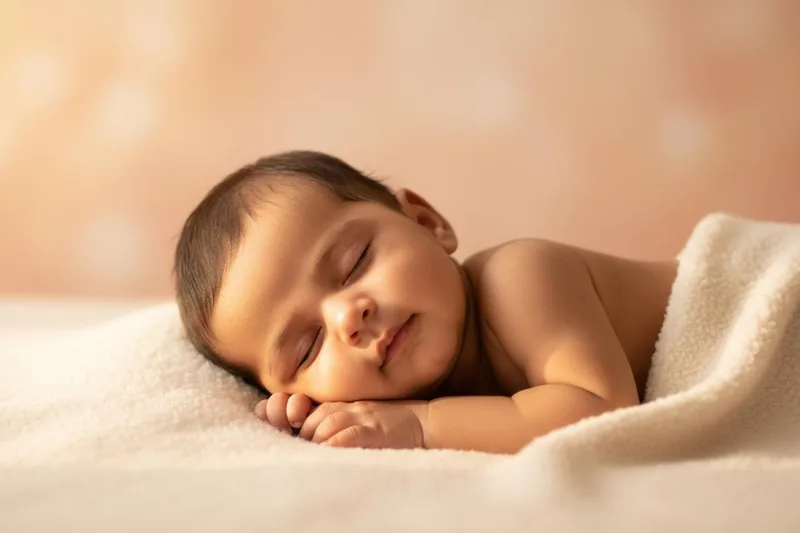
Moms and dads, you all know how important sleep is in a child's life. Sometimes when a baby doesn't sleep well, it affects the whole family, right? Not only when they are young, but also when they grow up, if a child doesn't get enough sleep, it can greatly affect their learning, behavior, attention, and even their mood throughout the day. So, today we will talk about sleep in a little more detail.
What really happens inside the brain during sleep?
While you might think that when we sleep, our brain just goes dormant and does nothing, that's not really the case. Our brain is very busy even when we're asleep. It goes through different sleep stages (some people call them `sleep stages`). It's like a cycle. The sleep stages can be divided into two main parts.
1. `Non-REM` sleep (Non-rapid eye movement sleep)
2. `REM` sleep (abbreviation for `Rapid Eye Movement`)
These `Non-REM` and `REM` stages combine to form a `sleep cycle`. Surprisingly, babies spend more time in `REM` sleep, and their sleep cycles are shorter than adults. As they get older, the time they spend in `REM` sleep decreases, and their sleep cycles gradually become longer. By the time a child starts school, a complete sleep cycle usually lasts about 90 minutes, which is similar to an adult`s sleep cycle.
Now let's look at these sleep stages in a little more detail.
Light stages of `Non-REM` sleep (stages 1 and 2)
This is the first stage of falling asleep. To be precise, the first and second stages of sleep. These are very light stages of sleep.
- At this time, if someone speaks a little, or if you hear a small noise , you can easily wake them up.
- It's normal for the eyes to move around.
- Heart rate and breathing rate gradually decrease.
- Body temperature also decreases slightly.
Simply put, this is the time when we "settle down" for sleep.
The deep stage of `Non-REM` sleep (stage 3)
This is true deep sleep. The third stage of sleep.
- It's very difficult to wake someone up at this time.
- If you wake him up suddenly, he may feel groggy and confused for a while, as if he's drunk. Has that happened to you sometimes?
- It is during this deep sleep that some children are more likely to experience things like night terrors, sleepwalking, or bed- wetting .
- This is the part of sleep that brings the most rest and refreshment to the body and mind. Hormones essential for body growth, especially growth hormones, are released during this deep sleep. That is why this deep sleep is so important for young children.
What happens during `REM` sleep? (The last stage)
The last part of sleep is `REM` sleep. This is also a very special stage.
- In this, the eyes move back and forth very quickly under the eyelids. That's why it's called `Rapid Eye Movement`.
- Breathing and heart rate also become a little faster, just like when we are awake.
- The amazing thing is, during this `REM` sleep, we are unable to move our limbs. It is temporary. The brain sends signals for it.
- It is during this time that we experience our very clear, sometimes unforgettable, vivid dreams.
- Research has shown that REM sleep is very important for learning and memory. This stage helps the brain retain what has been learned throughout the day.
So, you see, sleep is not just about closing your eyes, it is a very complex and important process.
How much sleep do toddlers need per day?
This is a question that many parents ask. In fact, the amount of sleep a child needs can vary slightly from child to child. However, there are generally recommended amounts of sleep by age group by doctors and experts. Let's take a look at what those are? (Does this include naps during the day?)
- Newborn babies (0-3 months): About 14-17 hours a day.
- Babies 4-12 months: About 12-16 hours a day.
- Toddlers 1-2 years old: About 11-14 hours a day.
- Preschoolers 3-5 years old: About 10-13 hours per day.
- School-age children 6-13 years old: About 9-12 hours per day.
- Teens 14-17 years old: About 8-10 hours a day.
Remember, these are just general recommendations. If your child is happy, active, and healthy throughout the day, he or she is probably getting the sleep they need. However, if it seems like they are sleeping significantly less or more than these recommended amounts, or if you have any concerns about sleep, it is best to seek medical advice.
How do I know if my child is not getting enough sleep?
Sometimes, if a child is not getting enough sleep, we can understand it by their behavior and daily activities. Here are some signs to see if your child has any of these:
- Feeling sleepy during the day. For example, falling asleep at school, in class, or while driving.
- Young children sometimes become overly playful and hyperactive. This may seem a bit strange, but when young children don't get enough sleep, instead of becoming sleepy, they can sometimes become very playful and restless.
- Trouble paying attention . Difficulty paying attention when studying or listening to the teacher.
- Loss of interest in schoolwork, declining grades.
- Being cranky, whiny, irritable, or moody .
- The emergence of behavior problems.
Think about it, if your child sometimes falls asleep right after school without playing or reading a book, or if he gets angry for no reason at all, it could be due to lack of sleep. If you notice these things often, it's important to pay attention to it.
How to help children sleep well?
Fortunately, there are some simple but very important habits that can help children of all ages get good sleep. Try these with your child:
- Make it a habit to go to bed at a set time every day. Try to keep this time consistent, even on weekends, if possible. For younger children, remind them, "It's time to get ready for bed," 30 minutes before bedtime and 10 minutes before bedtime. For older children, talk to them about setting a bedtime that will help them get the amount of sleep they need for their age.
- Establish a bedtime routine. This is very important. When you have a routine that you do every night, your child's body and mind will prepare for sleep. This can include things like washing your body, brushing your teeth, getting dressed comfortably, reading a book with you, or listening to a slow, soothing song. It's best to keep this routine for 20-30 minutes.
- Keep your child away from all screens, such as TVs, computers, phones, tablets, and video games, at least an hour before bed. The blue light from these devices suppresses the production of melatonin, a hormone that helps you fall asleep. This can make it harder to fall asleep. If possible, it's a good idea to remove these types of electronic devices from your child's bedroom.
- Make the bedroom a comfortable, quiet place. Make sure your child sleeps in a dark, quiet, and comfortable temperature.
- Keep your child active during the day. Children who play and exercise well sleep better at night. But running and jumping around too close to bedtime is not good.
- Eat dinner 2-3 hours before bedtime. Going to bed too early after a full meal can sometimes cause discomfort.
Remember, a good night's sleep is very important for a child's physical and mental health, learning, and behavior. Therefore, it is very important to instill these habits in your child little by little. Do these things with patience and love.
More details about sleep by age
As we discussed earlier, sleep patterns and needs change as a child ages. A newborn's sleep is very different from a school-age child's sleep, isn't it? For example, newborns sleep for a few hours during the day and a few hours at night, but as they get older, their daytime sleep decreases and their nighttime sleep increases. That's why there are age-specific recommendations. It's a good idea to ask your family doctor or pediatrician about how to manage sleep according to your child's age. They can give you advice that's right for you and your child.
So, what is the most important thing we should take home from this story?
Okay, so here are some things you need to keep in mind from what we've talked about today:
- Adequate, quality sleep is essential for children's physical and mental development, learning, and good behavior. It is just as important as good food and drink.
- Sleep is not a continuous process. It has different stages called `Non-REM` and `REM`, each of which is important for our body and mind.
- Make sure your child gets the right amount of sleep for his or her age. Remember the hours we talked about.
- If your child seems to be sleep deprived, pay attention to the signs (such as daytime sleepiness, irritability, and lack of attention).
- There are some simple habits that can help you sleep better. The most important ones are going to bed at a set time, establishing a bedtime routine, and staying away from screens like phones and TVs before bed.
- If, despite all of this, you still have problems with your child's sleep, never be afraid to seek medical advice. Sometimes there may be another underlying cause that is not apparent.
So, we hope these tips will help you provide your child with a comfortable, restful, and adequate sleep!
Sleep, children's sleep, baby sleep, sleep stages, REM sleep, Non-REM sleep, sleep problems, good sleep


💬 Comments (0)
No comments yet. Be the first to share your thoughts here.
Add Your Comment