

As your little one grows up, there are many new challenges that you will face as a mother or father, right? One of them is getting your little one used to going to the toilet, that is, teaching him to control his urine and feces . Many parents feel a little nervous when they think about this, and many questions like, 'Oh my god, when should I start?' and 'Is my baby ready for this?' come to mind. So today, let's talk about how exactly this thing called 'Toilet Training' is done, when should we start, and what we need to be careful about.
How do you know if your baby is ready to go to the toilet?
Many parents think, 'Oh, my friend's baby started using the toilet at 18 months, so mine should start at the same age.' But the truth is, not all babies are the same. One baby is ready at a different time than another. So it's not right to base decisions on age alone. What's more important is to look at the signs that your baby is physically and mentally ready for this. It's like learning to read letters and recognize colors before going to school.
Imagine, have you ever seen your little one suddenly stop what he is doing while playing, look at you for a while, maybe even touch his diaper? It is through small gestures like that that we can understand that 'Oh... he seems to be having a bowel movement now, he feels it'. This is the first and most important sign.
So, it's more important to pay attention to these signs than age. Let's see what other signs of 'baby being ready' are.
Also pay attention to these signs that your baby is ready:
If your baby is doing these things, it could be a sign that he is getting ready to start toilet training:
- Ability to understand simple instructions: When you give a simple instruction like 'bring the ball' or 'give me your shoes', see if he understands it and does it accordingly. This ability is also needed for toilet training to understand things like 'let's go to the potty' and 'sit'.
- Understanding and using toilet-related words: Does he understand words like ' urine ', 'potty', 'wet diaper'? Does he even try to say them? Even if he can't say 'mommy pee ', does he try to tell you in some way (perhaps by pointing to the potty or making an awkward noise) when he feels the need?
- Understanding the connection between urination /poo and using the toilet: The idea that 'I'm urinating , so I need to go to the potty' needs to gradually enter his little head. This may not happen at first, but after a while he will recognize this connection.
- Has the diaper been wet for two hours or more? This means that his bladder control has improved a bit, and he is urinating more urine at a time.It's about being able to hold a certain amount of weight. If the baby is getting wet for half an hour before, he's not ready for this yet.
- Being able to go to the potty on their own, sit on it for a while, and then get up again: Sitting on the potty is also a challenge for little ones. They need to have both physical strength and patience for it.
- Being able to pull down diapers , training pants, or underwear: If you can pull down clothes on your own, that's a big help. Otherwise, you'll have to help all the time.
- Showing interest in using the potty or wearing underwear: Some babies become interested in using the potty or wearing underwear when they see their parents going to the toilet. They may say, "I want to go too," or "I want a diaper like that." If there is this interest, it's a good time to start.
Important: Not all babies show all of these signs in the same way or at the same time. But if your baby is showing most of these, then it's probably time to start slowly.
Most children start showing these signs between 18 and 24 months of age. But some children may show signs later, perhaps as early as 3 years of age. There's nothing wrong with that. Boys, in particular, tend to start a little later than girls and take longer to adjust. So don't expect your son to adjust at the same age as your friend's daughter. Give him his time.
What are the best options if I delay starting toilet training?
Even if your baby shows signs that they are ready to go to the toilet, there are times when it is better to delay starting this task. Because at times like these, your baby may have less attention and patience to get used to something new. And you may also have less time and effort to devote to this.
Imagine if you started toilet training when you were getting ready for a big trip, or when you had a new baby in the house? It's an extra stress for the baby, and for you too. So it's wise to delay starting toilet training in these situations:
- When traveling: If you are going out frequently or traveling long distances, introducing a new toilet can be a hassle for both you and your baby. It can be uncomfortable if you have to look for a potty everywhere, or if your baby can't control his urges.
- When a new baby joins the family or is about to join: When a new brother or sister arrives, the older child already feels a big difference. His attention span is divided, and he may even feel a little jealous. At such a time, another big change, toilet training, can be difficult for him to handle.
- When moving a baby from the crib to a bed:Moving from a crib to a bed is also a big new experience for a baby. It's best to wait until he gets used to it before starting toilet training. It's hard for a baby to handle two or three big changes at once.
- When moving to a new home: Moving home is a big worry. It takes time for the baby to get used to the new environment. Don't start this task at a time like that.
- When your baby is sick (especially if they have diarrhea ): Don't try new things when your baby is sick with a fever or cold. Don't start toilet training if your baby has diarrhea. It's harder for them to control their urine and stool at that time, and they're more uncomfortable.
Remember: Toilet training is not something to be rushed or forced into. The best results come when your baby is happy and you are calm. If necessary, consult your family doctor or pediatrician about this.
A few more tips for successful toilet training
Okay, now you know how to check if your baby is ready and when not to start. Next, let's look at some little things that can make this task easier and more successful.
- Keep a positive attitude: This is the most important thing. If you get upset or scold your baby, he will be even more afraid and reluctant to do this task. Speak encouragingly, such as, "Okay, son/daughter, let's try," or "It's okay if we can't do it today, we'll see tomorrow."
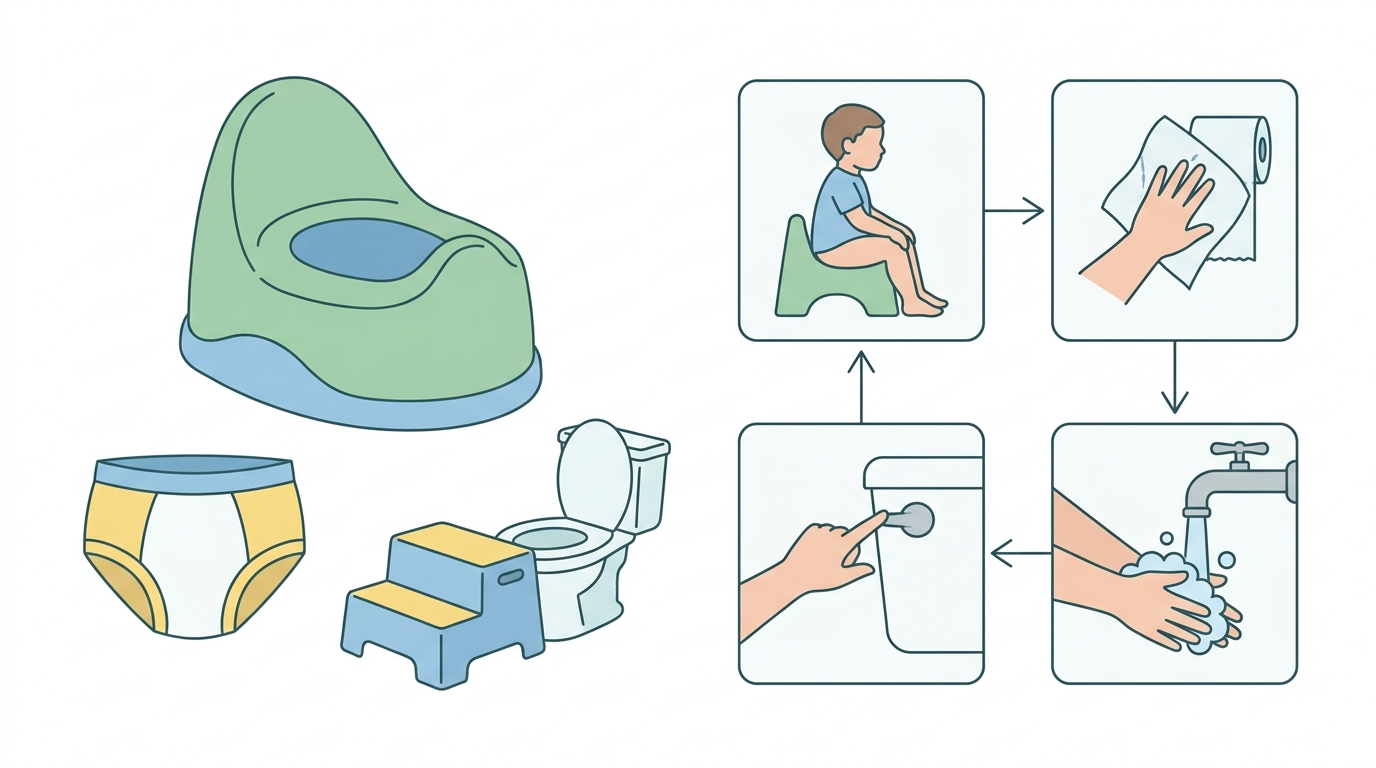
- Choose a potty: Choose a potty that is easy for your baby to use, and that they will like. Some potties have songs and lights. When your baby likes one, they will be more interested in using it. The potty should be placed where your baby can easily go, in a place where he or she often hangs out. It doesn't have to be in the bathroom in the early days.
- Take your baby to the potty frequently: Take your baby to the potty especially when he wakes up in the morning, after meals, after a nap, and before going to bed at night. This is when he is more likely to urinate /poo.
- Accept 'accidents' as normal: In the early stages, a baby may not be able to go to the potty properly and may urinate /poo on their clothes. These are called 'accidents'. Do not scold or punish the baby at such times. Instead, calmly say, 'Hey, you just peed a little, right? It's okay, we'll go to the potty next time,' and clean it up.
- Praise and give small gifts: When your baby uses the potty properly, praise him/her with words like, 'Wow... my daughter/son is so smart!', 'Good boy/girl!' You can also give him/her something like a small sticker or a small toy he/she likes. But don't make this a habit. The main thing is to show him/her your happiness.
- Get used to underwear:After a while, when your baby gets used to going to the potty, remove the diaper and put him in nice underpants. That way, he'll feel like he's a big boy now. Also, the discomfort of getting his underpants wet can increase his interest in going to the potty.
- Be patient: This is not something that can be done in a day or two. Some babies may take weeks, or even months, to fully adjust to this. So do this with patience and love.
Don't forget: every baby is different. Just because your friend's baby learned to use the potty in three days doesn't mean your baby will too. Help your baby go at his own pace.
The most important things to remember (Take-Home Message)
Okay, so let's remind you again of the most important points from what we talked about today.
- There is no specific age to start toilet training. It is important to look for signs that your baby is ready.
- If the baby understands instructions, says words about urine /poo, stays dry for more than two hours, and is interested in the potty, those are good signs.
- Boys usually take a little longer to get used to this.
- Don't start toilet training when there is a big change in the house (a new baby, moving house), or when the baby is sick.
- Patience, a positive attitude, and encouragement are your best friends on this journey.
- Accidents are a normal part of this process. Don't worry about them.
- If in doubt, always don't be afraid to seek advice from your family doctor or pediatrician .
I wish you and your little one all the best in overcoming this new challenge!
` Toilet training, potty training , children, health, parents, baby readiness, toilet habits
Doctor's Note
Toilet training is a process that depends on the child's physical and mental readiness. Preparation for this usually occurs between the ages of 2 and 3 years. The signs of readiness are when the child goes several hours without wetting his underwear, verbally or gestures that he needs to go to the toilet. It is important to introduce a small potty chair (potty chair) that is convenient for the child instead of forcing it, make him sit there at a fixed time every day and encourage the child every time he succeeds (Positive reinforcement).
❓ Some more questions you may encounter (FAQ)
How do I know if my child is ready for toilet training?▼
Readiness can be identified by the child's underwear remaining dry for at least 2 hours, showing discomfort and asking to be cleaned after defecating, and showing interest in the toilet seat.
What to do if the child does not want to use the toilet?▼
The child should never be punished or forced. Stop training for a few weeks and start slowly again when the child is willing.
How to teach hand washing during toilet training?▼
Washing hands with soap for 20 seconds after using the toilet can be practiced in a fun way by playing a game or singing a song with the child.


💬 Comments (0)
No comments yet. Be the first to share your thoughts here.
Add Your Comment