
When you start researching ReActiv8 restorative neurostimulation for chronic mechanical low back pain: reactivating stabilizing multifidus muscles, you have usually already walked a long, exhausting road. Maybe your lower back aches when you stand at the kitchen counter making morning coffee or tea, catches sharply when you unload groceries from the car, or stiffens up halfway through your commute. Be honest, you have probably tried stretching on the living room floor, heating pads, anti-inflammatory tablets, and months of physical therapy too, haven't you?
Have you ever wondered why your lower back still feels unstable—almost like it might "give way" during tiny everyday movements—even after a spine surgeon tells you that your scan does not require fusion surgery? In clinic, we doctors see this exact gap all the time. Often, the culprit is not a crushed nerve root, but deep spine-stabilizing muscles that have stayed switched off long after an old sprain healed. Frustrating, isn't it?
That is exactly where restorative neurostimulation enters modern spine care. Rather than masking pain signals on their way to your brain, this minimally invasive implanted therapy wakes up your body's natural muscular support system from the inside out. Let us walk through how this technology works, who truly qualifies, what daily sessions feel like, and how your Primary Care Physician (PCP) or family doctor can guide you to the right specialist team.
📌 Key Takeaways at a Glance
- Root-Cause Rehabilitation: ReActiv8 stimulates deep lumbar nerves to contract weakened spine-stabilizing muscles (lumbar multifidus muscles), restoring physical joint control rather than simply blocking nerve pain.
- Ideal Candidates: Designed for adults with chronic wear-and-tear back pain (chronic mechanical low back pain) lasting over 90 days who have not improved with physical therapy and medications, and who do not need spine surgery.
- Simple Home Schedule: After a 45-to-60-minute outpatient implant procedure, you run two gentle 30-minute muscle-reactivation sessions daily from your bed or couch using a wireless handheld remote.
- Gradual, Lasting Gains: Because real muscle strength takes time to rebuild, relief builds steadily over 3 to 12 months, with clinical trials showing over 70% of patients cutting pain by at least half at multi-year follow-up.
- Growing Coverage: Approved by the FDA in the US, backed by NICE guidance in the UK, and authorized in Australia, with expanding Medicare and private insurance pathways when conservative care is properly documented.
What Is ReActiv8 Restorative Neurostimulation for Chronic Mechanical Low Back Pain and How Does Reactivating Stabilizing Multifidus Muscles Work?
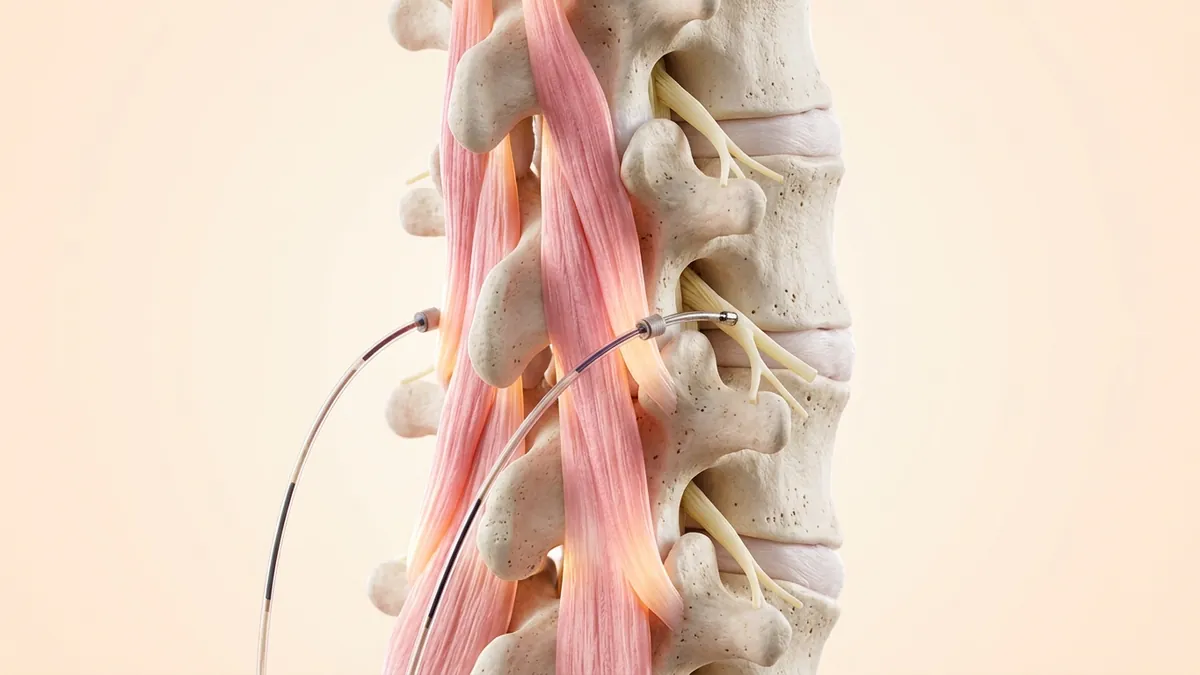
ReActiv8 restorative neurostimulation is an implanted medical device therapy that treats chronic mechanical low back pain by electrically stimulating the lumbar medial branch nerves twice daily to trigger smooth contractions in weakened multifidus muscles. Unlike pain-masking nerve stimulators, this rehabilitative system restores natural spinal stability, gradually reducing pain and disability over months.
Think about your spine like a tall sailboat mast for a second. Your large surface back muscles act like heavy outer ropes that bend and lift your trunk, while your deep spine-stabilizing muscles (lumbar multifidus muscles) sit right against each vertebra like precision guy-wires, keeping individual spinal joints snug and steady before you even lift your arm. We rarely stop to think about those tiny deep muscles until they stop firing, do we?
When your multifidus muscles stay dormant, small everyday motions—like leaning over the bathroom sink to brush your teeth or turning in bed—cause micro-slippage and joint irritation across your lumbar discs and facet joints. ReActiv8 places two thin, flexible leads beside the motor nerves supplying those muscles, specifically targeting the nerve branch behind your third lumbar bone (the L2 medial branch of the dorsal ramus). Twice a day, smooth electrical pulses override your body's neurological block, coaxing the multifidus muscles to contract and relax rhythmically. Over weeks and months, your brain relearns how to recruit those stabilizers naturally. Makes sense, right?
Why Do Deep Multifidus Muscles Shut Down and How Is Mechanical Back Pain Different From Sciatica?
Look closely at what happens inside your body right after you sprain a joint. Have you ever seen someone injure a knee and notice their front thigh muscle shrink within weeks? Doctors call that reflex muscle shutdown (arthrogenic muscle inhibition)—your nervous system automatically switches off muscles around an injured joint to prevent sudden movement. In your lower back, an acute disc strain or facet sprain triggers that exact same protective shutdown in your multifidus muscles. Pretty surprising, right?
For most people, those deep muscles wake back up once the initial injury settles. However, in many adults, the neurological "off switch" gets stuck. Without regular contraction, healthy muscle fibers slowly shrink and get replaced by streaks of fat—a change radiologists call muscle wasting and fat replacement (fatty infiltration) on a lower back magnetic resonance scan (lumbar MRI). Standard core exercises like planks often fail here because larger surface muscles take over and spasm while the deep multifidus remains silent.
Remember how we mentioned that "giving way" catch at the very beginning? We doctors always separate two very different kinds of chronic back pain during your exam. Pinched nerve leg pain (lumbar radiculopathy or sciatica) shoots sharp electricity, numbness, or weakness down below your knee from nerve compression. By contrast, chronic wear-and-tear back pain (nociceptive mechanical low back pain) stays centered across your beltline, buttocks, or upper thighs and flares with sustained positions or small load shifts. ReActiv8 specifically treats mechanical instability—not pinched leg nerves.
Who Qualifies for ReActiv8 Therapy and What Clinical Cutoffs or Contraindications Apply?
Because an implanted device is a meaningful medical step, we doctors use strict, evidence-based clinical cutoffs from pivotal trials before referring you to an interventional pain or spine specialist. What do you think separates a strong candidate from someone who needs a different treatment? It comes down to confirming both persistent mechanical pain and reversible muscle dysfunction.
- Duration and Conservative Care Threshold: Back pain present on at least half the days for more than 90 days (and usually over 6 months), with inadequate relief despite at least 90 days of structured physical therapy and oral medications.
- Validated Pain and Disability Scores: Average low back pain rated 6.0 or higher on a 0-to-10 numeric pain scale, alongside an Oswestry Disability Index (ODI) score between 21% and 60%, indicating moderate-to-severe interference with daily life.
- Bedside Instability Exam: A positive physical exam maneuver called the prone instability test, where gentle downward pressure on your lower spine hurts while you lie relaxed on an exam table, but eases noticeably as soon as you lift your legs and engage your back muscles.
- Lumbar MRI Muscle Grading: MRI confirmation of mild-to-moderate multifidus changes (Kjaer Grade 1 or Grade 2 fatty infiltration) with no urgent need for decompression or fusion surgery. Severe end-stage Grade 3 muscle replacement may lack enough living muscle fibers to respond well.
- Key Contraindications: Dominant leg sciatica, severe spinal canal narrowing (lumbar spinal stenosis), slipped vertebrae requiring stabilization surgery, Body Mass Index (BMI) typically above 35 kg/m², active systemic infection, pregnancy, or incompatible implanted cardiac devices.
How Does the Outpatient Implant Procedure Work and What Is the Daily 30-Minute Dosing Schedule?
If your Primary Care Physician (PCP) or family doctor refers you to a credentialed pain or spine specialist and you meet every criterion, there is no temporary external wire "trial week" like traditional nerve stimulators require. Think about why for a second: since restorative neurostimulation builds muscle strength over months rather than masking pain in five minutes, a three-day test wire wouldn't show anything, would it?
Instead, the implant is completed in one 45-to-60-minute minimally invasive outpatient procedure at an ambulatory surgery center or hospital day unit under light anesthesia or conscious sedation. Guided by live X-ray imaging (fluoroscopy), the specialist places two specialized four-electrode leads stabilized right beside the L2 medial branch nerves and connects them under the skin to a compact, matchbox-sized pulse generator tucked comfortably into the upper buttock area. Most patients head home the exact same day.
After a 14-day healing window for your small incisions to close, your clinic team programs the device to match your comfort level. From there, your home dosing schedule is remarkably straightforward: you lie comfortably on your stomach or side—perhaps while listening to a morning podcast or reading before sleep—and use your wireless activator to run two 30-minute sessions per day (typically 10 seconds of smooth contraction followed by 20 seconds of rest). In the landmark ReActiv8-B randomized clinical trial and its 3-to-5-year follow-up studies, improvements built steadily from month 3 onward, with over 70% of patients achieving at least a 50% drop in back pain and roughly two-thirds resolving disability to mild or minimal levels. Now that is reassuring data, isn't it?
How Does ReActiv8 Compare With Spinal Cord Stimulation, Nerve Ablation, and Spine Surgery?
Patients often ask us doctors how restorative muscle stimulation differs from other interventional back treatments they hear about at specialist clinics. Below is a clear side-by-side comparison to help you discuss your exact diagnosis with your care team.
| Treatment Option | Clinical Mechanism & Next Step |
|---|---|
| ReActiv8 Restorative Neurostimulation | Stimulates motor nerves twice daily to contract dormant multifidus muscles, restoring mechanical spine stability and addressing the underlying cause of wear-and-tear back pain. What you should do: Ask your family doctor or pain specialist whether a prone instability exam and lumbar MRI review show multifidus dysfunction without surgical nerve compression. |
| Traditional Spinal Cord Stimulation (SCS) | Places leads inside the spinal epidural space to deliver continuous electrical signals that mask neuropathic pain pathways—best suited for persistent leg sciatica or lingering nerve pain after prior back surgery. What you should do: Consider SCS over ReActiv8 if burning, shooting leg pain or post-surgical nerve root damage is your dominant daily symptom. |
| Lumbar Radiofrequency Ablation (RFA) | Uses targeted heat needles to temporarily deaden tiny sensory nerves around arthritic facet joints for 6 to 12 months—note that repeated heat ablation can inadvertently weaken multifidus motor nerve supply. What you should do: Discuss with your pain specialist whether preserving your medial branch motor nerves makes more sense if muscle instability drives your pain. |
| Lumbar Spinal Fusion Surgery | Permanently joins two or more vertebrae using bone grafts and hardware to correct major structural slippage, fracture, or severe instability pinching spinal nerves. What you should do: Reserve fusion strictly for clear structural defects confirmed by a spine surgeon, rather than uncomplicated chronic mechanical back pain. |
How Do Medicare, Private Insurance, the NHS, and Australian Health Plans Cover ReActiv8?
Because innovative medical technology only helps if patients can actually access it, navigating health coverage is a practical step we doctors take seriously. Coverage rules depend on where you live, and clear medical records from your Primary Care Physician (PCP) or family doctor make a tremendous difference.
In the United States, ReActiv8 holds full FDA Premarket Approval (P190021). Traditional Medicare and an expanding list of commercial insurers evaluate claims under dedicated neurostimulation procedure codes when your chart clearly documents more than 90 days of failed physical therapy, medication trials, pain scores, a positive prone instability test, and MRI findings ruling out surgery. Prior authorization through your pain specialist's dedicated reimbursement team is essential before scheduling.
In the United Kingdom, the National Institute for Health and Care Excellence published dedicated guidance (NICE IPG728), supporting use through specialist NHS multidisciplinary pain and spine centers with clinical audit oversight, as well as major UK private health insurers. In Australia, the device holds Therapeutic Goods Administration (TGA) approval and is accessible through credentialed private hospital neuromodulation specialists under private health hospital and prostheses arrangements. In Canada, availability remains concentrated in select tertiary neuromodulation centers and private surgical pathways, so asking your family GP for a regional spine pain referral is always your smartest starting move.
✔️ What You Should Do & ❌ What to Avoid
- ✔️ Keep a 90-day symptom and therapy log: Track your daily pain scores, physical therapy visits, and functional limits (like standing to cook dinner or walking the dog) so your doctor can document medical necessity smoothly.
- ✔️ Commit consistently to both 30-minute daily sessions: Treat your morning and evening sessions just like brushing your teeth—steady neuromuscular repetition is what rebuilds deep multifidus fibers.
- ✔️ Support muscle recovery with everyday nutrition: Pair therapy with adequate protein (such as fish, poultry, eggs, beans, or Greek yogurt), colourful anti-inflammatory produce, and steady water intake throughout the day.
- ❌ Do not bend deeply, twist sharply, or lift heavy loads for 4 to 6 weeks post-implant: Giving the specialized leads time to anchor securely in nearby tissue prevents accidental lead movement.
- ❌ Do not expect overnight pain-blocking relief: Remember how we talked about rebuilding shrunken muscle earlier? Stay patient through the first 8 to 12 weeks as strength gradually returns.
- ❌ Never enter an MRI scanner or undergo diathermy heat therapy without notifying staff: Always carry your implant wallet card so radiology teams verify exact MRI-conditional safety settings first.
🚨 When to Seek Immediate Emergency Care (Red-Flag Symptoms)
If you or someone near you develops any of these red-flag symptoms, do not wait — call 911 (or 999 in the UK / 000 in Australia) immediately or go straight to the nearest hospital Emergency Room (ER / A&E):
- Loss of bladder or bowel control: Sudden inability to pass urine, unexplained urinary overflow, or bowel incontinence, which can signal an urgent spinal nerve emergency called loss of lower spinal nerve control (cauda equina syndrome).
- Numbness in the "saddle" region: New numbness, tingling, or loss of sensation around your groin, buttocks, or inner thighs.
- Sudden or worsening leg weakness: A foot beginning to drag or slap the ground (foot drop) or both legs giving out when you try to stand.
- Signs of surgical pocket or spinal infection: High fever, shaking chills, worsening severe midline back pain, or redness, swelling, warmth, and pus draining from a recent implant incision (for mild non-emergency incision questions after hours, contact your surgical team, visit a local Urgent Care center, or dial 111 in the UK).
💡 Key Take-Home Message
- Chronic mechanical low back pain often lingers because deep stabilizing multifidus muscles remain neurologically switched off long after an initial sprain heals.
- ReActiv8 restorative neurostimulation bridges the gap between stalled physical therapy and invasive spine surgery by directly reconditioning your own stabilizing muscles twice a day.
- Start with your Primary Care Physician (PCP) or family doctor to rule out pinched nerves, organize an updated lumbar MRI, and request a referral to an interventional spine or pain specialist trained in restorative neuromodulation.






No comments yet. Be the first to share your question or experience below.