

Have you ever had an eye exam? When you go, the doctor asks you, "Is this clear?", "Is this better than before?" The number of our glasses is determined by the answers we give. But have you ever wondered how to find a number of glasses for a small baby who can't speak properly, or for someone who has lost their memory due to old age? That's why the test we're talking about today, called `Retinoscopy`, is so important.
Simply put, what is `Retinoscopy`?
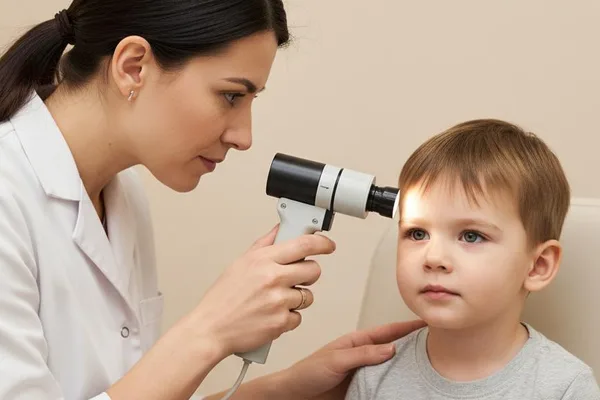
Retinoscopy is a special test that allows an eye doctor to accurately measure refractive errors in your eyes. They use a special hand-held instrument and light that is reflected back from the retina inside the eye.
Even though technology has advanced and there are other ways to measure eye defects, this method called `Retinoscopy` is still very popular all over the world. It is almost a must-do during a routine eye exam.
The greatest value of this is that it can be used to examine the eyes of those who cannot properly communicate their discomfort. Imagine, how do you give glasses to a small baby? He does not understand whether he can see the letters or not. Also, even for someone who cannot speak, has mental disabilities, or has difficulty communicating due to old age and brain diseases, this method can find a very accurate number of glasses.
That means, during this test, the doctor can find out exactly what's wrong with your eyes without asking you anything.
How does this test work? It's amazing!
The basic principle of the `Retinoscopy` test is very simple. It depends on the way light enters your eye, passes through the lens and cornea, and then hits the `Retina` at the back of the eye and is reflected back.
To be precise, when a bright enough light is shone directly into the eye, the pupil appears to glow due to the reflection back from inside the eye. You've probably seen a cat's eyes glow at night. That's what it's like. Doctors call this the fundus reflex or the red reflex.
Normally, in a person with healthy eyesight, that is, 20/20 vision, the light rays that are reflected from the retina inside the eye should come out of the eye parallel to each other. But if you have a refractive error, these light rays are bent in different ways because of that error. Then they do not come out parallel.
In a `Retinoscopy` test, the doctor places lenses of different powers in front of your eye and looks to see which lens refracts the light rays back into the eye. The power of the lens you find becomes the prescription number for your glasses.
This test can also help diagnose other eye conditions, for example:
- Amblyopia (lazy eye): Vision in one eye is weaker than the other.
- Presbyopia (age-related nearsightedness): The inability to see close objects clearly as you age.
- Strabismus (crossed eyes): Inability to keep both eyes pointed in the same direction.
Do you need to prepare before the test?
Most of the time, you don't need to do anything special to prepare for a retinoscopy. However, in rare cases, you may need to do something special. If there is, your doctor will let you know about it before the test. If you wear contact lenses, they will also tell you how many hours before the test you need to take them out.
Before performing a routine retinoscopy, your doctor will put special eyedrops in your eyes. These are called cycloplegic medications. These drops stop your eyes from focusing during the test. If they don't, your eyes will focus automatically, making it difficult for the doctor to get the right number for your glasses.
However, if the doctor is going to perform a special test called `dynamic retinoscopy`, then these `(cycloplegic)` eye drops will not be used. Because that test depends on the natural focusing ability of your eyes.
What happens during the test?
During a `retinoscopy` test, you will be seated in a chair in a darkened room. The doctor will sit facing you. The main instrument used for this is the `retinoscope`. This is a hand-held device that looks like a small flashlight with a large lens attached. The light and the viewing lens are designed so that the doctor can shine light into your eye at the same time and look at it closely.
Next, you need to use lenses of different powers to see how the light reflection from inside the eye changes. There are two main methods for this:
- The `Phoropter`: This is a large machine shaped like a butterfly with two holes for your eyes. If you've ever had an eye exam, you've probably seen this. By changing the different lenses and settings on it, the doctor can quickly check different numbers.
- Hand-held lenses: These can come in the form of a "lens card," which means that a number of lenses of different powers are mounted on a flat card. Or, you can wear individual lenses (loose lenses) one at a time in front of your eye.
When the doctor shines a light into your eye through these lenses, he or she will pay close attention to several changes in the brightness of the light inside the eye.
| What the doctor is looking at | What can you learn from it? |
|---|---|
| Movement of light | This can tell whether the power of the lens placed in front of the eye is too strong or not enough. |
| Angle of light | You can tell if you have astigmatism by the angle at which light appears. |
| The way light appears | Depending on how the light appears, the doctor can confirm whether he has found the exact number that matches. |
In this way, the doctor moves the light up, down, left, right, and diagonally several times. In the meantime, he changes different lenses. He may do this process several times, stopping halfway through, changing the light on the `retinoscope`, and taking notes in a book. All of these are normal parts of the examination.
A special method called `Dynamic Retinoscopy`
This is another special method of the `Retinoscopy` test. This mainly looks at your eyes` ability to `focus` on things that are close to you. Doctors call this `accommodation`.
During this `dynamic retinoscopy` test, you don`t put eye drops in your eyes as you`ve already mentioned. Instead, your doctor asks you to look at objects at different distances. Some objects may be between you and the doctor, and some may be behind the doctor. While you look at these objects, your doctor looks at your eyes through the `retinoscope`. Then, by looking at the way the light moves inside your eye, he can determine whether your eyes` ability to focus (accommodate) is working properly.
What happens after the test?
If you were given cycloplegic eye drops for your test, your pupils will be dilated for a while after the test. This means your eyes will be slightly dilated. The time it takes for the effects of these drops to wear off varies from person to person. Your doctor will tell you how long it usually takes.
Also, you may be given temporary protection, such as sunglasses, to wear when you go out. Because these eye drops prevent your blackheads from expanding and contracting on their own. This means that they cannot reduce the amount of light that enters your eyes when you are in a bright place. As a result, your eyes may feel a little like they are burning.
Are there any risks with this test?
In fact, the `Retinoscopy` test is a very safe test with no risks or side effects .
The aforementioned cycloplegic eye drops can cause minor side effects, but they are usually not serious. Also, some parts of the test may be difficult for someone who is sensitive to bright light (photophobia). If you have any such sensitivity to light, tell your doctor before the test. If you have any questions about the side effects of the eye drops, you can ask your doctor about them.
What are the results I will get? What do I do next?
After the doctor completes the retinoscopy, he or she will calculate your (or your loved one's) vision prescription. This number is similar to the number you get by asking questions. The doctor will explain what this number means, and how it affects you.
If the results confirm that you do not have 20/20 vision, what happens next?
If so, your doctor will talk to you about the best vision correction options for you. The most common options are glasses or contact lenses . Some people may also have vision correction surgery such as LASIK.
A good pair of glasses is like a tailored suit. An ophthalmologist who performs a retinoscopy is like a skilled tailor, hand-stitching each stitch until you get that perfect fit. This method is over 150 years old, but it is still used in routine eye exams today. So, if you or a loved one is having this test done, you can be sure that your doctor will find the best pair of glasses for you.
Take-Home Message
- Retinoscopy is a simple, painless, and highly accurate test to determine the correct number of glasses you need.
- This method is especially important for young babies, children, and people with special needs who cannot express their discomfort through speech.
- This involves shining a light into the eye and observing how it is reflected back from inside the eye.
- Sometimes special eye drops are put in the eyes, which can cause blurred vision for a short time after the test.
- This is a very safe test and carries almost no serious risks.
- Talk openly with your doctor about the test results and any questions you may have.




💬 Comments (0)
No comments yet. Be the first to share your thoughts here.
Add Your Comment