

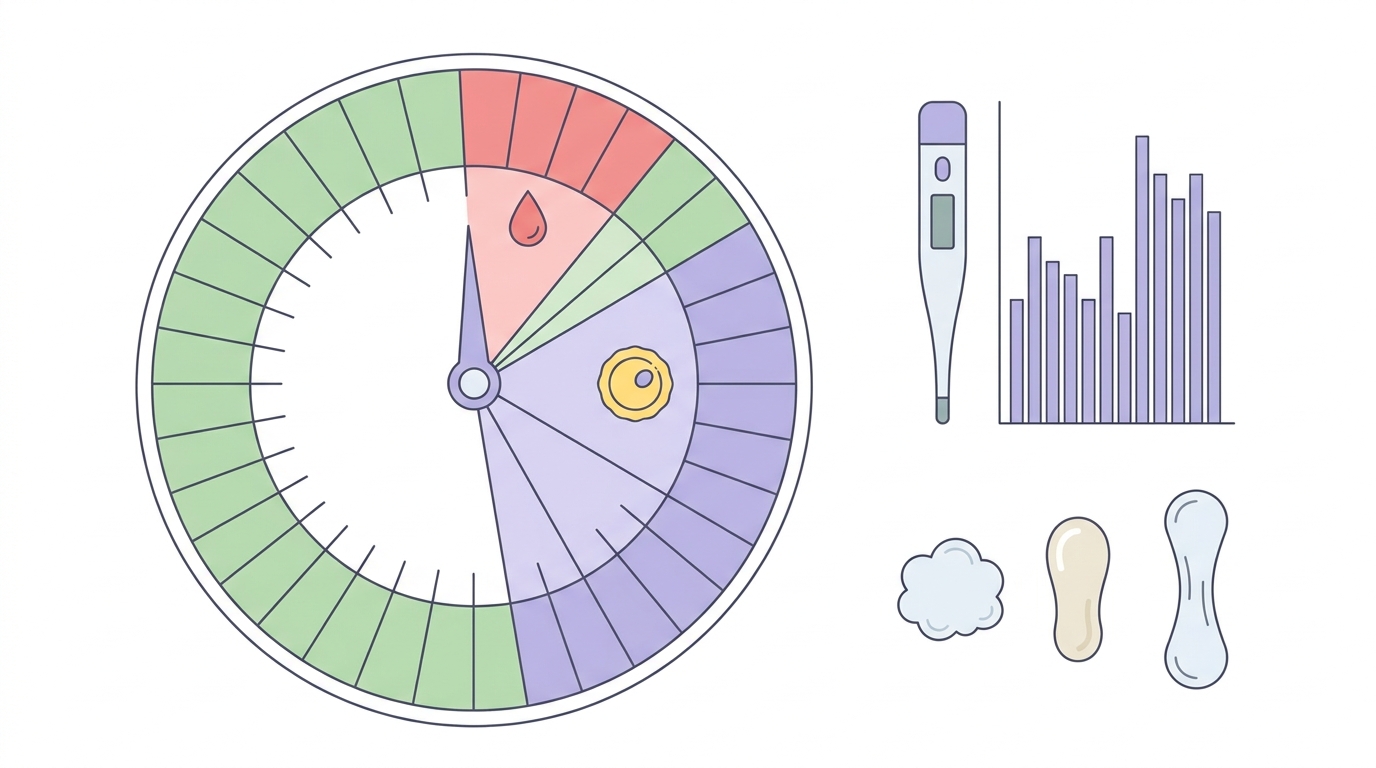
What is the Rhythm Method? Simply put…
Simply put, the Rhythm Method involves keeping track of your menstrual cycle and determining your fertile days, which are the days when you are most likely to conceive. Then, you either abstain from sex during those fertile days or use another form of birth control (such as condoms). This method also helps those who are trying to conceive know their fertile days and have sex during those days. This falls into the category of “Natural Family Planning” or “Fertility Awareness.”How does the menstrual cycle work?
A healthy woman's menstrual cycle usually lasts between 28 and 32 days. The first day of your cycle is the day you start your period. Ovulation , the release of a mature egg from one of your ovaries, usually happens around day 14 of your cycle. The egg that is released travels from the ovary into the fallopian tube .) travels along the fallopian tube. That's where a sperm can join this egg and get pregnant. If pregnancy doesn't occur, you'll have your next period about 14 days after ovulation. If you're starting to track your menstrual cycle, it's best to mark the first day of your period on a calendar. Count how many days until your next period. For example, let's say you started your period on March 1 (that's the first day). If your next period is on March 30, your cycle will be 29 days long. March 30 is the first day of your next cycle. You should keep track of it like this again.Why is this method called "Rhythm"?
The word “rhythm” refers to something that happens in a pattern, in a predictable way. So, this birth control method is called the “Rhythm Method” because it is based on your body’s natural rhythm, or the rhythm of your menstrual cycle on the calendar.How effective is the Rhythm Method?
This is a problem for many people. If you use the Rhythm Method alone, it has a success rate of about 75% . This means that 25 out of 100 women who use this method will get pregnant within a year. It is less successful than other methods, such as birth control pills or an intrauterine device ( IUD ). Its success depends on how accurately you track your cycle, and whether you avoid having sex during your fertile days or use another form of contraception.Important: If your menstrual cycle is shorter than 26 days or longer than 32 days, this method may not be suitable for you. Also, this method may not be as effective for those with irregular menstrual cycles.
How does the Rhythm Method work?
You can only conceive a child, which means you are fertile only a few days a month . When using the Rhythm Method, you analyze your past menstrual cycles to find out when your fertile days are. Then you can either abstain from sex during those days, or use a barrier method like condoms or spermicide . There are several ways to track your fertility. The most common way to track your fertility is to know how long your menstrual cycles are and use that information to determine when you ovulate. Most women, regardless of the length of their cycle, ovulate between days 14 and 16 after their period. An egg is only fertile for 24 hours after it is released. However, sperm can live in a woman's body for up to 5 days . Therefore, those using the Rhythm Method should avoid unprotected sex for 5 days before ovulation and 3 days after ovulation. You are usually most fertile when:- A few days before ovulation .
- On the day of ovulation.
- Within 24 hours of ovulation.
How to calculate fertile days? (Calendar method)
Okay, now let's see how to find your fertile days. Is this something you should do with a little care? 1. Step 1: The first day of your period is Day 1. Mark this on a calendar with an X. Also mark the first day of your next period with an X. The number of days between these two Xs is your cycle length. 2. Record for at least 6 months: Before using the Rhythm Method as a birth control method, you should record your menstrual cycle on a calendar for at least 6 months. 3. After 6 months:- Find the longest and shortest menstrual cycles on your calendar. For example, the longest one might be 31 days, and the shortest one might be 28 days.
- To find the first day of your fertile window, subtract 18 from your shortest cycle.. Suppose your shortest cycle is 28 days. Then subtract 18 from 28 and you get 10. That means that day 10 of your cycle is the first day you start to be fertile.
- To find the last day of your fertile window, subtract 11 from your longest cycle . Suppose your longest cycle is 31 days. Then subtract 11 from 31 and you get 20. That means your fertile window ends on the 20th day of your cycle.
- According to this example, you should avoid unprotected sex from day 10 to day 20 of your menstrual cycle, or use another form of protection (e.g. condoms).
Remember, you can't get pregnant every day during this fertile period. However, this period is "unsafe" for unprotected sex because you can get pregnant during this period. On the other hand, if you want a baby, you should have sex as much as possible during this fertile period.However, it is important to remember that using the Rhythm Method alone is not very reliable. If you combine the calendar method with other natural family planning methods, you are more likely to accurately determine when ovulation will occur.
What is the Standard Days Calendar Method?
This is a variation of the Rhythm Method. This method works best if your menstrual cycle is consistently between 26 and 32 days long . According to this “standard day method,” you are considered fertile from day 8 to day 19 of each menstrual cycle . You should either abstain from sex during those days or use a barrier method.What are other ways to naturally determine fertility?
In addition to the calendar method, there are other ways to track your fertility. When you use one of these methods in combination with another, it becomes even easier to find the day of ovulation.- Cervical Mucus Method: The mucus that comes out of your cervix changes with your menstrual cycle. During ovulation, it is clear, stretchy, and like egg white.If you use this method, you should check your cervical mucus daily and write down its characteristics. Over time, you will notice a pattern in this, which can help you determine your fertile days. However, this mucus can be affected by breastfeeding, taking birth control pills, having sexually transmitted infections ( STIs ), or having had previous surgery on the cervix.
- Basal Body Temperature (BBT): Another way is to measure your basal body temperature (BBT) every morning (before you get out of bed). This requires a thermometer that reads to two decimal places . When you ovulate, your temperature will rise by 0.4 to 1 degree Fahrenheit (0.22 to 0.56 degrees Celsius). You can chart this temperature (there are many charts online for this). You will then be able to identify a pattern. You will notice that your temperature will rise suddenly after ovulation, and then stabilize before that. Shortly before your period, your temperature will drop again. You should avoid unprotected sex for 5 days before your body temperature rises. You can have sex the day after your temperature rises.
- Cervical Changes: Ovulation can also be detected by examining your cervix and looking for changes in its appearance (e.g., softening, rising, or increasing in thickness).
- Ovulation Test Kits: You can buy an ovulation test kit or testing strips from your local pharmacy or supermarket. These at-home tests (similar to pregnancy tests) detect certain hormones in your urine. To get accurate results, follow the instructions on the package.
- Physical Changes: You may feel changes in your body during ovulation. For example, you may experience breast tenderness or a slight pain in your ovary. However, it is best to use these “feelings” in conjunction with other methods rather than relying solely on them.
What to do if you accidentally have unprotected sex during your fertile period?
This is a very important question. Emergency contraception medications are available in most pharmacies these days. Some types, like `postinor', can be purchased without a prescription, while others require a doctor's prescription. All of these types are most effective when taken as soon as possible . Some can be effective up to 5 days after unprotected sex. If you are using the Rhythm Method as your main method of birth control, it is a good idea to ask your doctor about emergency contraception in advance.Why do people use this rhythm method?
There are several reasons why fertility awareness methods like the Rhythm Method are attractive to some people:- Dislike of side effects of birth control methods.
- Religious opposition to the use of medical birth control methods.
- Reluctance to introduce artificial hormones into the body.
- Being able to quickly stop or restart birth control at any time.
- Being a birth control method that is available for free or at a low cost.
- Wanting to be free from things like implantable devices, pills, prescriptions, and trips to clinics.
What is the biggest disadvantage of the Rhythm Method?
The biggest downside is that it's not as effective at preventing pregnancy as other birth control methods . You need to keep track of your cycle and pay attention to it. Even if you do, it's hard to be 100% sure when your fertile days are. Some other downsides to the Rhythm Method include:- It can be annoying to keep track of your cycle every day.
- There is no protection against sexually transmitted infections (STIs).
- This is a challenge if your menstrual cycle is irregular.
- You may need to abstain from sex for about 10 days of each menstrual cycle or use another method.
- You need to observe for several months to identify a clear pattern of when you are fertile.
- This does not provide relief from menstrual pain like other birth control pills.
What are the advantages of the Rhythm Method?
One advantage of the Rhythm Method is that it is free and does not require a prescription . Also, if you decide to have a baby later, you can start trying sooner. Another advantage is that it avoids the side effects that can occur with other methods, such as pills, patches, shots, or implanted devices. Although these side effects are mild for most people, some of them may include:- Bleeding during menstruation or missed periods.
- Weight gain.
- Mood changes.
- Breast pain.
- Headache.
- Skin allergies.
- Nausea.
- Pain or infection where the implant was placed.
- Difficulty removing the inserted device.
- Ovarian cysts.
- High blood pressure.
- Increased risk of blood clots, stroke, and heart attacks.
- Allergic reactions.
What other options are there for birth control?
There are many alternative methods of birth control available today. Some of them are:- Abstinence: Abstaining from sex is 100% effective in preventing pregnancy.
- Barrier methods: These stop sperm from reaching an egg. Examples include condoms, spermicides, diaphragms, sponges, or cervical caps. These are about 88% effective. Using several of these methods together can increase success rates.
- Long-acting reversible contraceptives: These are birth control methods that are inserted into your body by a doctor. Examples include intrauterine devices (IUDs) and hormonal implants. These work for up to several years. They are about 99% effective when used correctly.
- Short-acting hormone treatments:These birth control methods can be taken or used daily, monthly, or quarterly. Examples include birth control pills, patches, shots, or a vaginal ring. These can be about 94% effective.
- Sterilization: These surgeries include tubal ligation or vasectomy. These are nearly 100% successful.
How can I learn more about Natural Family Planning?
Many health professionals can talk to you about natural family planning methods or nonmedical birth control methods. Your gynecologist or primary care provider is a good place to start. The more educated you are about this birth control method, the better results you can get.What is the Catholic Rhythm Method?
The Catholic Rhythm Method is also known as the Rhythm Method. In the 1930s, a Catholic doctor used the Rhythm Method to help couples avoid pregnancy. As a result, the Rhythm Method first became popular among Catholic couples, and there are times when the method is associated with that religion.Finally, remember this (Take-Home Message)
If you're interested in natural birth control, the Rhythm Method may be right for you. But keep in mind, it's not as reliable as hormonal or barrier methods . To be successful, you need to keep a very careful and responsible record of your menstrual cycle, and you need to avoid having sex around the time of ovulation or use another form of contraception.The Rhythm Method is most effective when used in conjunction with measuring your basal body temperature (BBT) or monitoring cervical mucus.However, it's wise to discuss your birth control goals with your doctor and decide which method is best for you. There is no one-size-fits-all method. It's important to seek medical advice to help you choose the one that's right for you.
` Rhythm method, birth control, natural family planning, menstrual cycle, ovulation, fertile days, unprotected sex
Doctor's Note
The Rhythm Method, a natural birth control method, is to record a woman's menstrual cycle in a calendar and avoid the fertile window to have sex. It is essential for a woman to have a regular menstrual cycle for this method to be successful. However, it has a higher failure rate compared to other methods of birth control, so it is advisable to use condoms as extra protection or choose a more reliable method of birth control.
❓ Some more questions you may encounter (FAQ)
How to calculate fertile window in rhythm system?▼
Taking into account the shortest and longest days of the menstrual cycle, the middle 6-8 days in which ovulation can occur are considered fertile days and sexual intercourse is avoided.
Is this method 100 percent successful?▼
no With a 24% chance of failure, the rhythm method is considered one of the riskier natural methods.
Is this method suitable for women with irregular periods?▼
no The rhythm method is not at all suitable for women with irregular menstrual cycles as the day of ovulation cannot be accurately predicted.





💬 Comments (0)
No comments yet. Be the first to share your thoughts here.
Add Your Comment