
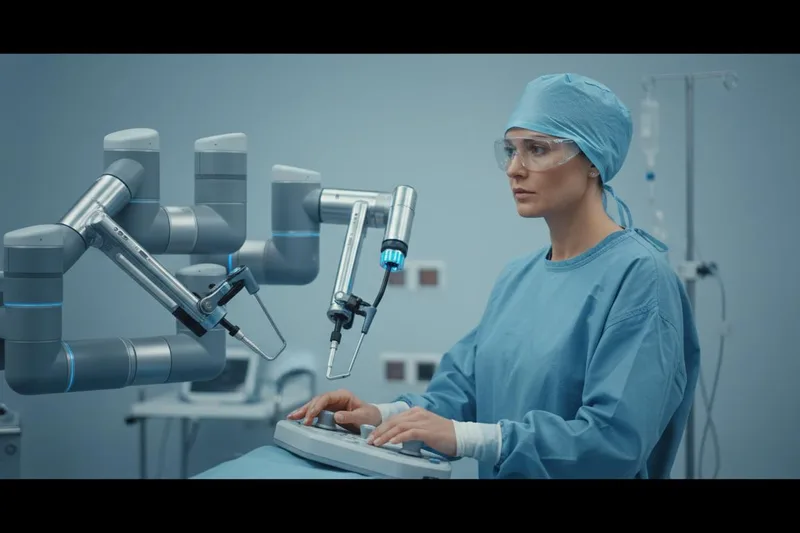
When you hear the word 'robotic surgery', you might be a little scared, right? You might think of a scene from a science fiction movie where a robot performs your surgery all by itself. But the reality is much different. This is an amazing advancement in medicine. Robotic surgery is a highly advanced technological tool that helps the surgeon, acting like an extension of his hands. So let's find out exactly what it is.
Simply put, what is robotic surgery?
Robotic surgery is a highly advanced technique used by surgeons to perform minimally invasive surgery. This means that surgery is performed through a few small incisions, rather than a large incision. This technology consists of three main parts:
- Robotic arms: These are equipped with very small surgical instruments. These arms can move more precisely and delicately than a human arm.
- A high-resolution 3D camera: This camera allows the surgeon to see the inside of the body being operated on in a very clear, magnified, three-dimensional (3D) view. It's as if they're looking inside.
- Surgical console: The surgeon sits at this console. Using controls similar to joysticks in a video game, he or she controls every movement of the robotic arm and camera.
The most important thing is that robotic surgery does not replace your surgeon. The robot does not do anything on its own. The experienced surgeon has full control. The robot is just a very capable assistant who enhances his skills.
Do doctors need special training to perform these surgeries?
Yes, absolutely. Surgeons must complete additional, specialized training to perform robotic surgery. Some doctors receive extensive training through special fellowships for this purpose. Therefore, only highly trained and experienced specialists can perform this.
What are the most common uses of robotic surgery?
Today, this technology is used by surgeons specializing in various fields. For example, it is widely used in abdominal, gynecological, urinary system, cardiac, and spinal surgeries.
Below are some of the most common surgeries performed with robotic technology.
| Type of surgery (Sinhala) | Medical name (English Term) |
|---|---|
| Removal of the appendix | Appendectomy |
| Removal of part of the colon | Colectomy |
| Hysterectomy | Hysterectomy |
| Gallbladder removal | Gallbladder removal |
| Hernia repair | Hernia repair |
| Gastric bypass surgery | Gastric bypass |
| Spinal surgery | Spine surgery |
How does the surgery happen? Let's take a step-by-step look at it.
The basic techniques used in robotic surgery are similar to those used in traditional open surgery. The main difference is the way the surgeon accesses the body.
Imagine, in traditional surgery, one large incision is made. But in robotic surgery, this is what happens:
1. The surgeon makes one or more very small incisions (perhaps about a centimeter) in the area of your body where the surgery will be performed.
2. Thin tubes called 'ports' are inserted through these incisions. These act like temporary tunnels.
3. Then, the robotic arms are connected to these ports, and surgical instruments and a camera are sent into the body.
4. The surgeon sits at the control panel and uses his hands and fingers to control the robotic arm. The 3D view from the camera allows for a clear view of everything.
5. After the surgery is complete, the instruments and ports are removed, and the small incisions are closed with stitches.
What are the advantages of robotic surgery?
Compared to traditional open surgery, robotic surgery offers many advantages to both the patient and the doctor.
| Benefits for the patient | Benefits for the surgeon |
|---|---|
| There is less pain during recovery. | A robotic arm can move with greater range and precision than a human arm. |
| The risk of infection is low. | The high-resolution 3D camera makes the surgical area very clear. |
| Blood loss from the body is minimal. | The surgery can be performed by easily rotating the instruments, even in a very small space. |
| The time spent in the hospital is short. | The doctor can sit in a more comfortable position and perform the surgery with less effort. |
| Because the incisions are very small, the scars left behind are very small. | Natural conditions such as hand tremors do not affect robotic hands. |
How successful are these surgeries? Are there any disadvantages?
According to current data, the overall success rate of robotic surgery is very high, ranging from 94% to 100%. However, as with any medical procedure, there are some disadvantages and risks.
- Not available in every hospital: This technology and the doctors trained for it are only available in some major hospitals.
- Switching to open surgery: Sometimes, an unexpected complication, such as scar tissue from a previous surgery, may prevent the robotic surgery from being performed. In such cases, the surgeon may have to switch to traditional open surgery to ensure the patient's safety.
- Nerve damage: Although very rare, there is a small chance that the equipment may cause some compression or damage to the surrounding nerves.
- Technical errors: It is extremely rare, but not impossible, for something to go wrong with the robot. However, the surgical team is trained to deal with such an eventuality.
How long does it take to recover after surgery?
Typically, recovery is much faster than with traditional surgery. Depending on the nature of your surgery and your overall health, you may be able to:
- Get out of bed and walk as soon as possible after anesthesia.
- Eat normally within a few hours after surgery.
- Maybe go home the same day or the next day.
Once you go home, it's important to follow your doctor's instructions. In general, remember these things:
- Take a good rest for a few days.
- Slowly start your daily routine.
- Avoid lifting heavy weights.
- Pay attention to the incision sites for signs of infection (redness, pus, warmth).
When should you see a doctor?
If you experience any of the following symptoms after your surgery, notify your doctor immediately or go to the hospital where you received treatment.
- Heavy bleeding from wounds.
- If you have a high fever.
- If a yellow pus-like fluid is coming out of the cuts.
- If the pain does not subside despite taking painkillers.
- If you see signs of a blood clot, such as swelling in the leg or groin.
- If nausea or vomiting persists.
Ultimately, robotic surgery is not a "better" method than other surgical methods. It is simply an advanced technique that doctors use. The type of surgery you need, your health condition, and the doctor's expertise will determine which method is best for you. So, if you are considering surgery, talk openly with your doctor about it and decide what option is best for you.
Take-Home Message
- In robotic surgery, the robot does not operate alone. Its full control lies in the hands of a trained and skilled surgeon.
- Because this method uses very small incisions, there is less pain, less bleeding, faster healing, and smaller scars than traditional surgery.
- Although this is a very successful method, it is not suitable for every patient or every surgery. (Wait, "எய" is Hindi, must avoid. Rephrase: எயய அ
- If you need surgery, it is very important to discuss with your doctor whether robotic surgery is a suitable option for you.




💬 Comments (0)
No comments yet. Be the first to share your thoughts here.
Add Your Comment