
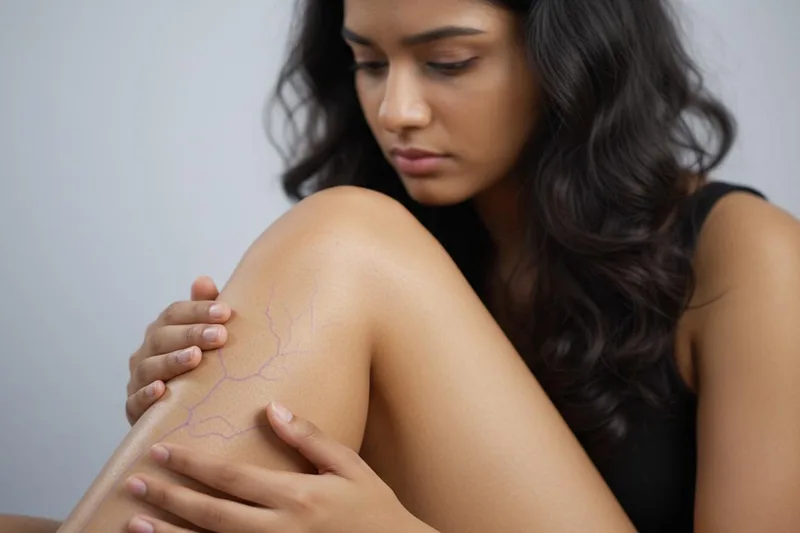
Have you ever noticed small, spider-like red, blue, or purple veins on your legs or face? Sometimes seeing these can be a little disturbing, even scary, right? "Oh, what is this?" You may think. So today we will talk about this condition called `(Spider Veins)` or medically known as `(Telangiectasias)`. There is nothing to be afraid of, the most important thing is to be aware of this.
What exactly are these spider veins that look like spider webs?
Simply put, spider veins are tiny blood vessels under your skin that become damaged and start to show through the skin's surface. They often appear as spider webs or as branches on a tree. They can appear anywhere, but they are most common on the legs and face.
The good news is that most of the time, these so-called ``Spider Veins'' are just a cosmetic issue, not a serious condition . They can be treated if you don't like the way they look. Treatment is usually successful. There are also some simple lifestyle changes that can help prevent new ones from forming.
Should we be afraid of spider veins?
Spider veins are usually nothing to worry about . They are just small blood vessels near your skin that have become weak and damaged. This means that they are mainly a cosmetic issue . Unless you find them unsightly, they won't harm you.
But, keep in mind, sometimes these ``Spider Veins`` can be an early sign of a more serious vein disease, such as ``Chronic Venous Insufficiency`` (CVI) . This ``CVI`` condition can affect your quality of life and cause other complications.
Therefore, if you notice that you have `(Spider Veins)`, the best thing to do is to see a doctor and get advice. Then the doctor can examine you and tell you if you are at risk of developing a condition like `(CVI)`.
How common are these? Who gets them more often?
Spider veins are very common . It is said that more than 50% of women have this condition. It becomes more common especially after the age of 80.
Also, spider veins are more common in women than in men. Hormonal changes may be a factor in this.
Are Spider Veins and Varicose Veins the same thing? What's the difference?
Here's where a lot of people get confused. Spider veins aren't actually veins. They're tiny blood vessels called capillaries, venules, and arterioles . These are the ones that connect to the larger blood vessels in our circulatory system. But the name "spider veins" is easy to pronounce and easy to remember.
On the other hand, `(Varicose Veins)` are damaged large veins . Veins are large blood vessels that carry oxygen-poor blood back to the heart. `(Varicose Veins)` are usually larger than `(Spider Veins)`, and they can also appear to bulge out of the skin. Some of you have blue, large, twisted veins in your legs, that's what it looks like.
Spider veins often do not cause symptoms. People seek treatment because of their appearance. However, varicose veins can cause symptoms such as pain and discomfort in the legs. Therefore, varicose veins are treated not only for their appearance but also to reduce these discomforts.
Many people with spider veins also have varicose veins, as the causes and risk factors for both are very similar.
Why do we get these Spider Veins? What are the causes?
Spider veins occur when these small blood vessels under the skin become weak and dilated. It is not always clear why this happens. However, there are several main causes that have been identified:
- Hormonal changes: Hormonal changes, such as during pregnancy and menopause, can affect the condition.
- Genetic influences: If someone in your family has it, you are more likely to develop it too. It can also be caused by certain genetic syndromes.
- Connective tissue diseases: These conditions can cause blood vessels to weaken.
- Injuries: An injury can occur at the scene of an accident.
What are the risk factors?
You may be at higher risk of developing spider veins if you:
- If you are in the same position for a long time: For those who stand for a long time (e.g. teachers, shop workers) or sit (e.g. office workers).
- If anyone in your family has it: If your mother, father, siblings have either `(Spider Veins)` or `(Varicose Veins)`.
- If your body mass index (BMI) is over 30 (obesity): As your body weight increases, pressure on your veins increases.
- If you are pregnant: These may appear with changes in your body during this time.
- If you use hormonal birth control methods.
- If you are taking hormone therapy during menopause.
- If you spend too much time in the sun: The sun shines brightly in a country like ours.
- If you smoke or have quit smoking.
What are the symptoms of Spider Veins?
Most of the time, spider veins do not cause any symptoms . However, a very small number of people, especially those with spider veins on their legs, may experience the following symptoms after standing for a long time:
- Inflammation
- Cramping
- Itchy feeling
- Tired, heavy legs
- A pain
But remember, these symptoms may not always be related to `(Spider Veins)`. That is, even if `(Spider Veins)` is treated, these symptoms may not decrease.
Can Spider Veins Cause Complications?
Spider veins alone are very rare. However, as I mentioned earlier, if you have other conditions like CVI, you are at risk for developing venous stasis ulcers or a skin infection called cellulitis . Therefore, it is important to talk to your doctor about the health of your blood vessels and what complications you should be aware of.
How does a doctor know for sure that these are Spider Veins?
To find out exactly if you have spider veins, a doctor will usually do the following:
- A physical exam will be performed: Your skin will be examined carefully, including the location and nature of your spider veins.
- Ask about your medical history and your family's medical history: things like whether anyone in your family has it, and whether you have any other illnesses.
The doctor will specifically look for signs of CVI, which could indicate a serious problem with your blood flow. If so, you may be referred to a vascular surgeon .
What are the treatments for spider veins?
Okay, now let's see what treatments are available for these `(Spider Veins)`. There are mainly two treatment methods:
- Sclerotherapy: This is the most common, non-invasive treatment for spider veins on the legs. A doctor injects a chemical solution into your spider veins. This solution causes the damaged blood vessels to close. You should see the spider veins disappear in about three to six weeks. Some people may need several treatments to completely remove them.
- Laser therapy: This is also a great non-invasive treatment. It is often used to treat spider veins on the face. Unlike sclerotherapy, a chemical solution is not injected. Instead, a doctor uses a laser beam to destroy the spider veins. If the spider veins are very small, you may see them disappear immediately. If they are larger, it may take a month or three to disappear. Some people may need several treatments.
If you are considering treatment, it is best to talk to a doctor about what is best for you. Remember, doctors will first check to see if you have symptoms of CVI, such as varicose veins or venous stasis ulcers. If you have a serious condition, they will treat that first, followed by spider veins.
What can we do to prevent new spider veins from forming?
In addition to treating existing ones, we should also try to prevent new ones from forming, right? Here are some simple things you can do to help:
- Don't stay in the same position for too long: If you work sitting down, get up and walk around every half hour. If you work standing up, sit down and take a short break every half hour.
- Avoid wearing tight clothing: Tight clothing can impede blood circulation and cause spider veins.
- Exercise regularly: Moving your body, especially your legs, improves blood circulation. Ask your doctor before starting a new exercise routine.
- Shake your ankles and feet: If you have to stay in one place for a long time, shake your toes and ankles up and down. Try tightening and loosening the muscles in the ankle area. This will help the blood flow in your legs.
- Maintain a healthy weight that suits you: When you have a healthy weight, there is no unnecessary pressure on the walls of your blood vessels.
- Keep your legs elevated: Try to keep your legs elevated at or slightly above the level of your heart for at least 30 minutes, at least twice a day.
- Wear compression stockings: Your doctor may recommend that you wear compression stockings to improve blood circulation in your legs. You may need to wear them for a while after treatment for spider veins. However, never start compression therapy without consulting a doctor.
If I have spider veins, what should I expect? How can I take care of myself?
Spider veins usually don't cause any major problems. Treatment can often get rid of them, and you can be happy with the way your skin looks. However, if new spider veins develop, you may need to have them treated again.
If you have a condition like CVI, it's a good idea to talk to a doctor about what to expect going forward.
Take care of yourself and follow the doctor's instructions. Usually, they say things like this:
- Be more active: Increase your level of physical activity throughout the day. This means planning and exercising, and incorporating walking into your daily routine. Reduce the amount of time you spend standing or sitting in one place.
- Eat a heart-healthy diet: By adopting a heart-healthy diet, such as the Mediterranean diet , you can maintain a healthy weight and reduce your risk of cardiovascular disease .
- Elevate your legs: Keeping your legs elevated at or above the level of your heart improves blood circulation in your legs. This can help prevent the formation of new spider veins or varicose veins and help control symptoms.
What time should I see a doctor?
If you have any doubts or concerns about your blood vessels, the best thing to do is to call a doctor and make an appointment to get checked out.
Also, if you see things like this, definitely call a doctor:
- If the area where a spider vein or other blood vessel is located becomes swollen, red, warm, or painful to the touch, these may be signs of a blood clot .
- If you have visible rashes or sores on your skin.
- If you notice a change in your skin color .
- If you have symptoms that interfere with your daily activities .
What are the important questions to ask the doctor?
Talk to your doctor about your spider veins and how they affect you. Here are some questions to ask:
- Should I be worried about my `(Spider Veins)`?
- Are my spider veins a symptom of another underlying condition?
- How can I prevent more `(Spider Veins)` from forming?
- What treatments can help me?
- What should I expect before, during, and after treatment?
- What are the side effects or complications of the treatment?
- What changes do I need to make in my lifestyle?
So, what are the most important things we should remember from this story? (Take-Home Message)
You may not be happy with the appearance of spider veins on your skin. But remember, most of the time they are harmless , and they can be treated and removed.
However, it's wise to talk to a doctor any time you notice new spider veins, as they can sometimes be an early sign of more serious blood circulation problems.
Ask your doctor about lifestyle changes that can help prevent the formation of new spider veins. Stay healthy and happy!
` Spider veins, varicose veins, skin veins, blood vessels, chronic venous insufficiency, sclerotherapy, laser treatment


💬 Comments (0)
No comments yet. Be the first to share your thoughts here.
Add Your Comment