
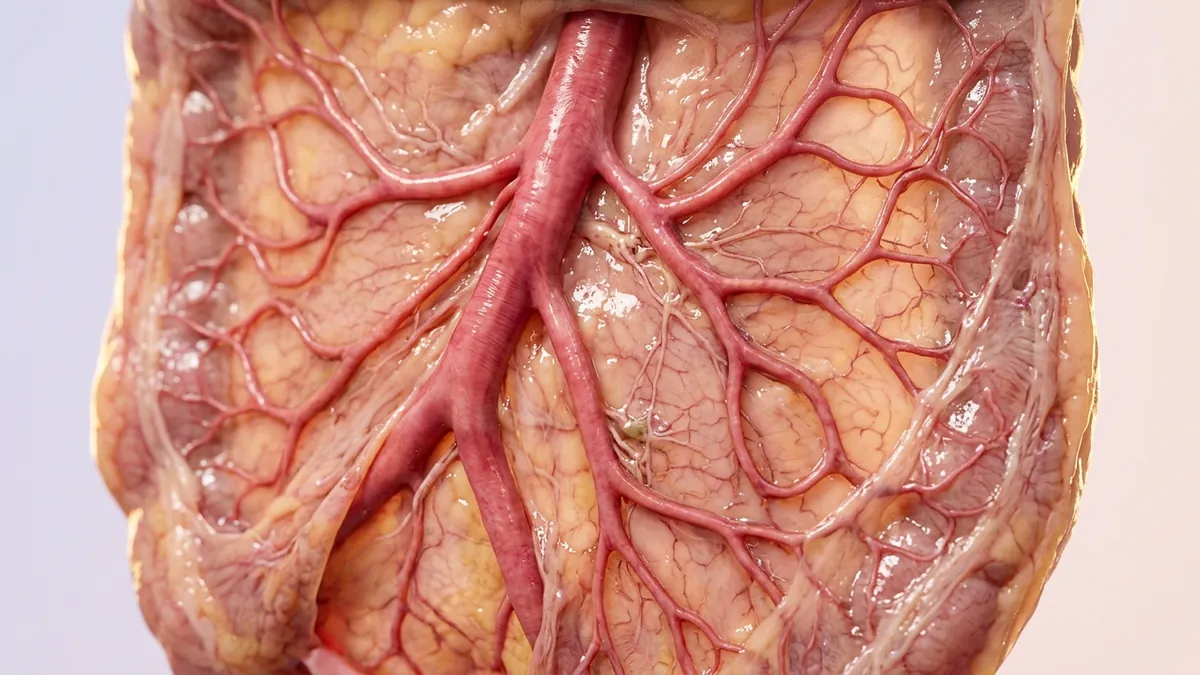
Earlier this week, a patient sat across from me in the clinic holding a folded ultrasound report, pointing nervously at three words highlighted in bold: superior mesenteric artery. "Doctor," they asked, "this sounds like something major—is my stomach in trouble?" Honestly, I see that exact look of worry all the time whenever an everyday organ or blood vessel gets dressed up in a big Latin name. Once we pulled up a simple diagram on my screen and walked through what this artery actually does every time you eat breakfast or dinner, their shoulders immediately dropped. Let us have that exact same conversation right here together so you feel completely clear and confident about how this vital lifeline works.
📌 Key Takeaways at a Glance
- Your gut's main fuel line: The superior mesenteric artery (SMA) branches off your main body artery, the abdominal aorta, to supply oxygen-rich blood to your pancreas, small intestine, and the first half of your large intestine.
- Built-in backup detours: Clever side-branch connections link the SMA with neighboring gut arteries, helping protect your bowel if one pathway slows down.
- Watch for post-meal pain: Narrowing or blockage of this artery reduces blood flow to the bowel (mesenteric ischemia), often causing cramping tummy pain 15 to 30 minutes after eating.
- Heart habits protect your gut: Brisk walking, fiber-rich foods, smoke-free living, and steady blood pressure keep this artery open and healthy.
Simply Put, What Is the Superior Mesenteric Artery?
The superior mesenteric artery (SMA) is a major blood vessel that branches directly off your body's main artery, the abdominal aorta, to deliver oxygen-rich and nutrient-filled blood to your pancreas, your entire small intestine, and the first half of your large intestine so your digestive system can break down and absorb food.
Think about how hard your digestive tract works every single day. From the moment you swallow your morning porridge or whole-grain toast, your intestines behave like a busy, non-stop processing factory—churning food, releasing digestive juices, and pumping vitamins, proteins, and energy straight into your bloodstream. Have you ever wondered why you sometimes feel a little sleepy after a big Sunday roast or heavy lunch? That happens because your gut demands a massive surge of fresh blood flow to power all that muscular squeezing and nutrient absorption. Pretty surprising, right?
To meet that demand, your heart pumps clean, oxygen-rich blood down through the largest blood vessel in your body, called the abdominal aorta. Picture the aorta as the main city water main running down the center of your body. The superior mesenteric artery is a sturdy main pipe branching straight off the front of that water main to feed the middle section of your digestive factory. In medical language, "superior" simply means "higher up." We doctors call it that because it sits right above another partner vessel, the inferior mesenteric artery, which takes care of the lower half of your large intestine.
Where Is the Superior Mesenteric Artery Located and How Does It Branch Out?
Your superior mesenteric artery sits deep in the middle of your upper abdomen, tucked neatly behind your pancreas and just below the base of your ribcage. It angles downward off the front of the abdominal aorta, slipping over a loop of your upper small intestine before fanning out inside a thin, supportive curtain of tissue called the mesentery—which is the exact fold of tissue that anchors your intestines gently to the back wall of your belly.
Just think about it for a second: your small intestine is roughly twenty feet long, coiled neatly inside your abdomen. To reach every single inch of that winding track, the superior mesenteric artery splits off like the sturdy trunk of an oak tree dividing into dozens of smaller limbs and twigs. Each major branch has its own dedicated neighborhood to nourish:
- Pancreatic and upper bowel branches (inferior pancreaticoduodenal arteries): These upper twigs feed the lower part of your pancreas and the first section of your small intestine (duodenum), where stomach acid is neutralized and digestion kicks into high gear.
- Small intestine arcades (jejunal and ileal branches): More than a dozen looping branches fan out across the entire middle and lower small intestine, creating interconnected arches that keep nutrient absorption running smoothly.
- Large intestine branches (ileocolic, right colic, and middle colic arteries): These vessels carry fresh blood to your appendix, the right side of your colon, and the transverse colon stretching across your upper belly.
Here is one of nature's smartest safety features, and we rarely stop to think about it, do we? The outer twigs of the superior mesenteric artery actually connect with branches from the celiac artery above it and the inferior mesenteric artery below it. Look at what happens if traffic backs up on a main highway: you take a local side road to reach your destination. Those natural connecting loops work the exact same way, allowing blood to detour around a partial slowdown so your bowel tissue stays nourished.
What Diseases and Conditions Affect the Superior Mesenteric Artery?
Just like the arteries feeding your heart or brain, the superior mesenteric artery can occasionally narrow, clog, bulge, or get pinched. Because your intestines rely on a steady stream of oxygen, reduced blood flow to the intestines (mesenteric ischemia) needs prompt medical attention before bowel tissue becomes injured. Remember how we talked about that tree-trunk blood supply earlier? Depending on whether a branch closes suddenly or narrows slowly over years, patients experience very different symptoms.
In everyday practice, we doctors watch for four main problems involving this artery:
- Sudden blockage (acute mesenteric ischemia): This happens abruptly when a blood clot travels from the heart—often in people with an irregular heartbeat such as atrial fibrillation—or forms right inside a narrowed SMA. Because oxygen stops suddenly, it causes severe, sudden tummy pain that feels far worse than what a doctor feels when gently pressing on your belly.
- Gradual narrowing (chronic mesenteric ischemia): Over many years, cholesterol and fatty plaque can build up inside the artery wall, a process known as hardening and narrowing of the arteries (atherosclerosis). Your gut gets enough blood while resting, but when you eat and your intestines cry out for extra oxygen, the narrowed pipe cannot keep up. Doctors often call this "intestinal angina"—a dull, cramping belly ache starting 15 to 30 minutes after meals that makes people afraid to eat and leads to unintended weight loss.
- Artery pinching (superior mesenteric artery syndrome): Because the third part of your small intestine passes right through the narrow V-shaped angle between the abdominal aorta and the SMA, losing a large amount of weight very quickly can shrink the protective fat pad cushioning that space. The artery then presses against the bowel like a gentle clamp, causing fullness, nausea, or vomiting after small meals.
- Wall bulging or tearing (SMA aneurysm or dissection): Less commonly, a weak spot in the artery wall can balloon outward (aneurysm) or develop a small inner tear (dissection), causing persistent upper abdominal or back discomfort that specialists monitor closely.
To help you compare these patterns clearly at a glance, look at how different warning signs point toward different underlying issues and next steps:
| Symptom or Pattern | What Is Happening & What You Should Do |
|---|---|
| Sudden, severe belly pain out of proportion to mild tenderness when touched | A blood clot may have abruptly blocked the superior mesenteric artery, starving the bowel of oxygen. What you should do: Treat this as a medical emergency—call your local emergency number or go straight to the nearest hospital Emergency Room (ER / A&E). |
| Cramping tummy pain 15–30 minutes after eating plus fear of food and weight loss | Cholesterol plaque may have narrowed the SMA over time (chronic mesenteric ischemia), limiting blood flow during digestion. What you should do: Book an appointment promptly with your Primary Care Physician (PCP) or family GP clinic to arrange a vascular ultrasound or CT scan. |
| Early fullness, nausea, and vomiting following rapid weight loss | Loss of abdominal fat cushioning can narrow the angle behind the SMA, pinching the upper small intestine (SMA syndrome). What you should do: See your Primary Care Physician (PCP) or family GP for a targeted nutrition review, imaging referral, and specialist guidance. |
| Incidental finding on a routine scan with zero stomach pain or weight loss | Mild age-related plaque or harmless branching variations often show up on abdominal scans ordered for unrelated reasons. What you should do: Review the report calmly with your doctor and focus on everyday blood pressure, cholesterol, and heart-healthy habits. |
How Do We Protect the Superior Mesenteric Artery and Keep Gut Blood Flow Healthy?
Now that makes sense, right? You cannot scrub out a single artery on its own, which is actually great news—every healthy habit that protects your heart and brain automatically keeps your superior mesenteric artery smooth, flexible, and wide open. See? That is the exact reason why we doctors always look at your whole circulatory system rather than one isolated vessel.
Whether you live in the United States, the United Kingdom, Canada, or Australia, small, realistic shifts in your daily routine make a measurable difference:
- Move your body most days of the week: Aim for at least 150 minutes a week of moderate movement—a brisk 30-minute walk around your neighborhood, cycling, swimming, or gardening all count. Regular exercise lowers blood pressure and keeps blood vessel linings healthy.
- Fill half your plate with colorful, high-fiber foods: Build meals around oats, beans, lentils, berries, leafy greens, nuts, olive oil, and oily fish like salmon or mackerel. Cutting back on salty takeaways, processed deli meats, and deep-fried foods helps prevent sticky cholesterol plaque from narrowing your gut arteries.
- Quit smoking and vaping nicotine completely: Nicotine and tobacco smoke irritate the delicate inner lining of the SMA, trigger blood vessel spasms, and make blood clots far more likely to form. Your Primary Care Physician (PCP) or family GP clinic can connect you with free or low-cost patches, medications, and quitlines.
- Keep blood pressure, cholesterol, and blood sugar steady: Uncontrolled high blood pressure, high LDL cholesterol, and type 2 diabetes quietly stiffen arterial walls over time. Taking prescribed medicines reliably and attending your routine blood pressure and blood panel checks protects every branch of your mesenteric circulation.
- Aim for steady, gradual weight balance: Carrying extra weight around the midsection strains your cardiovascular system, while crash dieting can trigger rapid fat loss around the SMA. Steady, sustainable habits protect both extremes.
✔️ What You Should Do & ❌ What to Avoid
- ✔️ Do keep a brief symptom and food diary if your stomach aches after meals, noting how many minutes after eating the pain starts and which foods trigger it.
- ✔️ Do stay well hydrated with water throughout the day, especially in warm weather or during exercise, so your blood flows smoothly without thickening.
- ✔️ Do take prescribed heart, blood-thinner, or cholesterol medicines every single day without skipping doses.
- ❌ Do not ignore predictable stomach pain after eating or simply stop eating meals to avoid discomfort—unexplained weight loss always deserves a proper medical check.
- ❌ Do not smoke or use nicotine products, as tobacco is the single fastest way to damage intestinal blood vessels.
- ❌ Do not attempt extreme crash diets that cause rapid, dramatic weight loss over a few short weeks.
When Should You See a Doctor About Intestinal Blood Flow?
If you notice mild, recurring tummy cramps after meals, a subtle drop in your weight without trying, or new digestive discomfort that lingers for more than a couple of weeks, schedule a regular visit at your Primary Care Physician (PCP) or family GP clinic. If symptoms are uncomfortable enough that you cannot wait for a routine slot—yet you feel stable without severe pain—a local Urgent Care center is another sensible place to get checked promptly.
During your clinic visit, we doctors start by listening carefully to your story, checking your blood pressure and heart rhythm, gently examining your abdomen, and ordering basic blood tests to look for anemia, inflammation, or nutritional changes. Because we cannot see deep abdominal arteries from the outside, we will then refer you to a radiologist or vascular specialist for painless imaging—typically a specialized blood-flow ultrasound (mesenteric duplex ultrasound) or a detailed blood-vessel X-ray scan (CT angiography)—to map your superior mesenteric artery clearly and plan safe, targeted treatment.
🚨 When to Seek Immediate Emergency Care (Red-Flag Symptoms)
If you or someone near you develops any of these red-flag symptoms, do not wait — call 911 (or 999 in the UK / 000 in Australia) immediately or go straight to the nearest hospital Emergency Room (ER / A&E):
- Sudden, severe, agonizing abdominal pain that comes on rapidly out of nowhere.
- Bright red blood in your stool, black tar-like bowel movements, or vomiting blood.
- Abdominal pain accompanied by a racing or irregular heartbeat, dizziness, fainting, or cold sweats.
- A rigid, swollen, or intensely tender belly along with high fever, chills, or persistent vomiting.
💡 Key Take-Home Message
- The superior mesenteric artery is the primary blood supply lifeline feeding your pancreas, small intestine, and upper large intestine.
- Interconnected side branches act as natural backup routes, though sudden clots or long-term cholesterol narrowing can still reduce gut blood flow.
- Cramping belly pain shortly after eating and unexplained weight loss are classic early clues that warrant a visit to your family doctor.
- Heart-healthy eating, regular walking, staying smoke-free, and managing blood pressure and cholesterol keep your entire intestinal circulation thriving.






No comments yet. Be the first to share your question or experience below.