
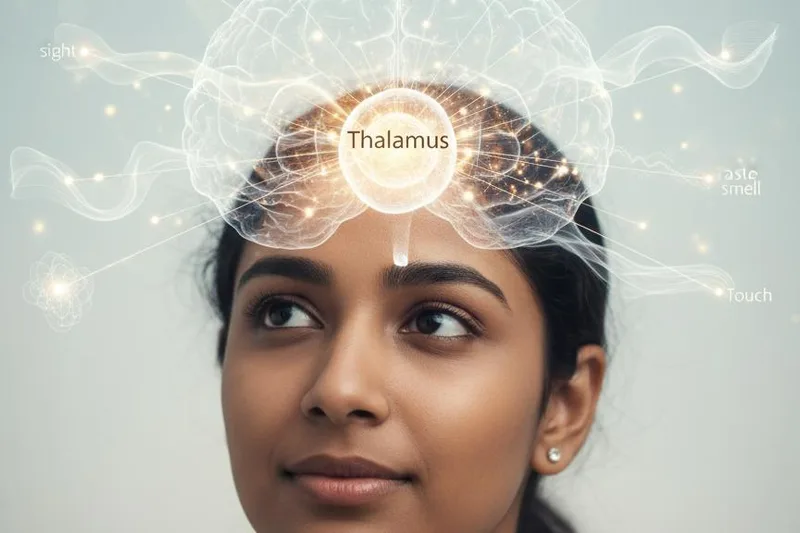
Have you ever wondered how the brain understands all the things we see with our eyes, hear with our ears, taste with our tongue, and feel with our body? There are so many things happening around us at the same time! Who sends all this information to the right places without it getting mixed up in the brain and telling us its meaning? That's why there is a very important, small but big organ inside our brain. Its name is the thalamus . Today we are talking about this wonderful organ.
Simply put, what is the thalamus?
Imagine you are going to the Colombo Fort railway station. All the trains coming from all over Sri Lanka arrive at the Fort first. From there, the trains are transferred to the other directions they need to go. Thalamasa is like the main railway station in our minds .
This is a small egg-shaped structure that's deep in our brain, right in the middle. There are actually two of these, one for each side of the brain. All sensory and motor information that comes to the brain from our body, first comes to this thalamus. That's where it sorts that information and says, "Okay, this is something related to vision, I want to send it to the part of the brain that controls vision," "This is something related to hearing, I want to send it to the part that controls that," and then it's directed to the right place. That is, the thalamus is the main center that receives, processes, and directs this information before it's sent to the outer layer of the brain, the cerebral cortex.
All but one sense passes through the thalamus before reaching the brain. That is the sense of smell . It has a special pathway.
What are the main functions of the thalamus?
The work done by this small organ is no small feat. Let's look at some of the most important things.
- Relaying sensory information: As we discussed earlier, the nerve signals for all of your senses—sight, hearing, taste, and touch—first arrive at the thalamus. Specialized parts there receive this information, process it, and send it to the appropriate parts of the brain. It's like sorting letters in a post office.
- Relaying motor information: When you want to move your arm, walk, or grab something, the commands from your brain travel through this thalamus. This means that it acts as a major junction for the pathways that control both sensation and movement.
- Prioritizing attention: Imagine you are in a crowded market. Someone is shouting on one side, a song is playing on the other, a car is driving ahead, and vegetables are colorful in a shop. If all of this went into our brain at once, wouldn't it drive our brain crazy? At that moment, the brain helps us sort through this pile of information by asking , "What is the most important thing right now? What should I pay attention to first?" It is this part of the brain that decides that paying attention to the sound of a car while crossing the road is more important than other sounds.
- Role in consciousness: The thalamus plays a major role in waking you up and keeping you alert throughout the day. It is also involved in controlling the sleep-wake cycle.
- Role in cognition and memory: The thalamus is closely connected to the ``Limbic System``, a system in our brain that is involved in things like emotions, storing and processing memories, and learning. Therefore, it also plays a role in controlling our memories and emotions.
What happens if the thalamus is damaged?
Being such an important center, even a small damage to the thalamus can have a big impact on many of our physical and mental functions. Imagine what would happen if the signaling system at the Fort railway station broke down. Wouldn't the entire country's train traffic be disrupted? That's how it is.
The two main causes of damage to the thalamus are stroke , which is the blockage or rupture of a blood vessel that supplies blood to the brain, and brain tumors .
| Symptoms that may occur due to damage | A simple explanation |
|---|---|
| Memory loss (Amnesia) | You may not be able to forget old things or form new memories. |
| Loss of interest in anything (Apathy) | You may lose interest or desire for things you used to enjoy. |
| Difficulty speaking and understanding (Aphasia) | Slurring words, speaking in a nonsensical manner, or having difficulty understanding what others are saying. |
| Attention and alertness problems | I can't focus on one thing, and I always feel sleepy. |
| Sensory processing problems | The way you feel things like touch, pain, and temperature may change. Sometimes even the slightest touch can feel like unbearable pain. |
| Difficulty moving | Movement problems such as tremors and difficulty walking may occur. |
| Chronic pain | Thalamic pain syndrome can occur without any injury to the body, causing persistent burning, tingling, or numbness. |
What are serious conditions?
If the damage to the thalamus is severe, it can have very serious consequences.
- Unconsciousness and Coma: A person can become completely unconscious.
- Sleep disorders: Problems such as insomnia may occur. A very rare, fatal disease called ``Fatal Familial Insomnia`` is directly related to damage to the thalamus.
- Vision problems: You may experience vision loss or difficulty seeing in bright light.
These symptoms, especially if they start suddenly (for example, slurred speech, weakness on one side of the body), may be signs of a stroke. It is essential to go to a hospital's emergency department (ETU) immediately.
Special diseases related to the thalamus
In addition to common strokes and tumors, there are several rare conditions that specifically affect the thalamus.
- Fatal Familial Insomnia: This is a very rare genetic disorder. When it develops, the person gradually loses the ability to sleep completely. Along with this, mental problems, weight loss, and eventually death occur.
- Creutzfeldt-Jacob Disease: This is also a very rare disease that damages the brain. This disease also damages the thalamus.
- Korsakoff Syndrome: This condition occurs when excessive alcohol consumption causes a deficiency of vitamin B1 (Thiamine), damaging the areas of the brain involved in memory, especially the pathways connecting to the thalamus. This results in severe memory loss.
Are there any treatments that target the thalassemia?
Yes. The thalamus is targeted when treating certain conditions. The best example is Parkinson's disease .
Symptoms of Parkinson's disease, such as tremors, are difficult for some people to control with medication. In such cases, a treatment called Deep Brain Stimulation (DBS) is used. This involves surgically placing a very fine electrode in a specific area of the thalamus and sending small electrical signals through it to control those abnormal movements. This can sometimes provide great relief to patients.
Take-Home Message
- The thalamus is the main "information junction" or "train station" in the center of our brain.
- Our senses such as sight, hearing, touch, taste, and information that controls body movements are sent to the brain through this.
- The brain is also essential for things like attention, alertness, sleep, memory, and emotions.
- If the thalamus is damaged due to causes such as stroke or brain tumors, serious problems such as memory loss, speech difficulties, movement problems, and chronic pain can occur.
- If you or someone you know suddenly experiences symptoms such as difficulty speaking, numbness on one side of the body, or a severe headache, don't waste time and see a doctor or go to the hospital immediately. It could be a sign of a serious brain condition.


💬 Comments (0)
No comments yet. Be the first to share your thoughts here.
Add Your Comment