

Have you ever been scared of getting an injection ? Or have you ever felt like "I wish this could change your focus" when you were in excruciating pain? Imagine what it would be like if you were transported to a beautiful beach or an underwater world where dolphins swim? That's what this latest technology, Virtual Reality, or as we all know it, VR, has now made possible in medicine . In some hospitals and clinics, doctors have already started sending you to this VR world to reduce your pain and fear.
Simply put, what is VR? How does it work?
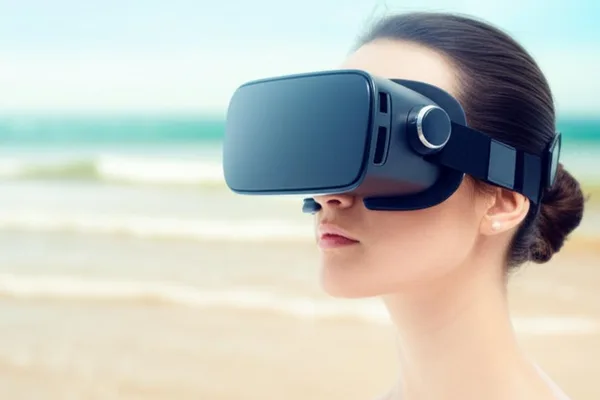
Okay, let's see how this works. All you have to do is put on a special headset (sometimes with handheld controllers). Once you put it on, the world around you disappears completely. Instead, you see a brand new, computer-generated world that spans 360 degrees. You can go inside that world, walk around it, and even interact with things in it.
Imagine you are underwater, with dolphins swimming all around you. When you look up, you see the sun shining through the water. When you look down, you see large whales swimming. You hear the echoing sounds of the underwater world. This experience is so real that your brain accepts it as such.
Simply put, your brain can't live in two realities at the same time. So the experience provided by the VR headset is accepted by the brain as real. Scientists call this 'presence'. This reduces the brain's ability to focus on negative things like pain, fear, and anxiety .
This ability is what makes VR technology so therapeutic. Also, because VR strongly stimulates our emotions, it increases our ability to learn.
Why is VR technology so important to the medical field?
In fact, doctors have been studying VR for decades to help manage pain. But now that technology has advanced, these devices are cheaper, smaller, faster, and easier to use . So, we're going to see more of these VR treatments in the future.
Moreover, a big problem in the world today is addiction to painkillers . VR is a good alternative to control pain without any drugs . Some patients may need drugs, but when combined with VR therapy, it helps to reduce the amount of drugs needed. Due to the value of this technology, even the FDA in the United States has given special approval to a VR system that reduces the pain of chronic back pain and fibromyalgia.
Main uses of VR technology
Now let's see where this amazing technology is used in the medical field.
| Usage | Description and examples |
|---|---|
| Pain Management | This is the most studied and widely used aspect of VR. A small child immersed in a VR game will not even feel an injection. This can be very helpful in reducing the severe pain of burn wounds, childbirth, and dental treatments. |
| Reducing Anxiety | During hours of difficult treatments, such as chemotherapy for cancer patients, VR can take the patient to a beautiful beach or a place where flowers are in bloom. Similarly, before a small child undergoes brain surgery, the doctor can 'walk' through a 3D image of his own brain and explain the operation. Because children see this as a video game, their fears are reduced. |
| Physical Therapy & Rehabilitation | This is very useful for people recovering from stroke, Parkinson's disease, and various accidents. For example, when a child with a severe pain condition called CRPS (Complex Regional Pain Syndrome) is given a VR game and asked to smash watermelons, they forget about the pain and engage in exercise. As a result, they recover faster. |
| Medical Training | This VR technology allows medical students to go inside a beating heart, see how blood flows, and hear heart sounds. This kind of experience makes their learning much more successful than just studying from a book. |
| Surgical Planning | Before performing a complex surgery like a brain tumor, the entire surgical team can put on a VR headset, go inside a computer model of the patient's brain, and discuss the best and safest way to perform the surgery. This maximizes patient safety. |
But, is VR suitable for everyone?
Despite the benefits of this technology, VR is not suitable for every patient or every disease.
If you ask whether VR can cure cancer, the answer is "no." VR is not a panacea for every disease. It is often used in addition to traditional treatments, to make those treatments more effective, not as a replacement for them.
Most people can use VR without any problems. However, a very small number of people (about 5% - 10%) can experience a condition called "cybersickness." This is when they feel a slight dizziness or nausea while wearing the headset. This goes away as soon as they take off the headset.
If you have a VR headset and are considering using it for a medical condition, it is best and safest to consult your doctor first and only use it under their guidance. A doctor is the one who will determine exactly what VR experience is right for you, how long it will last, and how often you should do it.
Take-Home Message
- Virtual Reality (VR) is a computer-generated world that tricks your brain into focusing on emotions like pain and fear.
- This is mainly used to reduce pain, eliminate fear of treatment, in physical therapy, and in medical education.
- VR is not a magic cure-all. It is a powerful, complementary tool used alongside conventional treatment.
- Some people may experience side effects such as mild dizziness.
- Before using VR for any medical condition, be sure to consult your doctor.




💬 Comments (0)
No comments yet. Be the first to share your thoughts here.
Add Your Comment