
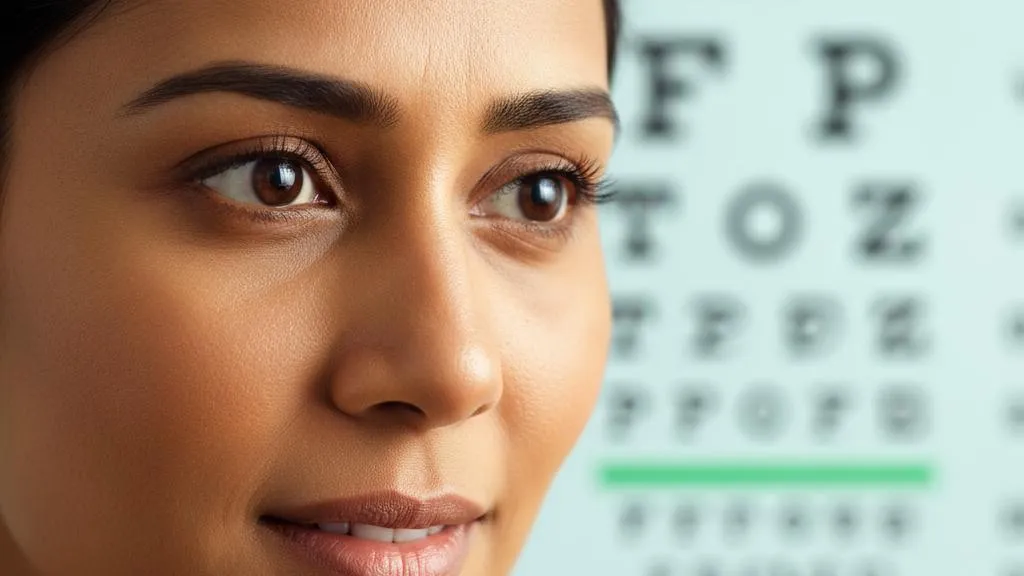
Have you ever gone to a clinic to get your eyes checked and found yourself staring at a big wall chart covered in shrinking rows of letters? You cover one eye, read aloud from the giant letter at the top down to the tiny ones near the bottom, and then switch sides. That familiar, straightforward checkup is what we doctors call a visual acuity test (a clinical measurement of eyesight sharpness).
We rarely stop to think about what those letters are actually telling your doctor, do we? Most of us just hope we reach the bottom line without guessing! Today, let's walk through how this classic eye test works, what numbers like 20/20 really mean for your daily life, and when blurred sight deserves a closer look—just like we would chat about it during a routine visit at your Primary Care Physician (PCP) or family GP clinic.
📌 Key Takeaways at a Glance
- Measures eyesight sharpness: A visual acuity test checks how clearly each eye distinguishes fine shapes and details at a set distance, usually 20 feet (6 meters).
- Spots common focusing issues early: It quickly flags refractive errors (focusing problems) like nearsightedness, farsightedness, astigmatism, and age-related near blur.
- Not a pass-or-fail test: Squinting or guessing skews your results—telling your doctor honestly where the letters blur helps get your prescription right.
- 20/20 is a baseline, not the whole picture: Having 20/20 vision means normal central sharpness, but a comprehensive eye exam also checks eye pressure, side vision, and the retina.
- Regular checks protect all ages: Children need early vision screening before school struggles start, and adults over 40 benefit from routine checks for reading strain and eye disease.
What Is a Visual Acuity Test and What Does It Measure?
A visual acuity test is a quick, painless eye exam that measures the sharpness and clarity of your eyesight at a set distance. Using a standardized wall chart or handheld card of letters and symbols, we doctors check how well each eye distinguishes fine details so we can spot blurry vision early.
Think about it for a second: every time you drive down the highway looking for an exit sign, check the route number on an approaching bus, or read the ingredients on a cereal box, you are relying on your visual acuity. In medical terms, acuity simply means how cleanly your cornea and lens focus incoming light onto the retina (the light-sensitive tissue at the back of your eye).
Have you ever wondered why the top letter E on an eye chart is so huge while the bottom rows look microscopic? Each row is mathematically calibrated to a specific viewing angle. By finding the smallest line you can read comfortably, we get an objective baseline of how your eyes are performing today compared to your last checkup. Pretty neat, right?
Why Is a Routine Eye Check and Visual Acuity Test So Important?
Many vision changes creep up so gradually that your brain simply adapts to the blur without sending you an obvious warning. That is why a routine vision check is the cornerstone of every eye exam—it catches subtle focusing shifts before they trigger daily headaches, neck tension, or unsafe driving.
Specifically, we doctors use this test as our first step to uncover four everyday refractive errors (conditions where the shape of your eye prevents light from focusing squarely on the retina):
- Nearsightedness (Myopia): Close-up objects like your phone screen or a paperback book look crisp, while distant things—such as classroom whiteboards, TV subtitles, or street signs—turn fuzzy.
- Farsightedness (Hyperopia): Distant scenery often looks clear, yet reading fine print or working on a laptop leaves your eyes aching, watery, or fatigued because your focusing muscles work overtime.
- Astigmatism (Corneal or Lens Curvature Irregularity): Because the front surface of the eye is curved slightly more like a football than a round basketball, light scatters unevenly, causing stretched blur at all distances and starburst streaks around headlights at night.
- Presbyopia (Age-Related Near Focusing Loss): Starting in our early to mid-40s, the natural lens inside the eye stiffens, making you hold restaurant menus or medicine labels at arm's length just to read them.
Beyond glasses prescriptions, a sudden drop in visual acuity can also alert us to underlying eye conditions like cataracts (clouding of the eye's natural lens), macular changes, or childhood amblyopia (lazy eye, where the brain favors one eye over the other). Catching amblyopia early through a nearsightedness test for children makes all the difference while a child's visual pathways are still developing.
What Are the Different Types of Visual Acuity Tests and Eye Charts?
We all picture the classic white poster covered in black block letters, yet eye clinics actually use several tailored versions of this test depending on a person's age, reading ability, and visual needs. Look at what happens here when we match the chart to the patient:
- Snellen Eye Chart (Standard Distance Chart): Invented in the 1860s, this traditional wall chart displays rows of high-contrast block letters—known medically as optotypes (standardized test characters)—that shrink progressively from top to bottom.
- LogMAR and ETDRS Charts: Often displayed on calibrated digital screens in modern optometry and ophthalmology clinics, these charts space every row and letter evenly, giving us ultra-precise measurements when tracking subtle changes over time.
- Tumbling E and Landolt C Charts: What do you think we use if someone is too young to know the alphabet or speaks a different native script? Instead of reading letters, you simply point your fingers in the direction the legs of the letter "E" or the gap in the letter "C" are facing.
- Pediatric Picture Charts (LEA Symbols): For toddlers and preschoolers, we swap letters for familiar outlines—like an apple, a house, a circle, and a square—turning a pediatric eye screening into a stress-free matching game.
- Near Vision Test (Jaeger or Rosenbaum Reading Card): Remember how we talked about presbyopia and close-up reading strain earlier? To test your near vision, we hand you a small card printed with miniature paragraphs and numbers held about 14 inches (35 centimeters) from your face.
How Does a Visual Acuity Test Work Step by Step?
Whether you visit your family GP clinic, a local optometrist, or an eye specialist, the testing routine follows a consistent, straightforward sequence so your results stay reliable from year to year:
- Setting the standard distance: You stand or sit exactly 20 feet (6 meters) away from the chart. If the exam room is smaller, we use a calibrated wall mirror or digital screen adjusted to simulate that exact optical distance.
- Covering one eye gently: You hold a small paddle called an occluder (an opaque eye cover) over one eye while keeping both eyes open underneath. Pressing directly on your closed eyelid can temporarily distort your cornea and blur that eye when it is tested next.
- Reading down the rows of optotypes: Starting near the top, you read each line aloud until the letters become too faint or fuzzy to identify reliably.
- Testing the second eye: Once your threshold is recorded, you switch the occluder to the opposite eye and repeat the process, since one eye is often slightly sharper than the other.
- Checking uncorrected versus corrected sight: If you already wear eyeglasses or contact lenses, we usually test you without them first to measure your natural baseline, and then with them on to see if your current prescription is still doing its job.
Be honest, you've tried squinting to squeeze out one extra line at the bottom of the chart too, haven't you? We doctors see it every single day! Squinting temporarily pinches the eyelids into a narrow slit that blocks scattered light rays, artificially sharpening blurry letters. Sometimes we actually use a tiny perforated paddle called a pinhole occluder on purpose—if looking through a pinhole makes blurry letters suddenly crisp, it tells us your blur is simply a focusing issue that new glasses can fix, rather than a problem with your optic nerve or retina. See? That's exactly why we always say not to squint or guess—just tell us honestly when the letters stop looking clear.
What Do Your Visual Acuity Results Mean? Understanding 20/20 Vision
When your test wraps up, your sharpness is written as a fraction, such as 20/20 in the United States and Canada—or 6/6 in the United Kingdom and Australia, where eye clinics measure distance in meters instead of feet. Both fractions mean the exact same thing.
The top number tells you the distance at which you stood from the chart (20 feet or 6 meters). The bottom number tells you the distance at which a person with standard, healthy eyesight can clearly read that same line. Let's put those numbers into everyday perspective:
- 20/20 (or 6/6) Vision: You have standard visual sharpness—you can clearly read at 20 feet what a person with normal eyesight reads at 20 feet.
- 20/15 (or 6/4.5) Vision: Your distance vision is sharper than average; you can read details from 20 feet away that most people have to walk up to 15 feet to see.
- 20/40 (or 6/12) Vision: Your distance sharpness is mildly reduced—you must stand 20 feet away to read what someone with 20/20 vision can spot from 40 feet away. In many regions, 20/40 with at least one eye (with or without glasses) is the minimum threshold required to hold a standard driver's license.
- 20/200 (or 6/60) Vision: You can only read the giant top letter at 20 feet that normal eyes see at 200 feet. If vision cannot be corrected better than 20/200 in the better-seeing eye, it meets the clinical definition of legal blindness.
Now that feels much clearer, doesn't it? Still, remember that 20/20 only measures sharp central sight straight ahead. You can have 20/20 acuity and still have early glaucoma affecting your peripheral (side) vision or dry eye irritation, which is why we follow up with a slit-lamp exam (microscopic front-of-eye check) and retinal evaluation.
Common Vision Issues Found During an Eye Exam and What to Do
If your visual acuity test shows that your eyesight is no longer hitting 20/20, don't worry—most causes are straightforward to manage once we pinpoint the pattern. Here is how common findings compare and what steps you can take next:
| Vision Condition or Finding | How It Affects Your Sight & Next Steps |
|---|---|
| Nearsightedness (Myopia) | Road signs, classroom boards, and distant faces look blurry while close-up reading stays clear, often due to an eyeball that is slightly longer from front to back. What you should do: Schedule a comprehensive eye exam with an optometrist for updated distance glasses, contact lenses, or myopia-control options if your child's prescription is progressing. |
| Farsightedness (Hyperopia) | Close-up tasks like reading, sewing, or scrolling on your phone feel blurry and trigger brow headaches or tired eyes by afternoon. What you should do: Get a full refraction check (lens prescription test) even if your distance vision seems fine, as mild plus-power lenses can relieve daily eye strain. |
| Astigmatism | Lines look wavy, shadow-edged, or stretched at both near and far distances, and oncoming headlights create glare or halos during night driving. What you should do: Ask your eye care provider about toric lenses or anti-reflective coatings, and avoid driving at night until your prescription is updated. |
| Presbyopia (Age 40+ Near Blur) | Small print on medicine bottles, restaurant menus, and smartphones blurs unless you hold them farther away or turn on bright overhead lighting. What you should do: Have a near vision test to choose properly measured reading glasses, bifocals, or progressive lenses rather than guessing with drugstore magnifiers alone. |
| Childhood Vision Imbalance (Amblyopia) | One eye sees noticeably fewer lines on the pediatric eye chart than the other, even though a child rarely complains because their brain relies on the stronger eye. What you should do: Book a pediatric eye specialist evaluation promptly, as early glasses or patching therapy can restore balanced vision while the visual system is still adaptable. |
✔️ What You Should Do & ❌ What to Avoid
- ✔️ Bring your current eyewear: Always pack your everyday glasses, reading glasses, and contact lens boxes when heading to your Primary Care Physician (PCP), family GP clinic, or optometrist.
- ✔️ Follow the 20-20-20 screen habit: Every 20 minutes spent on a computer or smartphone, look at something at least 20 feet (6 meters) away for 20 seconds to relax your focusing muscles.
- ✔️ Protect your eyes outdoors and at the table: Wear UV400-blocking sunglasses on bright days and include leafy greens like spinach and omega-3-rich fish such as salmon in your weekly meals to support retinal health.
- ❌ Do not squint or memorize the chart: Guessing letters gives your doctor false reassurance and can leave you walking out with an under-corrected prescription.
- ❌ Do not rely solely on online eye apps: Screen brightness, glare, and uncalibrated distances make smartphone vision tests unreliable substitutes for an in-person clinical eye exam.
- ❌ Do not ignore one-sided blur: If one eye suddenly seems cloudier than the other when you cover them individually, never wait months hoping it clears up on its own.
🚨 When to Seek Immediate Emergency Care (Red-Flag Symptoms)
If you or someone near you develops any of these red-flag symptoms, do not wait — call 911 (or 999 in the UK / 000 in Australia) immediately or go straight to the nearest hospital Emergency Room (ER / A&E):
- Sudden vision loss or rapid dimming: Abrupt partial or complete loss of sight in one or both eyes, even if it lasts only a few minutes and returns.
- A dark curtain or shadow: A gray veil or shadow creeping across any part of your visual field, which can signal a retinal detachment (peeling away of the back lining of the eye).
- Sudden shower of floaters and flashing lights: A brand-new burst of cobweb-like spots accompanied by lightning-like flashes in your side vision.
- Severe eye pain with headache and halos: Intense throbbing eye pain paired with redness, nausea, vomiting, or rainbow rings around lights, which can indicate acute angle-closure glaucoma (a sudden dangerous spike in eye pressure).
- Eye trauma or chemical exposure: Any direct blow to the eye, penetrating object, or splash of household cleaners or industrial chemicals (rinse immediately with clean lukewarm water for 15 minutes while heading to emergency care).
💡 Key Take-Home Message
- A visual acuity test is a fast, painless cornerstone of eye care that measures how sharply each eye focuses detail at a standardized distance.
- Routine testing catches common focusing issues like nearsightedness, farsightedness, astigmatism, and presbyopia early, keeping work, school, and driving safe.
- Be completely honest during the exam—don't squint or guess, because accurate measurements lead to comfortable, headache-free vision correction.
- Even if you enjoy crisp 20/20 sight, schedule regular comprehensive eye exams to check internal eye pressure, peripheral vision, and overall eye health.




No comments yet. Be the first to share your question or experience below.