

When you bathe your newborn baby or change his diaper, have you ever noticed a small bump on the bottom of his back, just above the point where his buttocks meet? Some parents get a little scared when they see this. “Oh, doctor, is this some kind of illness? Is something wrong inside?” they think. Is this really something to be afraid of? This is what we are talking about today.
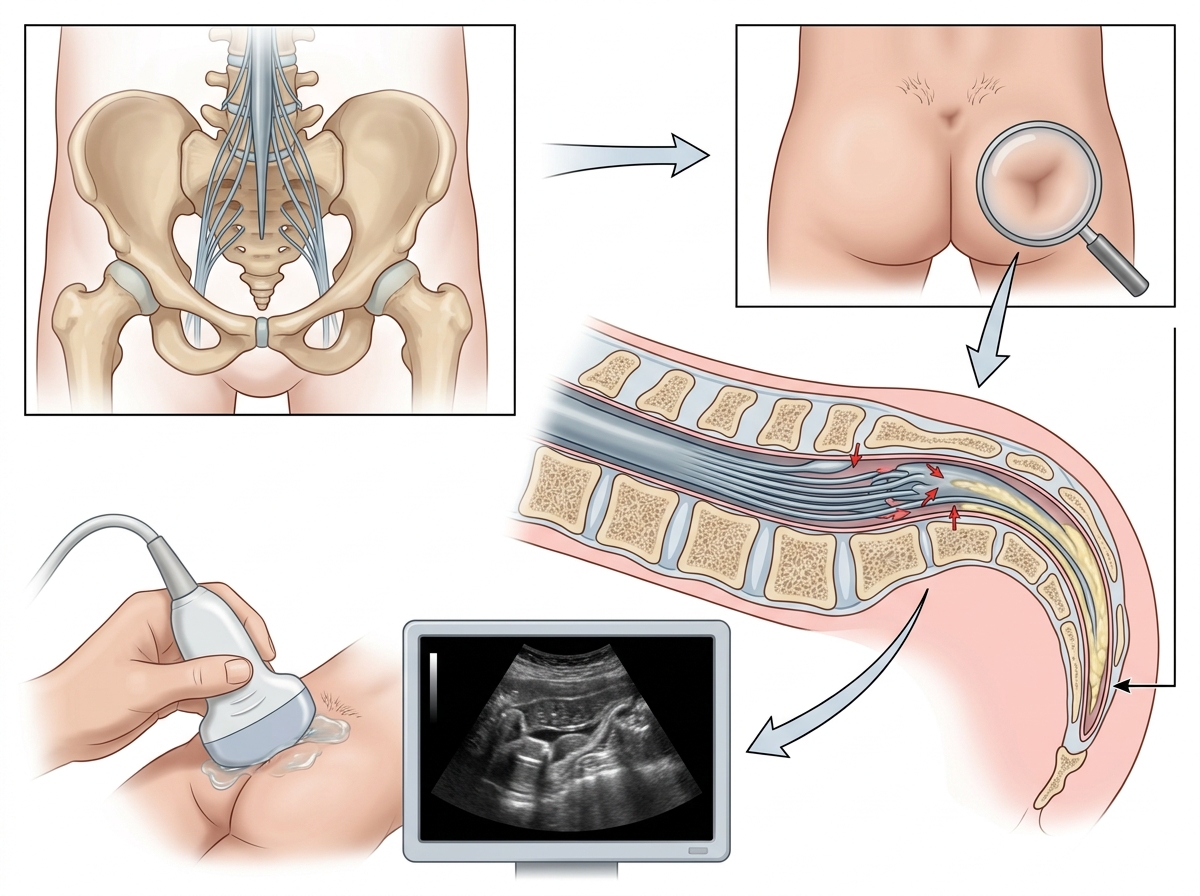
Two types of 'dimples' seen on the back
First, let's understand that there are two main types of dimples that appear on the lower back. Although both are congenital, there is a big difference between the two.
| Characteristic | Sacral Dimple (the dimple above the buttocks) | Back Dimples |
|---|---|---|
| Location | It is located in the midline of the spine, just above the edge where the two buttocks meet. | Located in the lower back, on either side of the spinal column. |
| Number | Usually, only one beat is seen. | They are seen as a pair, that is, two. |
| Health impact | Most often there is no harm done, but very rarely it can be a sign of an underlying spinal problem. | It's not a harmful condition at all. It's completely normal. |
Should we be concerned about a sacral dimple?
Simply put, a small percentage of newborns have this `Sacral Dimple`. The vast majority of these are harmless, just small bumps on the skin. So there is no reason to panic when you see this.
However, sometimes, especially if there are other symptoms along with the swelling, a doctor may want to investigate it a little further.
What are the times when you should talk to the doctor?
Check if your baby's ``Sacral Dimple`` has these things:
- If there are some tufts of hair around the bump.
- If you have a small mole-like area (skin tag) that has risen above the skin.
- If there is discolored skin in that area, for example, a red spot.
- If the hole is very deep or the bottom is not clearly visible.
If you see any of these symptoms, please don't panic, show your baby to your family doctor or pediatrician and tell them about it.
When these symptoms occur, your doctor may want to check for underlying spinal or nerve root problems. These are very rare conditions.
1. Tethered Cord Syndrome: This is when the nerve root in the spinal cord becomes trapped by surrounding tissue, preventing it from moving freely. A child with this condition may eventually develop numbness in the legs and difficulty controlling urine and stool (`bowel incontinence`).
2. Spina Bifida: This is a condition where the spinal cord does not fully close around the spinal cord when it forms. However, a rare condition called `Spina Bifida Occulta` is seen with a `Sacral Dimple`. In this condition, the spinal cord does not close completely, but the spinal cord is not affected. Often, there are no symptoms.
If a doctor suspects this, they can usually perform an ultrasound scan to clearly see the condition inside the spine.
Practical tip: If your baby's ``Sacral Dimple`` is a bit deep, dirt and sweat can accumulate in it and cause infections. So remember to wash the area thoroughly with water every time you bathe your baby, and keep it clean and dry.
What about the dimples on both sides of the back?
You don't need to worry about these at all. They are completely harmless and a normal part of the body. To be precise, they are caused by the ligaments that connect the skin to the underlying pelvic bone (the `pelvis`).
They even have a beautiful name – “Dimples of Venus.” Throughout history, they have been considered a symbol of beauty, fertility, and good luck in many cultures. So if you or your child has them, it’s a matter of joy, not fear.
Can these be made new?
Both of these types of spinal deformities are `congenital`, meaning they are present when we are born.
Therefore, if you are not born with `Back Dimples`, you cannot create them through exercise or any other method.
The reason is, there is no muscle where there are contractions. We can only develop muscle through exercise.
However, if you already have `Back Dimples`, you can make them look better and more pronounced with exercises. When you reduce unnecessary fat in the lower back and abdomen and strengthen the muscles in that area (`core strength exercises`), their dimples will be better and more visible. Also, these exercises are very helpful in reducing back pain .
Some exercises that can make back dimples look better
Important: Before starting any exercise, warm up. If you feel pain while doing the exercise, stop immediately.
- Adductor Stretch: Place one leg on a high surface, such as a table. Now lower yourself towards that leg from the waist. If possible, try to touch your toes with your hand. Hold this position for 20-30 seconds. Repeat three times.
- Glute Stretch: On a table, bend one of your legs at a 90-degree angle (ankle on the table). Now bend forward, keeping your back straight. Hold this position for 20-30 seconds. Repeat three times.
- Supine Hip Twist (with a Physioball): Lie faceup on a large exercise ball (a `physioball`). Bend your knees and hips to 90 degrees and rest them on the ball. Now slowly rotate your hips from side to side, without falling off the ball. Repeat 10-20 times in one go.
Take-Home Message
- The sacral dimple above your baby's buttocks is usually completely harmless, so don't worry about it unnecessarily.
- However, if you notice anything related to the rash, such as hair growth, skin changes, or a lump that has emerged from the skin, don't panic and talk to your doctor about it.
- Back dimples are a completely harmless, normal body feature.
- Exercise cannot create new back dimples, but it can improve the appearance of existing back dimples.
Sacral Dimple, Back Dimples, Back Dimples, Baby's Back Dimples, Spina Bifida, Tethered Cord Syndrome, Child Health, Dimples of Venus
A note from Nirogi Lanka
Sacral dimples found in the lower part of the spine (Sacral area) of newborn babies are often a harmless birth defect.
- If the bump is small in size (less than 5 mm), the bottom is clearly visible and is located in the midline between the buttocks, there is no risk to the baby.
- If the bump is large in size, if the bottom is not visible, if it is located above the buttock line or if there is hair, skin tags/hemangioma nearby, it may be a change in the nervous system (Tethered cord syndrome), so see a pediatrician immediately for an ultrasound scan.
- Avoid pressing, digging, or probing the puncture site with objects such as needles.
❓ Some more questions you may encounter (FAQ)
What is Sacral Dimple?▼
A sacral dimple is a small bump in the skin above the gluteal cleft in the lower part of a newborn baby's spine.
What is the difference between Sacral Dimple and Back Dimples (Dimples of Venus)?▼
Sacral Dimple is a vertebra located in the lower center of the spine, and Back Dimples (Venus dimples) are two protective vertebras that come from generation, located on both sides of the spine in relation to the hip bone.
When should a pediatrician do an ultrasound because of a sacral dimple?▼
An ultrasound scan should be performed if the hernia is larger than 5 mm, the bottom is not visible, is more than 2.5 cm above the buttock line, or there is a nearby mass, hair, or skin discoloration.


💬 Comments (0)
No comments yet. Be the first to share your thoughts here.
Add Your Comment