

Have you ever gone to a doctor for a skin problem and heard them say, “We need to take a small piece of this and test it”? We usually call this a ‘ biopsy .’ That’s how a specialist doctor takes a small piece of your skin, nail, or hair and finds out exactly what the disease is. The strange thing is, we never meet this doctor in person. Today we’re talking about the hero behind the scenes who helps you diagnose your disease accurately, a Dermatopathologist.
Simply put, who is this Dermatopathologist?
This name may sound a bit complicated, but it's actually quite easy to understand. It's a combination of two words.
1. Dermatology : This is the science and medicine of skin diseases. You go to a dermatologist for a skin problem.
2. Pathology: This is the science that studies diseases. They examine tissues and cells from our bodies under a microscope to diagnose diseases. These doctors can tell exactly whether it's cancer or an infection.
When these two fields come together, the subspecialty of dermatopathology is formed. So, a dermatopathologist is a doctor who has received special training to examine samples taken from the skin, hair, and nails under a microscope and accurately diagnose diseases. To be precise, someone is like a detective who diagnoses diseases in the field of dermatology .
What exactly do these doctors do?
Imagine your dermatologist notices a strange spot on your skin and takes a small sample (biopsy) of it. What happens next?
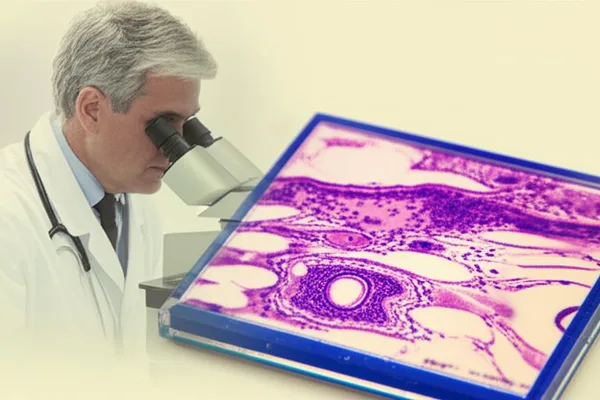
That small piece of skin is prepared according to a special procedure and sent to the lab. That's where the Dermatopathologist's work begins. He uses very powerful microscopes (light microscopes, electron microscopes) to study the changes in that piece of skin at the cellular level.
They look to see if there is anything different from normal healthy cells. Is it a cancer cell? Is it a change caused by an allergy? Is it a bacterial or fungal infection? Or is it something caused by a problem with the immune system? Only after this test can we say for sure.
Then, this specialist will write a complete report including all of his findings. That report will be sent back to your dermatologist. Your treatment will begin based on that report.
How difficult is it to become a Dermatopathologist?
This is not an easy journey as you might think. This is a field of medicine that requires a high level of training. Typically, the journey goes like this:
- Basic degree: A 4-year Bachelor of Science degree.
- Medical School: 4-5 year medical degree (MBBS).
- Internship : 1 year of training.
- Postgraduate training (Residency): Here they receive 3-4 years of specialist training in either Dermatology or Pathology.
- Fellowship: After that, there is another 1-2 years of in-depth training in this subspecialty field called Dermatopathology .
Just imagine, by the time all this is over, you will have to dedicate more than 10-12 years to education and training. This shows the importance of this field and the dedication required for it.
What types of conditions do these specialists diagnose?
A dermatopathologist does not directly treat patients. However, their diagnosis will determine the treatment you receive. Let's take a look at some of the main conditions they diagnose.
| Medical condition | The role of the dermatopathologist |
|---|---|
| Skin Cancers | Identifying common and serious types of cancer, such as Basal Cell Carcinoma and Melanoma . It provides information about how deep the cancer has spread and how fast the cells are dividing. This information is essential for planning treatment. |
| Psoriasis | This is a disease caused by a problem with the immune system. Sometimes it can be confused with other skin diseases. A biopsy can confirm whether this is psoriasis or not and what type it is. |
| Hair loss (Alopecia Areata) | This condition, where hair falls out in patches, is also a problem with the immune system. This disease can be confirmed by examining a small piece of tissue taken from the scalp and seeing if immune cells have gathered around the hair follicle. |
| Allergies and infections | Microscopic examination of skin lesions, such as blisters, eczema, and rashes, confirms whether they are caused by an allergy, bacterial, viral, or fungal infection. |
Why don't you need to see a Dermatopathologist?
If you have any problems with your skin, nails, or hair, you should first see a dermatologist . For example:
- A change in the color, shape, or size of a birthmark on the skin.
- Persistent acne.
- Hives or various rashes.
- Scarring.
- Fungal infections of the nails.
- Unusual hair loss.
Your doctor will look at these symptoms, take a biopsy if necessary, and consult a dermatopathologist for an opinion. This means that you will not need to see a dermatopathologist directly.
Why is accurate diagnosis so important?
If you get the wrong diagnosis, you could end up with the wrong treatment. It could even make your condition worse. Imagine what could happen if something as serious as skin cancer is mistakenly diagnosed as a common skin condition. It could even be life-threatening.
Therefore, especially if you suspect a serious condition such as skin cancer, it is very important to ask your doctor if the biopsy sample will be examined by a dermatopathologist. If necessary, you can also get a second opinion from such a specialist.
This shows how valuable the services of such specialist doctors who work behind the scenes for our health, even though we don't see them, are.
Take-Home Message
- A dermatopathologist is a doctor who has received special training to diagnose diseases by examining skin, hair, and nail samples under a microscope.
- If you have a biopsy for a skin condition, this specialist will examine the sample. But you won't meet him in person.
- Your dermatologist will decide on treatment based on the report provided by the dermatopathologist.
- Their expertise is essential to accurately diagnose many diseases such as skin cancer, psoriasis, and hair loss.
- If you suspect a serious skin condition, it is important to ask your doctor if the tissue sample can be examined by a dermatopathologist.
Dermatopathologist, Dermatopathology, Skin Disease, Skin Disease, Biopsy, Biopsy, Skin Cancer, Melanoma, Psoriasis




💬 Comments (0)
No comments yet. Be the first to share your thoughts here.
Add Your Comment