
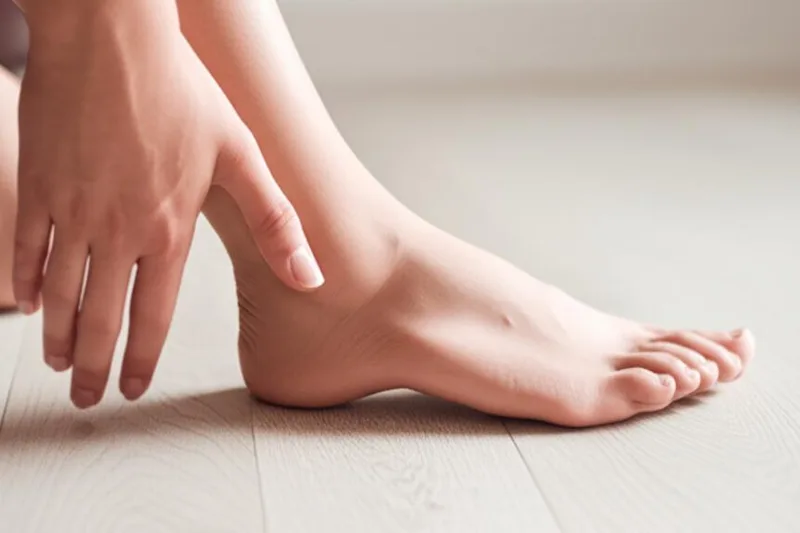
Do you experience pain on the inside of your leg, especially your ankle, when you walk a short distance or climb stairs? Perhaps your arch is gradually losing its shape and your foot is becoming flat? These symptoms are not just normal. Today we are talking about a condition called Posterior Tibial Tendon Dysfunction that can be behind this. Although this is a bit of a serious word, let's understand it simply.
What exactly is Posterior Tibial Tendon Dysfunction (PTTD)?
Simply put, tendons are strong bands of tissue that connect muscles to bones. The Posterior Tibial Tendon is one such special tendon. It starts in the calf muscle, runs along the inside of the ankle, and attaches to a bone in the middle of the foot.
Its main function is to support the arch of our foot . It is also what helps us lift our toes when we walk, run, or jump.
Now, PTTD is when the aforementioned ligament becomes swollen or torn. When this happens, the ligament can no longer support the curve of the foot. As a result, the curve of the foot gradually disappears, resulting in a condition called ' flat foot '. This condition can be considered the main reason why the feet become flat in adults.
This disease usually develops in four main stages.
| Stage | Characteristics and description |
|---|---|
| Stage 1 | The tendon is pulled, but not torn. It hurts when walking. There may be some swelling. But you can still stand on one leg on your toes. |
| Stage 2 | The tendon is somewhat torn. The pain and swelling are more than before. The flatness of the sole is clearly visible. It is difficult or impossible to stand on one leg on the tips of the toes. |
| Stage 3 | The shape of the leg is significantly deformed. The heel loses its flexibility and the leg becomes stiff. |
| Stage 4 | This is the most severe case. Both the ankle and foot are deformed. This condition can progress to arthritis of the ankle. |
Why does this situation occur?
Imagine you suddenly fall. In a major accident like that, this ligament can tear or swell. In addition, overuse is also a major cause. This risk is higher for those who play high-pressure sports like tennis, football, basketball, and long-distance runners. When the ligament tears or swells, the curve of the sole of the foot slowly begins to collapse.
In addition, there are several other risk factors :
- Obesity: Increased body weight increases the pressure on the feet.
- High blood pressure (Hypertension)
- Diabetes
- Steroid drug use
- Previous surgeries in that area
- Arthritis conditions like Reiter's syndrome
- Activities that put a lot of force on the legs, such as running up a hill
- This hairline naturally weakens with age (especially in women over 40 ).
Do you have these symptoms too? PTTD symptoms
The main symptoms are pain and swelling in the inner side of the leg and ankle. This pain is especially worse when standing or walking.
In addition, these symptoms may also appear:
- The arch of the foot is lost and becomes flat.
- Inability to stand on tiptoes.
- Difficulty walking on uneven ground.
- Difficulty going up and down stairs.
- Wearing a shoe on one foot differently than the other.
- Inward rolling of the ankle.
- Flat feet can also put pressure on the outside of the ankle, causing pain there as well.
- The foot and toes begin to turn outward.
How can the doctor confirm if this is PTTD?
When you go to see a doctor, he or she will first ask you about your symptoms and examine your foot and ankle carefully. You may also be referred to a foot and ankle surgeon.
Usually several tests are done like this:
- Single-Leg Heel Raise Test: Here, you will be asked to stand with your back to a wall, raise your good leg, and lift your affected leg up with the toes. Usually, the heel will roll inward when you do this. If it doesn't, it could be a sign of PTTD. In the second stage of the disease, you may not be able to do this even once.
- "Too many toes sign": This is where the doctor stands behind you and looks at your feet. Normally, when you look at someone from behind, you can only see the little toe and a small part of the toe beyond it. However, because the soles of someone with PTTD are flat and the toes are turned outward, more toes than normal are visible behind them.
In addition to these tests, your doctor may also recommend tests such as an X-ray, MRI, Ultrasound, or CT scan to confirm the condition and assess the extent of the damage.
What are the treatments for this?
The best thing is to detect this condition early . Then there is a greater chance of treating it non-surgically. Your doctor will decide on the treatment based on the severity of your symptoms.
Non-surgical treatments
| Treatment method | What is happening? |
|---|---|
| Immobilization | I have been wearing a cast or a special walking boot on my leg for about two months. This helps reduce swelling and helps the tendon heal. |
| Braces (special supports) | You will be given a custom-made ankle brace to wear to support your ankle and foot. |
| Medicines | Your doctor may prescribe painkillers such as non-steroidal anti-inflammatory drugs (NSAIDs) (e.g. ibuprofen) for pain and swelling. But remember, do not continue to use any medication without your doctor's advice. |
| Physical therapy | Exercise and adequate rest are provided to strengthen the muscles and ligaments around the affected area. |
| Orthotics | These are medical devices that doctors recommend. Things like special insoles (shoe inserts) that are placed inside shoes. These provide support for the curve of the sole and the arch of the foot. |
Surgery
If the pain does not improve after about 6 months of non-surgical treatment, your doctor may consider surgery. The most appropriate surgery will depend on the location of the pain and the extent of the damage to the ligament. Some of these include:
- Tenosynovectomy: Removal and cleaning of the inflamed tissue around the tendon.
- Osteotomy: Reshaping the heel bone.
- Tendon transfer: Taking a section of a healthy tendon from another part of the body and transplanting it into the damaged tendon.
- Arthrodesis: The fusing of two or more bones together to stop movement in the affected joint.
How long will it take to heal?
PTTD is a painful condition. It can take several months to fully heal. During this healing period, you will need to make changes to your daily routine and be very careful before you can return to your normal life. It is very important to follow your doctor's instructions exactly.
Take-Home Message
- Pain on the inside of the leg, around the ankle, and flat feet are the main symptoms of PTTD. These should never be ignored.
- If you have these symptoms, see a doctor immediately . If detected early, it can be cured without surgery.
- This risk is higher for people with conditions like diabetes, high blood pressure, and obesity. Therefore, it is important to control these diseases as well.
- Follow the treatment (rest, exercise, medication) prescribed by your doctor exactly. Avoid taking medication on your own.
- Be patient during the healing process. It is very important to give your body the time it needs to heal.
👩🏽⚕️ Additional questions (FAQs)
💬 🦵 What is this 'Tibia' bone? Where is it located?
The tibia is the main bone in the front of our leg, below the knee. In Sinhala, we also call it the shin bone. On the inside of this bone, a major tendon (Posterior Tibial Tendon) runs down, which helps to keep the arch of our foot straight.
💬 🦶 Why do I have pain starting from my shin bone (tibia bone) all the way down to my sole?
This is often caused by a problem with the Posterior Tibial Tendon (PTTD). This tendon is located on the inside of the tibia bone. When this tendon is weakened or injured, the arch of the foot can be lost and the foot can become flat. That's why you feel pain from the shin bone all the way down to the sole of the foot.
💬 👟 What can be done for the pain that comes from the tibia bone and the flat soles?
First, you can rest the leg and apply ice. In many cases, you will need to use special shoes (orthotics) to support the arch of the foot. If the pain persists, you should definitely see a doctor to determine if it is a PTTD condition.


💬 Comments (0)
No comments yet. Be the first to share your thoughts here.
Add Your Comment