
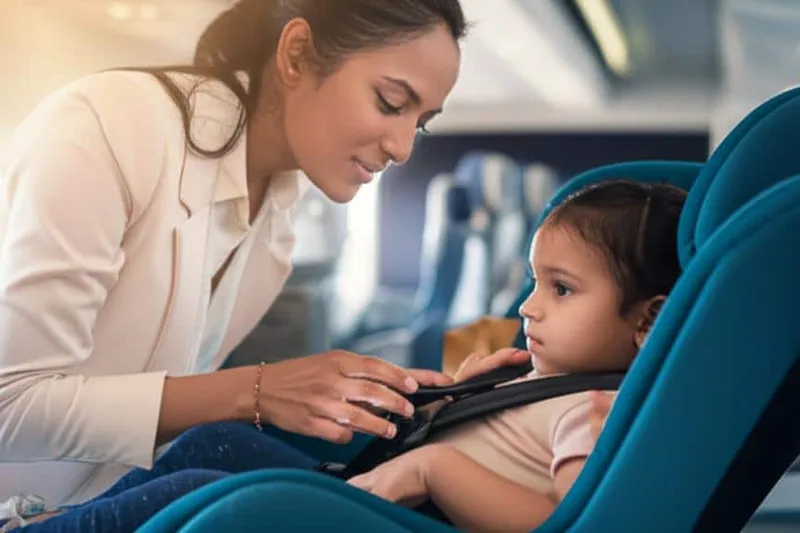
Traveling with a small child is not an easy task, is it? Especially if it's a plane trip, it's normal to feel a little scared and nervous. Besides food, toys, and clothes, the biggest question we all have is "How do I ensure the safety of my child on the plane?" Even though it is allowed to travel for free with a child under two years old on your lap, it's not really the safest way. A properly selected car seat can keep your child safe and reduce the burden on your mind.
Child safety on an airplane
Although not required by law, major agencies like the Federal Aviation Administration (FAA) in the United States strongly recommend that you seat your child in a special, approved child restraint system. These special seats provide more protection for your child than using a regular seat belt alone, or even sitting on your lap.
There are two main types of safety systems that can be used on an aircraft:
1. Child Restraint System (CRS): Simply put, these are the 'car seats' we all know and use in cars.
2. Child Aviation Restraint System (CARES): This is a special harness system approved by the FAA that can be used as an alternative to a car seat.
Things we need to know about car seats (CRS)
Not all car seats we commonly use are approved for use on airplanes. An approved CRS must have a label clearly stating "For use in aircraft."
This label is very important. It should be visible to the flight attendants when boarding the plane. If you don't have one, you may have to check your car seat in your checked baggage, leaving your child without a secure seat for the entire trip.
What seats are banned?
Booster seats , which do not have a backrest, are completely prohibited on airplanes.
Booster seats do not provide the same level of protection as other car seats. Because the back of an airplane seat can move around, there is a greater risk of injury to the child's abdomen in an emergency.
How to choose the right seat?
You should choose the right car seat for your child based on their age, size, and the maximum weight limit set by the car seat manufacturer. If your child exceeds the weight limit for one seat, you will need to move to the next level seat.
Seat size and fit on the plane
Most approved car seats, as long as they are less than 16 inches wide, will fit perfectly in an airplane seat. Imagine you bought a ticket for your child and brought an approved car seat, but it gets stuck in the seat. If that happens, the airline is legally obligated to find you another seat that fits in the same class.
Rear-facing? Forward-facing?
These are the two main types of car seats that are best for airplanes. The best type depends on your child's age and size.
| Seat type | Who is it suitable for? | Important points |
|---|---|---|
| Rear-facing car seats | Usually for children up to 3 years old. | It is safest to leave a child in this type of seat for as long as possible, until they exceed the manufacturer's weight and height limits. |
| Forward-facing car seats | Once the child outgrows the rear-facing seat, usually until about 7 years old. | The child can use this seat until they exceed the weight and height limits for it. |
When can you use a seat belt?
Children aged 8 years or older can safely use a regular seat belt on an airplane if they meet the following requirements:
- If the lap belt is positioned exactly across the top of the thighs .
- If the shoulder belt goes exactly over the shoulder and chest .
- If the seat belt does not go over the stomach or neck .
If your child is too big for a forward-facing car seat but doesn't fit snugly with a regular seat belt, you may want to consider a CARES system.
More tips when flying with a CRS
It's not enough to just bring the car seat. There are a few things you can do in advance to make the flight as comfortable as possible.
- Ask about discounts: Call your airline and ask if they have special discounts for children. Sometimes they do. When booking a ticket, be sure to mention the child's age and make sure you don't have seats near the exit row.
- Choose appropriate seats: Choose adjacent seats for you and your child. These seats should not be in an exit row. Many airlines recommend placing the car seat in a window seat . This will prevent others from blocking the exit in case of an emergency.
- Ask for help getting to a connecting flight: A car seat is a big, heavy item. It's not as easy as you might think to carry it, your other luggage, and your baby through an airport. You can ask the airline for help. They may be able to provide a shuttle to take you to your next flight.
An alternative to the car seat: the CARES system
CARES is a special harness that can be used as an alternative to a regular car seat. It can be used by children weighing between 10 and 20 kilograms (22-44 pounds). Therefore, it is a good alternative for airplanes where a booster seat cannot be used.
The CARES system is so lightweight that it can be folded up and carried in your carry-on bag. However, it is not suitable for use in cars. It is the only harness system approved by the FAA for use in aircraft.
For children with special needs
Typically, once a child weighs over 18 kilograms (40 pounds), they are larger than a standard CRS. However, a child with special needs may still need a safety seat on an airplane, even if they weigh more.
There are special CRSs made specifically for these types of children. If you meet the following requirements, you and your child can travel safely.
- The child must be under 18 years of age.
- The CRS must be approved and properly labeled.
- The child's weight must fit the weight limit of the relevant CRS.
- The child must be secure in the seat.
Take-Home Message
- It is always safer to use an approved child restraint system (CRS) than to carry your child on your lap.
- Always check if your car seat has a label that says "For use in aircraft."
- Booster seats without backrests are strictly prohibited on airplanes.
- Choose the seat (rear-facing or forward-facing) that is appropriate for the child's age and size.
- Always reserve adjacent seats, avoid seats near emergency exit doors (exit row), and place the CRS in a window seat if possible.
- If you have any doubts, talk to the airline before the flight. If you have any concerns about your child's health, don't forget to discuss them with your doctor before the trip.




💬 Comments (0)
No comments yet. Be the first to share your thoughts here.
Add Your Comment