

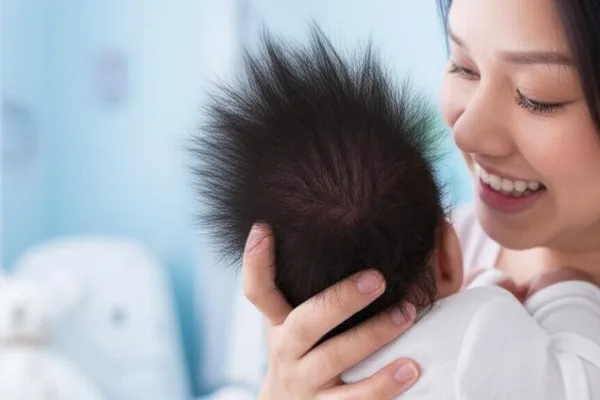
You may have seen in the hospital or at a relative's house that some newborn babies are born with very thick, long hair. However, there are also babies who are born without a single strand of hair on their head. As a mother , you may also wonder, "Why does my baby have so little hair?", "How much hair does that baby have!" This is very common. Even doctors can't say 100% for sure why this happens. But it is believed that genes and DNA play a major role in this. So today, let's talk about what you need to know about this amazing hair in babies.
How hair grows in the womb
Your baby's hair starts growing in your womb. This is a very amazing process. Imagine, your baby's hair starts growing before you even know it.
Simply put, here's how it happens:
| Pregnancy period (in weeks) | What happens to the baby's body |
|---|---|
| Around 14 weeks | Hair follicles, the basis for hair, begin to form. |
| Around 20 weeks | Hair begins to appear in places like the eyebrows, upper lip, and chin. |
| Around 22 weeks | A fine, fine hair grows all over the baby's body, especially on the shoulders, back, ears, and forehead. We call this (lanugo) . |
| Around 23 weeks | The pigment that gives color to the baby's hair, called melanin , begins to be produced. |
This fine layer of hair called lanugo usually falls out between 24 and 28 weeks of pregnancy. This means that it disappears before the baby is born. However, some premature babies may still have lanugo hair at birth. It falls out after a few days.
But the story of the hair on a baby's head is different. The hair follicles that form while the baby is in the womb are what the baby has for the rest of its life. New hair follicles do not form after birth . So the amount of hair on the head is determined there.
What happens to hair after birth?
This is where many mothers get worried. A baby born with a lot of hair will lose most of its hair within the first 6 months. It may even become bald within a few weeks.
But don't worry, it's very normal. That hair will grow back!
Why does this happen? The reason is hormonal changes . When the baby is in your womb, he receives a large amount of hormones from you. But after birth, these hormone levels drop suddenly. This causes the baby's hair growth to temporarily stop, and the old hair falls out.
As new hair begins to grow, you may notice patchy or bald spots as the old hair falls out. This will go away after a while.
Another surprising thing is that the new hair that grows can be completely different in color or texture than the hair that was there when the baby was born .
Imagine, you and your husband both have black, straight hair. But the baby was born with brown hair. But in a few months, that hair will fall out and the new hair that grows back may be black like yours. Sometimes, curly hair may appear. We can't tell for sure in advance, it's something that's determined by genes.
How to take care of baby's hair?
Some babies' hair grows back quickly. For others, it can take years. The most important thing is to not compare your baby to other babies . Every baby is unique.
Here are some things you can do to keep your baby's hair healthy:
About cutting hair
Many people think that when a baby's head is shaved, it will grow hair. This is a complete misconception . The thickness of hair is determined by genes, not by cutting. Therefore, do not rush to cut your baby's hair until he is at least a year old. Let nature and genes take their toll.
How to wash your head
You should wash your baby's hair two or three times a week. When washing, use a baby shampoo that is formulated for babies and won't irritate their eyes. Don't rub too hard. Doing so can strip the hair of its natural oils, leaving it dry and frizzy. Be very gentle, massaging your hair with your fingertips.
Be careful with oils and lotions.
It's normal for newborn babies to have dry, flaky skin on their scalp. Don't apply oil, petroleum jelly, or other lotions to this. These will only cause the dry skin to stick together and make the condition worse.
Sometimes, babies develop yellow, crusty or oily scaly patches on their scalp. We call this Cradle Cap . It is not painful or itchy. So there is nothing to worry about. These will gradually fall off when you gently wash your head and comb it with a baby hairbrush.
However, if this cradle cap condition does not go away or seems to be getting worse, definitely see your doctor for advice.
Take-Home Message
- The amount of hair a baby has at birth is completely genetic. Don't compare it to other babies.
- Hair loss in newborns is a very common occurrence due to hormonal changes. Don't worry about it.
- New hair that grows back may be different in color and texture than the hair you had at birth.
- Shaving a baby's head or cutting their hair will not make their hair grow thicker or faster.
- Wash your baby's head 2-3 times a week with a mild shampoo. Avoid applying oils to normal dry skin.
- If a condition such as cradle cap persists or worsens, consult your doctor .




💬 Comments (0)
No comments yet. Be the first to share your thoughts here.
Add Your Comment