
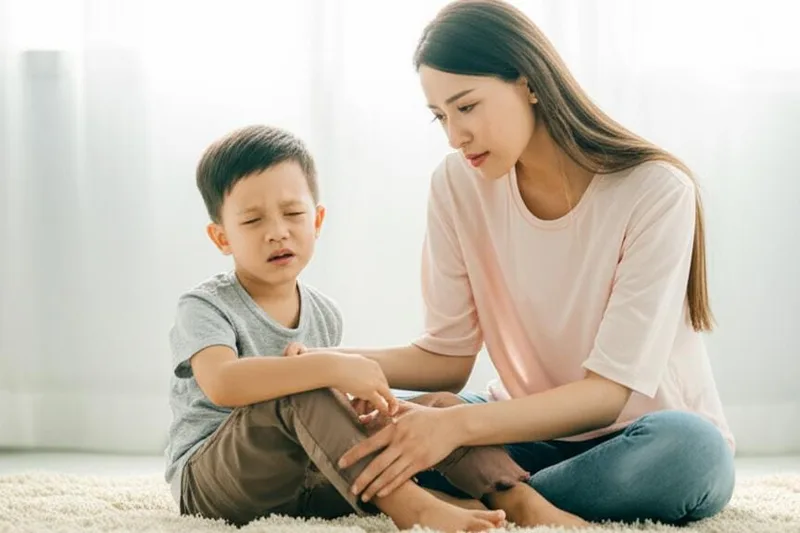
As a parent of a small child, you may have experienced this. Your baby, who has been playing and running around all day, suddenly starts crying when he goes to bed at night because his legs hurt. Or he keeps saying, "Mommy, my legs hurt" since the evening. This is what we often call "Growing Pains." However, when you hear this name, some people may think that it is actually a pain that comes with growing up. Let's see if this story is true or not.
What exactly are these "Growing Pains"?
Simply put, “groin pain” is a type of cramping or cramping pain that occurs in young children, especially in the legs. It is not dangerous , meaning it does not cause any harm to the body. However, it can be a bit annoying for little ones.
In the past, people thought that this pain was caused by the rapid growth of bones . That's why the name "Growing Pains" was coined. But later it was discovered that this pain is not actually directly related to the growth of the body. But the name is still used.
This pain can usually begin as early as 3 years of age. It is most commonly seen in children under 12 years of age .
Is “Growing Pains” a real thing?
Yes, absolutely. When your baby says his legs hurt, it's not something you're imagining. The pain is real . But the name "growing pains" is a bit of a misnomer, because as we said before, it's not directly related to growing.
What difficulties does the baby experience during these "growing pains"?
Most often, this pain occurs in both legs of children. It can be especially in the shins, calves, thighs, or behind the knees . Sometimes, this pain can also occur in the arms, but it is a little less common.
Imagine your daughter comes home from school in the afternoon, plays, eats dinner, and goes to bed. After a while, she cries, saying, "Mommy, my leg hurts." When you touch it, it's not swollen or red. When you wake up in the morning, it's fine, and she's playing as usual. That's the normal nature of "growing pains."
A few more details:
- It usually affects both sides of the body (such as both legs).
- The pain often comes in the evening or at night .
- The pain can last from a few minutes to a few hours .
- This is not a constant thing . You can go days or weeks without any pain and then suddenly it comes back.
- Sometimes the pain is so bad that it can wake you up from sleep .
- But by morning, or after a little rest, the pain goes away.
- This pain is more likely to occur on a day when the baby has been playing a lot and running around .
- The most important thing is that there are no other symptoms associated with this pain. That is, there is no swelling, redness, or lameness.
- The baby does not stop doing his daily activities or playing because of this pain.
How does “Growing Pains” feel?
Many children say that it feels like they are being squeezed from the inside, like a deep ache . However, not all children feel the same way. Some children may feel the pain very sharply , while others may feel it very gently .
What is the real cause of "growing pains"?
To be honest, doctors still don't know exactly what causes these "growing pains." But there are a few things they think or suspect might be the cause:
- Excessive running, jumping, and playing: This can cause overuse of muscles. This can be a reason for sore legs at night after a hard day's work.
- Natural changes in the body of some children:
- Some children may have loose, flexible joints. This is called ``Hypermobility'' in medical science.
- Having flat feet.
- Conditions like scoliosis.
Things like this can also put a little pressure on the body.
- Vitamin D deficiency or low bone density: These can also cause problems with bones and muscles and cause pain.
- Stress or emotional distress: Don't be surprised, sometimes things like sadness, fear, and pressure can also cause muscle aches, headaches, and stomach upsets.
- Hereditary factors: This can sometimes run in families. This means that if your mother, father, or siblings had this type of pain as a child, your baby is more likely to have it too.
How does a doctor determine that this is "grovin' pain"?
There is no specific test to diagnose "growing pains." The doctor will do a physical examination and ask you about your baby's symptoms. The doctor may ask questions like:
- Where is the pain?
- How does the pain feel? (e.g., is it tight, stabbing, aching?)
- When did this start?
- What was the baby doing the day the pain started? (e.g., did he play a lot?)
- How often does this pain occur?
- Does doing something make the pain less or more?
- How long has the pain been present?
Sometimes, the doctor may also order blood tests or scans such as X-rays or MRIs to rule out other conditions . This is especially true if the pain description is different from "growing pains." For example:
- If the pain is only on one side of the body (e.g., only one leg).
- If the pain does not subside even after resting .
- If there are other symptoms such as swelling and redness along with the pain.
- If you have joint pain .
At times like this, the doctor will continue to investigate to see if there is any other problem.
What treatments and care can be done for “growing pains”?
There is no specific treatment for “growing pains.” This is not a disease. But there are some things you can do to help ease the pain and provide comfort to your baby. Your doctor may suggest things like:
- Light massage: Gently, lovingly stroking the painful area can provide great relief to the baby.
- Muscle stretches: You can ask your doctor or a physical therapist to do some simple leg muscle stretches two or three times a day.
- Applying heat: You can place a hot water bottle (wrapped in a cloth to prevent it from touching the skin) or a heated towel on the painful area. (Heating pad)
- Bathing in hot water: Bathing in hot water can relax muscles and reduce pain.
- Painkillers : If the pain is severe, you can give ` Acetaminophen (Tylenol®)` or ` Ibuprofen (Advil®, Motrin®)` (Ibuprofen (Advil®, Motrin®)) on the advice of your doctor. But remember, it is not good to give medicine as you feel like it without asking a doctor, right? Also, do not give Aspirin to young children, because it can cause a dangerous condition called ` Reye's syndrome `.
- Change in physical activity: Sometimes, reducing or changing the baby's activities can help reduce pain.
- `Physical therapy` :Some children may need the help of a physical therapist. They will teach them exercises that strengthen muscles and improve flexibility.
- Orthotics: For children with problems such as flat feet, special insoles that are placed inside the shoes may help reduce pain.
- Different sports and activities: Instead of continuing to play the same type of sport, it is also better to focus on different activities that exercise different muscle groups.
Remember, there is no one-size-fits-all method. You may need to experiment until you find what works best for your baby.
When should we definitely see a doctor?
If your baby is experiencing pain that you can't understand , it's always best to see a doctor for advice. The doctor can then decide whether it's "growing pains" or something that needs to be investigated further.
Also, if your baby has any of the symptoms below , you should see a doctor immediately :
- Very severe pain (so unbearable for the baby).
- If something like a knot in a muscle gets caught.
- If you walk with a limp .
- If the painful area is red and swollen .
- Dark-colored pee (urine).
- If the swelling does not go down after 24 hours or is getting worse.
Having symptoms like these could indicate a more serious condition, so it's important to seek medical advice immediately.
How long will these "grooving pains" last?
After the first episode of “growing pains,” they can come back for months, even years . But they don’t always. They can be pain-free for a few days or weeks, and then come back.
Most children outgrow this pain by the age of 12. However, some teenagers may still have it.
What should we as parents know if our baby has "growing pains"?
Although “growing pains” are not a dangerous condition, when they occur frequently, they can affect your baby and your family’s daily life . Your baby may not be able to sleep well at night. Or, they may reduce their playtime and running during the day, fearing that they will be hurt later. As a parent, this can be a bit of a worry for you, because it’s not easy to see your baby in pain.
Because there is no clear reason for this, it can sometimes be a bit frustrating for both parents and children.It may be. But a doctor can advise you on ways to reduce the pain.
The most important thing is to listen carefully to what the baby says. To make him feel that you understand his pain and that you are always there to help him. This gives the baby a lot of mental strength.
Take-Home Message
Okay, so let's recap the most important points we talked about about "Growing Pains"?
- "Growing pains" are a non-threatening pain that occurs in the legs (and sometimes the arms) of young children.
- This has no direct connection with getting bigger.
- It often comes in the evening or at night , and disappears by morning.
- If the pain is not accompanied by other symptoms such as swelling, redness, or stiffness, it is more likely to be "growing pains."
- Light massage, applying heat, and bathing in hot water can provide relief .
- If the pain is severe, painkillers can be given on the advice of a doctor.
- If your baby has other symptoms such as severe pain, swelling, or lameness, see a doctor immediately .
- It is very important to listen to the baby, understand him, and support him .
So, if your baby is also experiencing this kind of pain, don't panic. I hope this information is helpful to you. As always, if you have any doubts, it's best to talk to a doctor.


💬 Comments (0)
No comments have been posted yet. Add your comment here for the first time.
Add your comment