
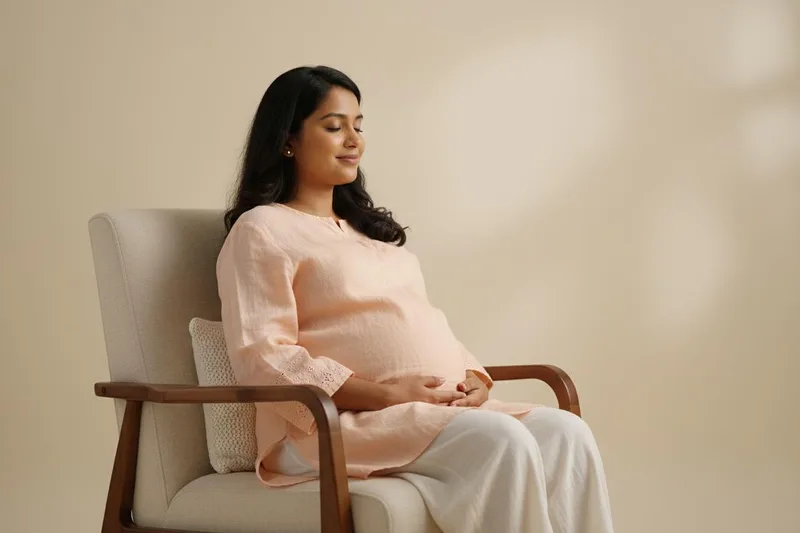
Hello! You must be very happy these days because of the little one you are expecting? Also, during this time, you may be feeling a little uncomfortable , back pain, etc. During pregnancy, our body goes through a lot of changes. As the baby grows, the belly comes forward, and the body weight increases. So, it is very important to be careful about how you sit, stand, and do things properly. Today, let's talk about maintaining good posture and body mechanics . If you know these things well, you can spend this time much easier and with less back pain.
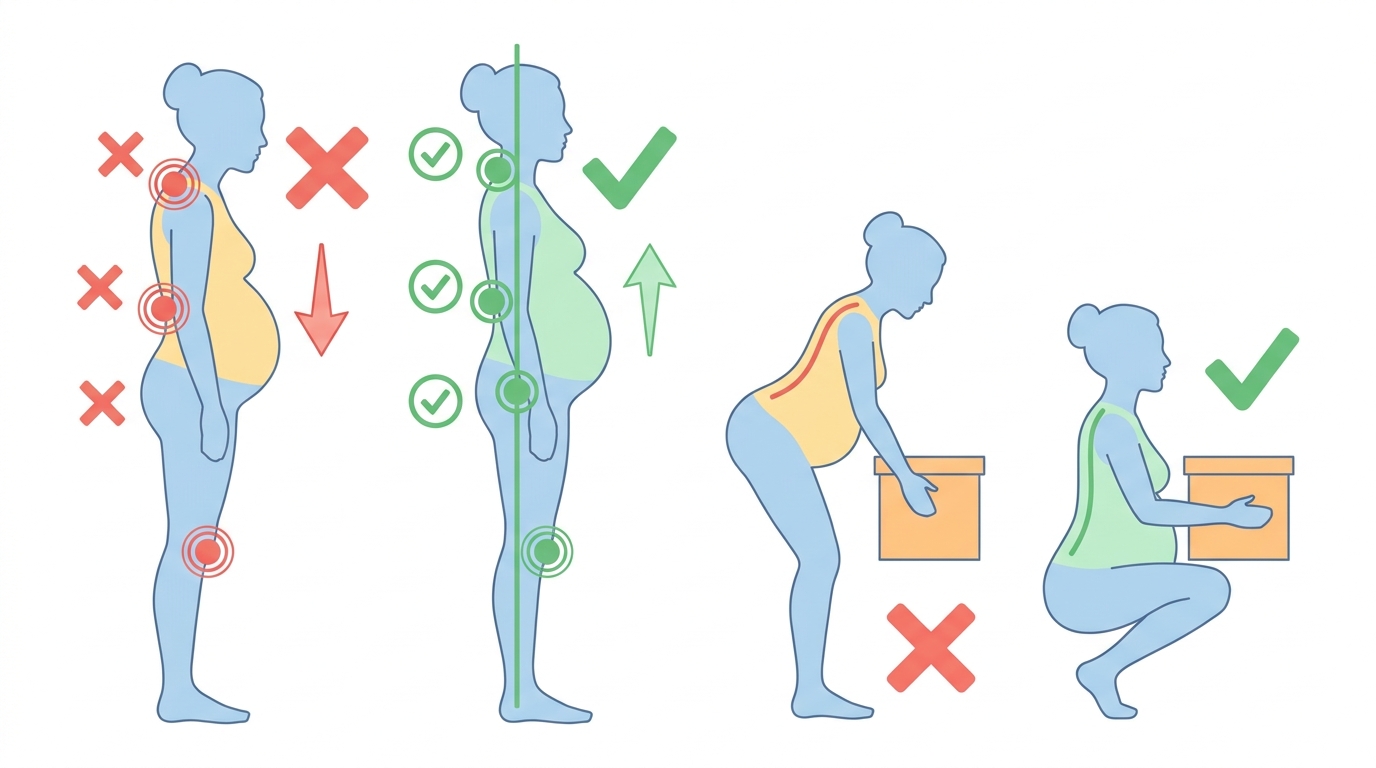
What is this good posture?
Simply put, good posture is the way we hold our bodies when we are standing, sitting, or lying down. Especially during pregnancy, we need to practice maintaining these postures in a way that puts as little pressure on your back, neck, and shoulders as possible. This will reduce unnecessary strain and pain on your body. Think of it this way: your spine is like a pillar in a house. When it is strong and straight, the whole body is in good shape.
How do we stand properly?
During pregnancy, as the belly bulges forward, many people unknowingly get used to standing with their backs arched and their shoulders hunched forward. This only increases back pain . So, let's see how to stand properly?
- Keep your head straight: Keep your chin tucked in and your head straight. Don't tilt your head forward, back, or to the side.
- Earlobes to the middle of the shoulders: Try to keep your earlobes exactly in the middle of your shoulders.
- Shoulders back, chest forward: Pull your shoulders back a little and keep your chest forward. But don't keep them too tight.
- Knees straight, but don't lock them: Keep your knees straight, but don't lock them completely. Keep them relaxed.
- Pull your head up: Imagine someone is pulling the top of your head up.
- Tighten your stomach whenever possible: Pull your stomach in and tighten it as if you are pulling it up. But do this only as much as you can during pregnancy . Don't do it in a way that puts pressure on the baby.
- Buttocks in: If possible, keep your buttocks in.
- Feet in the same direction: Stand with your toes pointing in the same direction and your body weight evenly distributed across both feet.
- Low- heeled shoes: Wear low-heeled (but not completely flat) shoes that provide good support for your feet.
- Don't stay in the same position for too long: Don't stand in the same position for too long. If possible, move around a bit and change your position.
- Adjust your work height: If you work standing for a long time, adjust your desk height to a comfortable height for you, if possible.
- Put one leg up: Place a small chair or box on top of it and put one leg up on it. Switch legs every few minutes.
- While working in the kitchen: Open the cupboard under the kitchen sink and place one leg inside. Switch legs every 5-15 minutes. This will give your back a lot of relief.
Remember: When you stand this way, your spine is in a natural position. This means that there is no unnecessary pressure.
How do you sit properly?
Sitting with back pain during pregnancy can be difficult at times, isn't it? But if you know how to sit properly, you can greatly reduce that discomfort.
- Back straight, shoulders back: Sit with your back straight and your shoulders back slightly. Your buttocks should touch the back of the chair.
- Back support: Place a small, rolled-up towel or lumbar roll in the hollow of your back. This will provide good support for your back.
- How to sit properly without support:
- Sit on the edge of the chair and slouch.
- Now, straighten your back and arch your back as much as possible. Hold for a few seconds.
- Then ease the position a little (about 10 degrees). This is the best position for your back.
- Balance your body weight: Sit in a way that your body weight is evenly distributed on both hips.
- Hips and knees at a 90-degree angle: Keep your hips and knees at a 90-degree angle. Use a footrest to support your feet if necessary.
- Don't cross your legs: Sit with both feet on the floor, without crossing your legs.
Further things to be aware of:
- Don't stay in the same position for more than 30 minutes: If possible, get up every 30 minutes, walk around a bit, and change positions.
- Adjust your chair at work: If you work in an office, adjust your chair and desk height to a comfortable height for you. Rest your elbows and forearms on the armrests of your chair or on the desk, and keep your shoulders relaxed.
- If you're sitting in a pivot chair: If you're sitting in a pivot chair, don't just rotate at the waist. Turn your whole body.
- When you get up:When getting up from a chair, stand up with your legs straight and lean forward slightly. Do not bend forward at the waist. As soon as you get up, bend backward about ten times to give your back a little stretch.
Important: If you have back pain, sit as little as possible. If you do sit, don't sit for more than 10-15 minutes at a time.
Correct posture when driving a vehicle
Driving during pregnancy requires some caution. It's also important to be comfortable and have good back support.
- Use a lumbar roll: Keep a lumbar roll that fits the curve of your spine.
- Knees at hip level: Your knees should be at or slightly above your hips.
- Move the seat closer to the steering wheel: Move the seat closer to the steering wheel to support the curve of your spine. Keep the seat at a distance where you can easily reach the pedals with your legs bent and your knees bent.
- Wear your seat belt correctly (CRITICAL): Always wear both the lap belt and the shoulder belt.
- Lap belt: Wear it under the belly, as low as possible across the hips, and above the thighs. Never let it go above the belly.
- Shoulder belt: Wear it between your breasts .
- Make both of these belts as snug as possible.
- If your vehicle has an airbag: If your vehicle has an airbag , it is mandatory to wear a seat belt. Also, stay at least 10 inches back from the airbag . If you are in the driver's seat, the airbag is located inside the steering wheel. When driving, adjust the steering wheel so that it is facing your chest and away from your head and stomach.
The correct way to lift a weight
You should avoid lifting heavy objects as much as possible during pregnancy. But if you have to lift something in an emergency, be aware of these things:
- Don't lift more than 20 pounds (about 9 kilograms): Don't try to lift objects that are awkwardly shaped, hard to grip, or weigh more than 20 pounds.
- Stand well: Before lifting something, make sure you are standing on a stable, non-slip surface.
- If you are lifting something below waist level: Keep your back straight, bend your knees and hips as you lower. Never bend forward at the waist while keeping your knees straight. This is a mistake that many people make.
- Stand with your legs wide apart and close to the object: Stand close to the object you are going to lift, with your legs slightly wide apart, and your feet firmly planted on the ground.
- Tighten your abdominal muscles:Tighten your abdominal muscles and the muscles around your vagina (as if doing Kegel exercises ) and lift the weight with the strength of your legs. Do not lift the weight in one go.
- Stand up straight without twisting: Stand completely straight without twisting. Always put your feet forward when lifting an object.
- If you are lifting something from a table: Pull it to the edge of the table and bring it closer to your body. Bend your knees and approach the object. Use the strength of your legs to lift the object and stand.
- Do not lift weights above waist level.
- Hold the package close to your body: If you are carrying a package, hold it close to your body, clasp your hands together, tighten your abdominal muscles, and walk slowly with small steps.
- When lowering an object: Keep your legs straight as you would when lifting it, tighten your abdominal muscles, and lower it by bending your hips and knees.
Look how important it is to lift weights properly. These little things can greatly reduce the damage to your back.
How to get something that is above
Sometimes we have to pick up something from a shelf, right? Then do it like this:
- Use a chair or stool: Use a chair or small stool to raise yourself to the height of the object you are going to pick up.
- Get as close to the item as possible.
- Get an idea of the weight: Check beforehand how heavy the thing you are going to lift is.
- Lift with both hands.
What is the best position to sleep/sniff?
Sleeping comfortably during pregnancy can be a challenge, especially in the final months. But sleeping in the right position is good for both you and your baby.
- Pillow for your head only: No matter how you lie down, place a pillow under your head, but not under your shoulders. Choose a pillow that is high enough to rest your head comfortably and that doesn't put pressure on your back.
- A pillow between your legs: Placing a pillow between your legs will give you great support, especially when sleeping on your side.
- Turn to one side, bend your knees slightly: Try to sleep in a way that helps maintain the natural curve of your spine. The best way is to turn to one side (preferably the left side), bend your knees slightly, and put a pillow between your legs.
- Don't sleep this way: Don't sleep on your side with your knees tucked up to your chest. Also, avoid sleeping on your stomach altogether.
- A firm mattress:Choose a firm mattress and box spring that won't sag. If necessary, place a board under the mattress. You can also temporarily sleep on the floor. If you've always slept on a soft mattress, it may be a little difficult to suddenly switch to a firm mattress. Do what's most comfortable for you.
- A lumbar support: If you need more comfort while sleeping at night, use a lumbar support . A rolled bed sheet or towel wrapped around your waist can also help.
- When getting out of bed: When getting up from a lying position, first turn to the side, bring both knees to your chest, and slowly lower both legs off the bed. Then push yourself up with both hands and sit up. Do not bend forward at the waist.
The most important things for you to remember (Take-Home Message)
Okay, so we've talked about a lot today, haven't we? I think these little things will help a lot in keeping your body comfortable and pain-free during pregnancy.
Simply put, keep your back straight, shoulders back and relaxed, bend your knees when lifting, and sleep on your left side with a pillow between your legs. Once you make these things a habit, you will be able to spend this beautiful time more comfortably!
If you have any questions, don't forget to ask your doctor or midwife. They will give you better advice. I wish you and your baby good health!
` Pregnancy, posture, back pain, correct posture, body mechanics, pregnancy wellness, posture
ukat juk’ampinaka Doctoran qillqatapa
ukat juk’ampinaka Usuñ pachanx qhipäxa ukat ch’akhanak usuchjasiñax wali uñt’atawa, kunatix pesaje ukat centro de gravedad uksanx nayrar sartañaw utji. Chiqap postura ukat cuerpon mecánica ukanakax uka usunak jisk’achaspawa. Saytʼatäkasax chiqak saytʼasiñax wali askiwa, pesajenak apthapisin qhipäxar kʼuchuñat sipansa, quntʼasiñax wali askiwa, ukat quntʼatäkasas qhipäxar saytʼayasiñaw wakisi. Qhipäxan sinti usutästa jan ukax chhuxriñchjatästa ukhaxa, doctoraruw uñjañama.
❓ ukat juk’ampinaka Mä qawqha juk’amp jiskt’äwinakampiw jikisipxasma (FAQ) .
ukat juk’ampinaka ¿Usutäkasin saytʼatäkasajj kawkïr posturas uñchʼukiñasa?▼
ukat juk’ampinaka Amparanakam qhipäxar uchañama ukat pechomasa nayrar sartayañama. Janchi pesaje ukaxa pä kayuru mä khuskhaki jaljata sayt’añawa jan qunqurinakaru llawintasa.
ukat juk’ampinaka ¿Kunas ikiñatakix wali askïspa?▼
ukat juk’ampinaka Ukax wali askiwa ladoman ikiñax (juk’ampirus ch’iqa tuqin - Lado ikiña). Qunqurinak taypiru ukat puraka manqhar almohadanak uchasax qhipäx usux jukʼampiw jilxattaspa, ukhamat yanaptʼañataki.
¿Ususiri taykax pesajenak apthapiñax walikïskiti?▼
ukat juk’ampinaka Janiw jach’a yänak apthapiñamäkiti. Janipuniw cinturarux qunt’asiñamäkiti kunawsatix mä peso esencial apthapisktan ukhaxa, qunqurinakax doblar ukat peso ukax kayu muskulu ch’amampiw apthapiñani.


💬 Comments (0)
No comments have been posted yet. Add your comment here for the first time.
Add your comment