
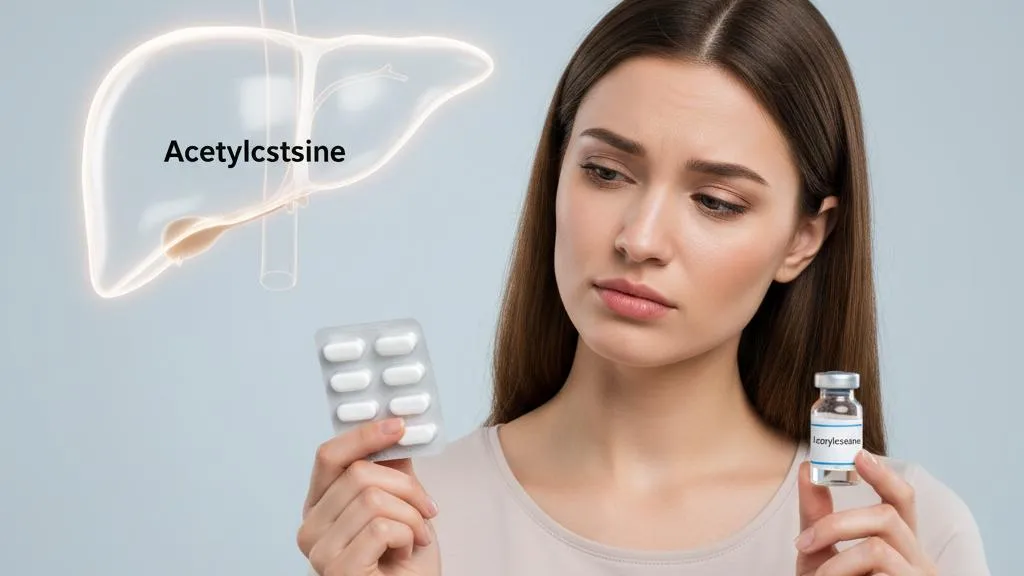
Paracetamol is an indispensable item in all of our homes, isn't it? We quickly take a paracetamol tablet for a slight fever or a headache. But like anything, if you take too much of it, that is, if you drink more than the prescribed dose, it can be very dangerous for the body. Especially, it can cause great damage to our liver. In such an emergency, that is, when someone drinks too much paracetamol and is about to damage the liver, today we are talking about a life-saving medicine that doctors use to stop that damage. That is, acetylcysteine .
What kind of medicine is this acetylcysteine?
Simply put, Acetylcysteine is a medicine that is mainly given to protect our liver when we overdose on Paracetamol. When we take too much Paracetamol, a toxic chemical is formed that damages the liver. What this medicine does is deactivate that toxic chemical and stop the damage to the liver. Therefore, this is a very important medicine that helps save lives.
But it has another use. Sometimes, a doctor may prescribe this medicine for another reason. That is, to thin out thick mucus that comes with difficulty breathing. In conditions like asthma, where mucus builds up in the chest and makes it difficult to breathe, this medicine is used in the form of effervescent tablets that are dissolved in water and drunk.
This means that this medicine is mainly used in two situations. One is to be given in the hospital as emergency treatment for paracetamol poisoning. The other is to be used at home on the recommendation of a doctor to thin mucus.
Things you need to tell your doctor before taking this medicine
It is very important that your doctor is aware of your medical condition when administering this medicine, especially in an emergency. Therefore, be sure to tell your doctor if you have any of the conditions listed below.
| Your medical condition or condition | Why should you inform the doctor? |
|---|---|
| Heart disease | The effectiveness of this medication may change with certain heart conditions. |
| Kidney disease | Since medication is eliminated from the body through the kidneys, it is important to be aware of kidney function. |
| Stomach ulcers or varicose veins | This medicine may cause nausea or vomiting, so it should be reported if you already have stomach problems. |
| Allergies to acetylcysteine or other substances | If you have an allergy to a medicine, food, or other substance, it can help prevent serious reactions. |
| Being pregnant or trying to get pregnant | This information is essential for the doctor to consider the possible impact on the baby. |
| Breastfeeding the baby | This is important to determine whether the medication passes to the baby through breast milk and to take the safest steps. |
How do you use this medicine?
This is very important. In the event of a paracetamol overdose, this treatment should only be done under medical supervision in a hospital or clinic. You will not be allowed to take it home. A doctor or nurse will give you this medicine. It may be given as a liquid to drink by mouth, or in some cases, it may be given through a nasogastric tube.
It is very important to take all doses of your medication on time until your treatment is complete. The hospital staff will make sure that you do this.
What if there is an emergency?
If you suspect that someone has taken too much paracetamol or other medication, whether by mistake or on purpose, don't delay for a second. It could be a life-or-death situation.
Do these things immediately:
- Call the National Poisons Information Centre at the Colombo National Hospital. They will tell you exactly what to do.
- Be sure to take the patient to the nearest hospital's Emergency Treatment Unit (ETU).
Can this medicine be given to small children?
Yes, this medicine is used even for very small babies in emergencies. But it is done very carefully and under the strict supervision of doctors. The dose is calculated exactly according to the child's weight.
What are the possible side effects of this medicine?
Like any medicine, acetylcysteine can cause some side effects. However, when you receive this treatment in a hospital, there is nothing to worry about as the doctors and nurses are constantly monitoring your condition.
| Type of side effect | Symptoms |
|---|---|
| Things to tell your doctor or nurse immediately | |
| Allergic reactions | Skin rash, itching, swelling of the lips, tongue or face, difficulty breathing. |
| Symptoms of internal bleeding | Black or tarry stools, vomit that looks like coffee grounds, or vomit blood. |
| Things that are usually not serious, but should be said if they persist | |
| Nausea | Stomach discomfort, feeling like vomiting. |
| Vomiting | Vomiting. |
Are there any problems with other medications?
Acetylcysteine generally does not cause major problems with other medications. However, it is safest to tell your doctor about all the medications you are taking (including vitamins and herbal remedies).
How to store the medicine?
This advice is only important if a doctor has given you acetylcysteine effervescent tablets to use at home to thin your mucus. The medicine given for a paracetamol overdose is not allowed to be taken out of the hospital.
- Keep it out of reach of children, where they cannot reach it.
- Store at room temperature (between 20-25 degrees Celsius). Keep away from excessive heat and moisture.
💡 Take-Home Message
- Acetylcysteine is a life-saving drug that primarily prevents liver damage caused by paracetamol overdose.
- A drug overdose is a medical emergency. Immediately take the patient to the nearest hospital Emergency Department (ETU).
- It is essential to inform your doctor about all your medical conditions and other medications you are taking before taking this medicine.
- This medicine is also used on medical prescription to thin mucus.
- Never share any medication prescribed by your doctor with others.


Janiw kuna arsuwinakas jichhakamax uñt’ayatäkiti. Aka chiqanx amuyt’awim jan ukax jiskt’awim yapxatañamawa.