

Have you ever been stuck trying to decide on a dress, "Is this blue? Or purple?" Or have you ever felt like you see a color differently when a friend shows you? Maybe you were surprised to see your son use brown instead of green when he was coloring a picture. Things like this are very common among us. The reason for this could be a slight difference in the way your eyes see colors, which is called Color Vision Deficiency. Today we are going to talk about the test that will tell you exactly what this is, which is known as the 'Color Blind Test'.
What exactly is a 'Color Blind Test'?
Simply put, this is a test where your doctor, especially an eye doctor, tests you to see exactly how well you see colors. Although we call this a 'color blind test', it's a bit of a misnomer. Because when we say 'blind', we think of seeing nothing. But this condition is not a complete loss of color vision. Total color blindness is a very, very rare condition.
What actually happens is that some colors, especially red and green, or blue and yellow, are difficult to distinguish from each other. So the more accurate name for this is a color vision test . This is to test how you perceive and see colors.
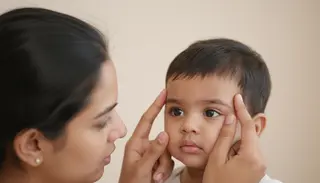
Your doctor may do this test when you go for a routine eye exam. Or your child may even have it done during an eye exam at school. They will let you know if there is a change in your child's color vision and if they need to see an ophthalmologist.
Can Online Tests Be Trusted?
Nowadays, many people who suspect they have a problem go online and look it up. If you search for 'color blind test', you'll find a lot of online tests. If you have even the slightest doubt about your color vision, taking a test like this might be a good place to start.
But keep this in mind. An online test is just a simulation of a real medical test. It can never definitively determine whether you have color vision deficiency. You should definitely see a doctor, especially an ophthalmologist, and get a proper examination.
What are the types of tests? How are they done?
Because there are different types of color vision deficiency, there are different types of tests to check for it. But all of these tests are very simple, quick, andThere is no pain at all. The doctor will show you some pictures and ask you what you see. These may be pictures on cards, in books, or on a computer screen.
There are several main types of tests.
1. Color Plate Tests
These are the most commonly used tests. They are also called pseudoisochromatic plate tests.'' In this test, you are asked to identify a number, shape, or letter in a different color against a background of small dots of different colors and sizes. You can only see the shape if you can distinguish between the two colors.
2. Ordering Tests
In these tests, you are given a set of cards or blocks of different colors and asked to arrange them in a specific order according to their color. For example, you may be asked to arrange them in order from light blue to dark blue.
3. Comparison Tests
These are the most accurate ways to diagnose red-green color deficiency. However, they are rarely used in clinics. They are mostly used in research. A special device called an Anomaloscope'' is used for this.
Let's now take a detailed look at some of the most commonly used tests.
| Name of the test | What are you checking? | How to do it |
|---|---|---|
| Ishihara Test | Red-green color deficiency in adults. | Show them 8 to 34 dotted sheets and ask them to say the number or symbol hidden there. |
| Richmond HRR Test | Both red-green and blue-yellow color deficiencies and their severity. | 24 dot-based sheets are provided to help students identify shapes such as squares, circles, and triangles. |
| CVTME Test (for children) | Red-green color deficiency in young children between the ages of 3-6. | Instead of numbers, they are given simple shapes like circles, squares, and stars, and pictures like boats and houses to identify. |
| Farnsworth-Munsell D-15 | Both red-green and blue-yellow color deficiencies. | Blocks of 15 different colors are given to be arranged in order of their colors. |
What do the test results say?
The best thing about this test is that you don't have to wait long to get the results. The doctor gets the results as soon as you're done. He then explains them to you in simple terms:
- What type of color vision deficiency do you have (e.g. red-green or blue-yellow).
- What is its severity (i.e., is it mild, moderate, or severe).
Sometimes, if a single test cannot accurately diagnose the condition, the doctor may refer you for another test.
Think about it, even if you've had this condition since childhood, you may not have known about it. Some people discover by accident that they can't see certain colors properly. So if you have any doubts, talk to your doctor honestly about it. Tell him exactly what you see, how you see it.
This is not a "pass" or "fail" test. There are no "right" or "wrong" answers. It is simply a test to collect information about your eyes and vision.
If I have color vision deficiency, what should I do?
If your doctor tells you that you have color vision deficiency, don't worry or be afraid. This is a common condition that affects millions of people around the world.
This condition is often caused by genetic factors. That is, it is something that is passed down from generation to generation. Therefore, there is no "cure" for this yet. However, there are many ways to help you live a normal, problem-free life with it. Your doctor will advise you according to your condition.
To give a few examples:
- Special glasses or lenses:For some types of color blindness, there are special types of lenses that help distinguish colors.
- Technology helps: You can use apps on smartphones to help you identify colors that are difficult for you to identify.
- In daily life: Simple things like labeling clothes and remembering the order of top, middle, and bottom at traffic lights can make life easier.
- For children: If your child has this condition, it is very important to tell the teacher at school about it. Then the teacher can use colors that are easy for the child to understand when teaching lessons.
The most important thing is to be aware of this condition and adjust your life accordingly. Your doctor will provide all the necessary guidance for this.
💡 Take-Home Message
- Color blindness is not something to be afraid of as you might think. It is a common condition for many people around the world.
- While it's a good idea to take an online test, don't rely solely on the results. Always see an eye doctor for a proper diagnosis.
- The color vision test is a very simple, quick, and painless test.
- This is not an exam. So tell the doctor honestly and accurately what you see during the exam.
- Even if you are diagnosed with color blindness, you can live successfully and happily with it. There are many methods and technologies available today to help you do so.





Janiw kuna arsuwinakas jichhakamax uñt’ayatäkiti. Aka chiqanx amuyt’awim jan ukax jiskt’awim yapxatañamawa.