

There are so many things to manage as a person with diabetes, right? Blood sugar levels, blood pressure, cholesterol... In the midst of all this, sometimes we can forget to pay attention to our eyes. But it is very important that we are aware of the effects that diabetes can have on the eyes. Because if we recognize it early, we can protect our precious vision.
HbA1c ukax wilan glucosa ukar mayjt’ayi. HbA1c (%), mmol/mol, ukhamaraki glucosa promedio wilanxa mg/dL ukhamaraki mmol/L ukjamaraki mä ratuki mayjt’ayaña.
Simply put, what is Diabetic Macular Edema (DME)?
Although this is a bit of a complicated name, let's simply understand what's going on.
When you have diabetes, high blood sugar levels over time can damage the delicate blood vessels (blood vessels) inside your eyes. This condition is called diabetic retinopathy .
Fluid begins to leak from these damaged blood vessels. This fluid collects on the retina, the light-sensitive part of the back of the eye. The retina also has a very important central part that gives us clear, sharp vision, called the macula . The leaking fluid collects in the area where the macula is located and causes it to swell. This swelling is called Diabetic Macular Edema (DME) .
Imagine, when the lens, the main focus point of the retina, which is like the film in a camera, swells, the image we get becomes blurry. It's like looking at something through a glass of water.
Do you have these characteristics?
The most dangerous thing about DME is that it sometimes doesn't show any symptoms in the early stages. That's why it's important for everyone with diabetes to have their eyes checked at least once a year. However, watch out for these signs:
- Blurred vision: Things that you look at directly, such as someone's face, text in a book, or images on TV, appear blurry.
- Wrinkled appearance: Objects with straight lines (such as window frames and door frames) may appear to be wrinkled or stretched.
- Faded colors: Colors that previously appeared bright now appear "faded," faded.
If you have any of these symptoms, see your doctor right away. The sooner you start treatment, the better your chances of preventing permanent vision damage.
How does the doctor diagnose this disease?
When you go to the doctor, he or she will ask you a few questions. For example, are you experiencing any changes in your vision, do you have diabetes, what are your blood sugar and A1c levels, blood pressure, and cholesterol levels?
After that, a complete eye examination is performed, which mainly involves several tests.
| Name of the test | What is simply happening? |
|---|---|
| Visual Acuity Test | The reading test we've all done, where you look at a board and read. It measures how clearly you can see at different distances. |
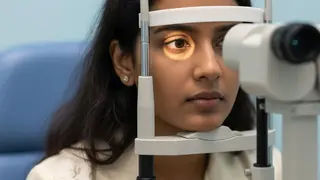
| Dilated Eye Exam | A special liquid (eye drops) is put into the eye to enlarge the pupil . Then, a special instrument is used to look inside the eye and check the condition of the retina, whether there is fluid leaking from the blood vessels, and whether there is swelling. |
| Fluorescein Angiogram (FA) | A special dye is injected into a vein in the arm. As this dye travels along the blood vessels inside the eye, pictures are taken with a special camera. This can pinpoint the exact location of the blood vessel leaks. |
| Optical Coherence Tomography (OCT) | This is like a cross-section scan of the inside of the eye. It uses special light beams to very accurately measure the thickness, swelling, and amount of fluid buildup in the retina and sclera. |
After these tests, the doctor will determine whether you have DME and how severe it is.
What are the treatments for this?
Fortunately, there are now very effective treatments for DME. The main goal of treatment is to stop fluid leaking from the blood vessels and reduce swelling.1. Anti-VEGF Injections
This is the most common and effective treatment available. It can be a bit scary to think about getting an injection in the eye, but it is done with a very fine needle and a numbing medication. So it doesn't feel much pain.
These injections work by preventing the growth of new, weak blood vessels that leak easily. These drugs (examples: Aflibercept, Bevacizumab, Ranibizumab, Faricimab) stabilize the blood vessels and stop fluid leaking. You usually need to have several treatments, about once a month.
2. Laser treatment (Laser Photocoagulation)
In some severe cases, laser beams are used to "seal" or cauterize the leaking blood vessels. This prevents further damage.
3. Steroid Injections
Some patients are given steroid injections to control swelling.
4. Surgery (Vitrectomy)
This is usually done rarely, especially if there is a large amount of bleeding into the eye and complete loss of vision. This involves removing the cloudy fluid inside the eye and replacing it with a clear solution.
Your eye doctor will decide which treatment is best for you.
How should you take care of yourself?
As well as the treatment your doctor provides, taking care of yourself is also extremely important in controlling this disease.
- Control Diabetes: This is the most important thing . Keep your blood sugar, blood pressure, and cholesterol levels under control as per your doctor's instructions. A proper diet, exercise, and taking prescribed medications are essential.
- Don't skip eye exams: Even if you don't have symptoms, get your eyes checked according to the schedule your doctor recommends. This is also important to monitor the success of your treatments.
- If you have low vision, consider assistive devices: If glasses alone aren't enough, talk to your doctor about things like magnifying glasses.
Mental health is also very important.
It's normal to feel sad, anxious, and scared when you have a vision problem. You don't have to fight these feelings alone.
- Talk about your feelings: Talk about this with your family and friends. Tell your doctor how you feel.
- Seek counseling: If necessary, ask your doctor for help from a mental health professional who works with people with diabetes or the visually impaired.
- Join support groups: You will feel a lot of strength when you talk to others who are going through the same situation as you.
💡 Take-Home Message
- Diabetic Macular Edema (DME) is a serious side effect of diabetes, but if detected and treated early, vision can be preserved.
- If you experience symptoms such as blurred vision, image distortion, or color fading , see a doctor immediately.
- The most important thing you can do is to control your diabetes well. Control your blood sugar, blood pressure, and cholesterol.
- Never miss the eye exams and treatments prescribed by your doctor.
- You are not alone on this journey. Doctors, family, and support groups are there to help you. Staying positive is also part of the treatment.





Janiw kuna arsuwinakas jichhakamax uñt’ayatäkiti. Aka chiqanx amuyt’awim jan ukax jiskt’awim yapxatañamawa.