

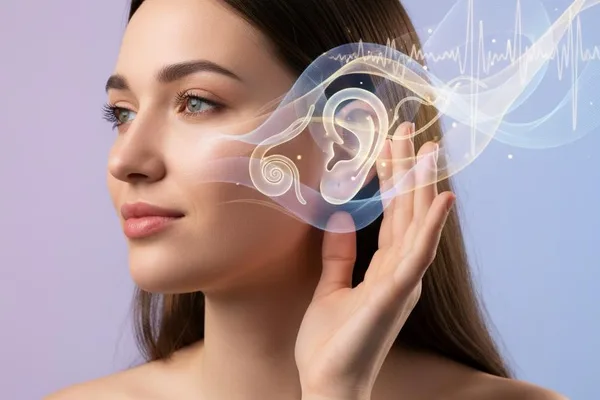
We all know that our ears help us hear the sounds around us and talk to others. But did you know that there is a major control center inside the ear that helps you stand up straight, walk, and balance without falling? The ear is actually a much more complex and amazing organ than we think. So today, let's talk about our ear, how it works, the diseases it can cause, and how to take care of it.
What are the two main functions of the ear?
The ear has two main functions: hearing and maintaining balance in the body.
1. How does hearing happen?
Simply put, this is an amazing process.
- Sound waves enter our ears.
- These sound waves travel and hit the eardrum, or in medical terms, the tympanic membrane . Then the eardrum begins to vibrate.
- This vibration is transmitted to three tiny bones in the middle ear (called `Ossicles` ). These three bones amplify the vibration and send it to the inner ear.
- When you go into the inner ear, there are very fine hair-like cells called stereocilia . These convert those vibrations into electrical signals.
- Finally, these electrical signals travel along the nerves to the brain. The brain interprets these signals as "sound" and tells us what it is.
2. How do you control balance?
This system inside the ear keeps you from falling when you walk, run, or bend your head.
- Our inner ear has a system of fluid-filled semicircular canals .
- When you move your head from side to side, the fluid inside these tubes also moves in that direction.
- When this fluid moves, the fine hair-like sensors there are stimulated.
- This information travels to the brain via the vestibular nerve .
- The brain uses that information to send signals to the body's muscles, helping to keep you balanced and prevent you from falling.
Let's learn about the parts of the ear.
The ear can be divided into three main parts: the outer ear, the middle ear, and the inner ear. These are separated from each other by the eardrum.
| Ear part | Description |
|---|---|
| Outer Ear | This is the part of the ear that we can see. It is made of cartilage. Its main function is to collect sound waves and funnel them into the ear canal. The glands that produce earwax are also located in this part. |
| Middle Ear | The part that starts on the other side of the eardrum. The three small bones ( `Ossicles` ) that we mentioned earlier are here. The Eustachian tube is also here. This tube is connected to our throat. The pressure in the ear is equalized through this tube. When you go to a mountainous area like Nuwara Eliya, it feels like your eardrums are falling out because of this pressure difference. |
| Inner Ear | This is the most complex part of the ear. There are two main things here. One is the snail-shaped cochlea, which is responsible for hearing. The other is the semicircular canals, which are responsible for balance. |
What are the common diseases and conditions that affect the ear?
Various medical conditions can affect our ears. Let's learn about a few of them.
Earache/Ear Infection (Otitis Media)
This most often occurs in the middle ear. This infection occurs when bacteria or viruses enter the middle ear and become trapped. This condition is more common in young children than adults. It can usually be treated with antibiotics. In some severe cases, ear tubes may be needed.
Swimmer's Ear (Swimmer's Ear / Otitis Externa)
This is an infection of the outer ear, that is, the ear canal. Despite its name, it is not just for swimmers. When water gets into the ear, it can be caused by bacteria or fungi growing in the moisture. Also, inserting objects like cotton swabs into the ear can damage the skin of the ear and increase the risk of developing this infection.
Remember the most important thing: Never put anything inside your ear like a cotton swab, key, or hairpin to clean it. This will only push the earwax further in and can damage the eardrum.
Ruptured Eardrum
This is a hole in the eardrum. This can be caused by infections, trauma to the ear, loud noises, or foreign objects in the ear. Most of the time, it heals on its own within a few weeks. However, in some cases, surgery (`Tympanoplasty`) may be required.
Eustachian Tube Dysfunction
This condition occurs when the Eustachian tube, which we discussed earlier, becomes blocked. This changes the pressure inside the ear, causing symptoms such as a feeling of fullness in the ear, ringing in the ears (tinnitus), and mild hearing loss.
Otosclerosis
What happens in this is that the little bones in the middle ear gradually harden and lose their ability to vibrate. Then sound waves don't reach the inner ear properly. Because of this, hearing gradually begins to decrease. This usually requires surgery.
Vestibular Neuritis
This condition is caused by swelling of the nerve responsible for balance in the inner ear. The main symptom is sudden, severe dizziness (vertigo) . It may also be accompanied by nausea and vomiting. This requires medication and sometimes physical therapy.
Symptoms that can indicate an ear problem
If you have a problem with your ear, you may experience one or more of the following symptoms. If you have any of these symptoms, it is important to see a doctor as soon as possible.
| Symptom | Description |
|---|---|
| Ear Pain | It can be sharp or dull pain. This is a key sign of an infection. |
| Ear Drainage | Pus, blood, or clear fluid coming out of the ear. |
| Muffled Hearing | Sounds are not heard clearly, sounding muffled. |
| Clogged Ears | The feeling of something being filled inside the ear. |
| Dizziness/Vertigo | Feeling like you or the environment around you is spinning. This could be a problem with your inner ear. |
| Hearing noises in the ears (Tinnitus) | A constant ringing sound inside the ear, even when there is no sound around. |
How to keep your ears healthy?
Our ears are very valuable and sensitive organs, so it is our responsibility to take care of them.
- Avoid loud noises: Avoid listening to music with headphones at high volume, and avoid being in places with loud noises (e.g. factories, music concerts). If you must be in such places, wear ear plugs.
- Keep your ears dry: Minimize water from getting into your ears while bathing or swimming. Use ear plugs if you are swimming. If water does get into your ears, tilt your head to the side to drain it.
- Don't put anything in your ear: As we mentioned earlier, don't put cotton swabs or other sharp objects in your ear. Earwax is a natural product that naturally comes out. It's for your ear's protection. If you think you have a blockage, see a doctor.
- Protect yourself when playing sports: If you play contact sports, wear head and ear protection.
- Seek medical advice promptly: If you experience any symptoms such as ear pain, hearing loss, or dizziness, do not ignore them and see your doctor immediately.
Take-Home Message
- Your ear is an essential organ for hearing and maintaining balance in the body.
- Never insert objects like cotton swabs, hairpins, or keys into your ear to clean it. This can do more harm than good.
- If you have symptoms such as ear pain, hearing loss, ear discharge, or severe dizziness, do not ignore it and see a doctor immediately.
- Exposure to loud noises can permanently damage your hearing, so always protect your ears.




💬 Comments (0)
No comments have been posted yet. Add your comment here for the first time.
Add your comment