
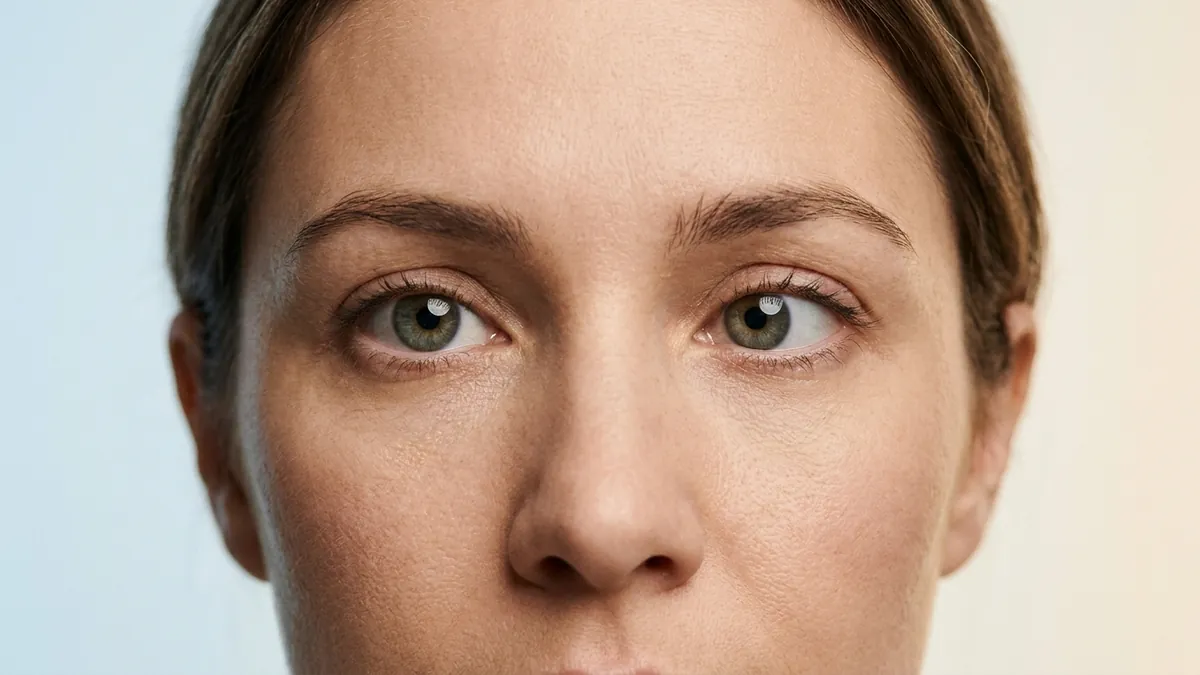
Have you ever noticed that when you close one eye with your hand, the closed eye seems to be pulled slightly towards the nose? You may not notice this yourself, but your doctor may have noticed it when examining your eyes. In fact, many people have this condition for a very short time. We medically call it Esophoria. This is usually not a big problem, but sometimes it can be a little annoying if it increases.
Why is it so important to have eyes aligned?
Think of it this way: our eyes are like two cameras. The images from these two cameras are combined in our brain to form a single, clear, three-dimensional (3D) image. We call this binocular vision (stereopsis). For this process to work properly, both eyes must be pointing in the same direction, at the same time.
Now, in a person with a slightly more severe case of Esophoria, when one eye is closed, the other eye is pulled inward, making it a little difficult for the brain to combine the two images. The brain is constantly trying to correct this. This can cause you some discomfort.
| Symptoms that may occur due to Esophoria | |
|---|---|
| Double vision (Diplopia) | Seeing things in two ways. |
| Eye pain and strain | Feeling like your eyes hurt after reading a book or watching TV for a while. |
| Headaches | Headaches, especially when working with your eyes. |
| Dizziness or vertigo | Sometimes it feels like dizziness. |
What are the causes of esophoria?
In fact, when we have both eyes open, the brain is constantly making small adjustments to keep them aligned. When one eye is closed, it doesn't receive the same signals as the other, so it's normal for it to shift slightly to one side. However, there are several reasons why you might be experiencing a condition called Esophoria.
Congenital causes (Anatomy)
Some people can be born with this condition. This means that the shape of the face, the position of the eyes, or the weakness of the muscles that move the eyes can cause this condition.
Eyesight
If you have poor distance vision (farsightedness - hyperopia) , you are more likely to develop Esophoria because your eyes have to work harder to focus.
How you use your eyes
In some professions, as well as in some tasks, only one eye is used continuously. For example, when someone looks through a microscope, binoculars, or a jeweler uses a loupe, one eye is most likely to be strained. This condition can also be caused by things like these.
Other medical conditions
Although it is uncommon, it can be seen with certain brain-related conditions, such as stroke. It can also occur with traumatic brain injuries (TBIs) and concussions.
What are the treatments for this?
In most cases, if you are not experiencing any discomfort, treatment for Esophoria is not required. However, if you are experiencing symptoms such as headaches, eye pain, or if the condition worsens over time, your doctor will prescribe a treatment that is right for you.
The important thing is, this is not something you can diagnose or treat on your own at home. You should definitely see an eye specialist for advice.
There are several treatment methods.
| Treatment method | Simple explanation |
|---|---|
| Glasses or contact lenses (Vision correction) | If you have a vision problem, this condition can be controlled simply by wearing prescription glasses. |
| Vision therapy | This is like physical therapy for the eyes. Special exercises are given to strengthen the muscles around the eyes. |
| Prism lenses | These can be added to your glasses or built into the lenses themselves. These lenses change the way light enters the eye and help keep your eyes aligned. |
| Botox injections (Botox®) | In this, a very small amount of Botox® is injected into the muscles that pull the eye inward, temporarily weakening those muscles. This then controls the twitching of the eye. |
| Surgery | If other treatments are unsuccessful, surgery to weaken the muscles that pull the eye inward can be a last resort. This is often the last resort because it is irreversible. |
What happens if left untreated?
It is normal to have a small amount of Esophoria. However, if it is severe, it can worsen over time if left untreated. If this happens, the eye may turn inward (esotropia) even when you are not closing your eyes. This can be very disruptive to your daily life.
To put it simply, imagine that the driver's side rearview mirror in your car is not adjusted properly. You constantly have to adjust it manually. It gets tiring and your hand hurts when you do this several times a day, doesn't it? The same thing happens with Esophoria. The brain and the eye muscles are constantly working hard to correct this distortion. Headaches and eye pain are caused by that extra effort.
Therefore, if you have frequent headaches, sore eyes, or a change in your vision, don't just assume, "This is normal," but definitely see a doctor, especially an ophthalmologist.
💡 Take-Home Message
- Esophoria is when one eye is closed and the eye moves in towards the nose. It is normal to have a very small amount.
- If you have symptoms like frequent headaches, eye strain, or double vision, don't ignore them.
- This is not something you can diagnose and treat on your own. Be sure to seek the advice of an ophthalmologist.
- There are effective treatments available, from glasses to surgery, so there's no need to be afraid.
- Talking to your doctor about the discomfort you are feeling is the best way to prevent further complications.






Janiw kuna arsuwinakas jichhakamax uñt’ayatäkiti. Aka chiqanx amuyt’awim jan ukax jiskt’awim yapxatañamawa.